We Put 8 White Label SEO Providers to the Test: The Good, The Bad, and The Profitable

A new client signs the contract. Everything is on track until they ask one question: “Can you handle our SEO too?”

You know it’s a valuable service. But hiring an in-house team takes time, money, and the right expertise.

That’s why many growing agencies turn to white label SEO. It lets them expand their services, deliver measurable results, and keep clients happy without building an entire SEO department from scratch.

The challenge is choosing the right partner. Some providers deliver consistent results and make your agency look good. Others overpromise, underdeliver, and put your reputation at risk.

To help you avoid costly mistakes, we evaluated some of the industry’s leading providers, comparing their strengths, limitations, pricing, and overall value for agencies.

In this guide, you’ll discover how white label SEO works, our top provider picks for 2026, the benefits of outsourcing SEO, and the key factors to consider before choosing the right partner for your agency.


Best White Label SEO Providers for 2026 at a Glance

Provider Best For Local SEO Technical SEO Content Writing Link Building White-Label Reporting
The HOTH Full-service SEO
SEOReseller Agency fulfillment
DashClicks All-in-one platform
Vendasta Multi-service agencies
Boostability SMB & local SEO
FATJOE Content & link building
Stan Ventures Link building ✅*
PageTraffic Enterprise SEO

What Is White Label SEO?

White label SEO is a partnership where a specialized SEO provider completes SEO work for your clients, but everything is delivered under your agency’s brand. Your clients see your company name on reports, emails, and deliverables, while the provider works behind the scenes.

Think of it like a web design agency that hires a freelance developer to build a custom feature. The client works only with the agency and never knows someone else wrote the code. 

A white label SEO partner can handle tasks such as keyword research, on-page optimization, technical SEO audits, content creation, link building, local SEO, and monthly performance reporting. While they do the work, your agency manages the client relationship and communication.

This approach is popular because SEO requires skilled professionals, premium tools like Ahrefs and Semrush, and ongoing effort. Instead of hiring an in-house SEO team, agencies can partner with experts and expand their services more quickly.

The biggest difference between white label SEO and regular outsourcing is branding. A true white label provider delivers unbranded reports and client-ready deliverables, allowing your agency to take full credit for the work while maintaining a consistent brand experience.

Quick Read: Search Engine Basics Guide

Behind the Scenes: How White Label SEO Works

A white label SEO reseller handles the SEO work behind the scenes while your agency manages the client relationship. Your clients receive the results under your brand, creating a smooth and professional experience.

Here’s how the process typically works.

Partner with a White Label SEO Provider

The first step is choosing a reliable white label SEO provider that matches your agency’s needs. Once you partner with them, you’ll agree on service packages, pricing, communication methods, and branding. Most providers offer wholesale pricing, allowing you to set your own prices and earn a profit. 

Understanding Client Needs

Once you sign a new client, you share important details with your white label SEO provider. This includes the client’s website, business goals, target audience, competitors, and target keywords. 

Using this information, the provider creates an SEO strategy that aligns with the client’s objectives and your agency’s expectations. 

SEO Audit and Strategy

Next, the provider reviews the client’s website to identify SEO issues and growth opportunities. They check technical problems, content gaps, backlinks, and competitors before creating a clear SEO strategy. You receive this plan as a branded document that you can share with your client. 

Execute the Campaign

Once the strategy is approved, the provider begins the SEO work. This may include optimizing website pages, creating content, building quality backlinks, and fixing technical issues. As the campaign progresses, you receive regular updates and can make changes based on your client’s goals.

Track Progress and Share Updates 

The provider shares regular reports showing keyword rankings, website traffic, completed tasks, and the next steps. You can review these reports and share them with your clients under your agency’s brand. Some providers also offer dashboards where clients can track campaign progress in real time. 

Scale Services as You Grow

As your agency gains more clients, your white label SEO provider can handle the increased workload. Many providers also assign a dedicated account manager to support your growing business. This allows you to focus on winning new clients and building stronger relationships while your partner manages the SEO work. 


Top 8 White Label SEO Agencies in 2026

Every provider claims to be the best white label SEO company, but their services, support, and results can vary significantly. That’s why we’ve compared 8 leading providers to help you understand where each one stands and which agencies they’re best suited for. 

1. The HOTH

Founded in 2010, The HOTH is one of the most recognized providers of white label SEO services. It offers everything from link building and content creation to fully managed SEO campaigns, giving agencies the flexibility to choose the services they need. 

Over the years, it has built a strong reputation for its wide range of solutions and agency-friendly approach. However, because it manages a large client base, the overall experience and service quality may vary between campaigns. 

The Good

  • Offers fully managed SEO, local SEO, link building, content writing, and technical SEO services.
  • Lets you order individual SEO services or complete managed campaigns based on your clients’ needs.
  • Provides 100% white-label reports and deliverables with your agency’s branding.
  • Includes a dashboard to manage orders, track campaign progress, and access reports.
  • Supports agencies of all sizes, making it easy to scale as your client base grows.
  • Offers wholesale pricing, allowing agencies to set their own profit margins.
  • Backed by a large customer base and years of experience in white label SEO.

The Bad

  • Some services are sold separately, which can increase the overall cost.
  • Service quality may vary slightly between campaigns.

Best For

  • Agencies that want to offer SEO without building an in-house team.
  • Agencies that want to purchase individual SEO services instead of fixed monthly packages. 
  • Agencies managing multiple clients and needing a scalable fulfillment partner.
  • Marketing agencies that need white-label reports and branded deliverables.
  • Agencies looking for link building, content writing, and managed SEO from one provider.

Pricing

  • Individual SEO services start at $40 for Content Refresh and $50 for Blog Content.
  • Managed SEO plans start at $1,000/month.
  • Technical SEO is available as a one-time service starting at $1,000.
  • Link building services start at $150, while premium backlink packages start at $375.
  • Digital PR services start at $1,500/month, and AI Discover starts at $5,000/month.
  • You can purchase services individually or combine them based on your clients’ needs

2. SEOReseller

Founded in 2008, SEOReseller is one of the longest-running white label SEO providers. It offers a complete platform for agencies, including SEO services, white-label reporting, client dashboards, and sales tools. 

Its all-in-one approach makes it a good choice for agencies that want to expand their SEO services without building an in-house team. 

The Good

  • Offers a complete range of SEO services, including local SEO, technical SEO, content writing, and link building.
  • Provides a fully white-label dashboard with branded reports and campaign tracking.
  • Includes proposal and website audit tools to help agencies win more clients.
  • Offers lead tracking and agency tools to manage campaigns more efficiently.
  • No long-term contracts or setup fees, giving agencies more flexibility.
  • Wholesale pricing helps agencies maintain healthy profit margins as they grow.
  • Provides training resources and dedicated support for agency partners.

The Bad

  • The platform has a learning curve for first-time users.
  • Smaller agencies may not need all the features it offers.

Pricing

  • GBP Only SEO: Starts at $299/client/month
  • Local SEO: Starts at $499/client/month
  • National SEO: Starts at $699/client/month

3. DashClicks

DashClicks is an all-in-one platform built for marketing agencies. It combines white label SEO with tools for CRM, client reporting, project management, and sales. This makes it a strong choice for agencies that want to manage clients and deliver digital marketing services from one platform. 

The Good

  • Offers fully managed white label SEO, PPC, web design, and social media services.
  • Includes a white-label dashboard with branded reports and campaign tracking.
  • Provides built-in CRM, project management, billing, and client communication tools.
  • Offers a branded client portal to manage campaigns and share reports.
  • Combines agency management and service fulfillment in one platform.
  • Easy to scale as your agency grows.

The Bad

  • The platform has many features, so it can take time for new users to learn.
  • Some advanced tools may be more than what small agencies need.

Best For

  • Marketing agencies that want to manage clients and services from one platform.
  • Agencies offering white label SEO and other digital marketing services.
  • Growing agencies that need CRM, reporting, and project management tools.
  • Agencies looking to automate client reporting and campaign workflows.
  • Teams that want to scale without building a large in-house team.

Pricing

  • White label SEO fulfillment pricing isn’t publicly listed. Contact the sales team for a custom quote

4. Vendasta

Vendasta is an all-in-one platform built for marketing agencies that want to sell and manage digital services under their own brand. Along with white label SEO, it offers tools for client management, reporting, online reputation, listings, and website services. 

Its broad range of solutions makes it a good choice for agencies looking to grow beyond SEO

The Good

  • Offers white label SEO, websites, reputation management, listings, and advertising services.
  • Provides a fully branded platform with client dashboards and white-label reports.
  • Includes built-in CRM, sales tools, billing, and client management features.
  • Gives agencies access to a large marketplace of digital marketing solutions.
  • Makes it easy to resell multiple services from one platform.
  • Automates routine tasks, helping agencies save time as they grow.

The Bad

  • Better suited for full-service marketing agencies than agencies focused only on SEO.
  • Some advanced features and marketplace services require additional subscriptions.

Best For

  • Agencies that want to sell multiple digital marketing services under one brand.
  • Growing agencies looking for an all-in-one platform to manage sales, clients, billing, and fulfillment.
  • Agencies serving local businesses with SEO, listings, reputation management, and websites.
  • Businesses that want access to a large marketplace of white-label marketing solutions.
  • Agencies planning to scale without building a large in-house team.

Pricing

  • Contact the Vendasta team for a custom quote based on your service requirements.

5. Boostability

Boostability is a white label SEO provider that focuses on helping small and local businesses improve their search rankings. It offers services such as local SEO, keyword optimization, content creation, link building, and SEO reporting through its agency partner program. 

Its scalable approach and affordable plans make it a popular choice for agencies managing multiple small business clients. 

The Good

  • Specializes in SEO for small and local businesses.
  • Provides dedicated Partner Growth Managers and sales support for agency partners.
  • Offers a white-label reporting dashboard with keyword tracking and campaign updates.
  • Includes scalable SEO fulfillment designed for agencies managing multiple clients.
  • Provides training and marketing resources to help agencies sell SEO services.
  • Supports agencies in multiple countries and languages.

The Bad

  • Focuses mainly on small and local businesses, so it may not be the best choice for complex enterprise SEO projects.
  • Uses a standardized SEO approach, which offers less flexibility for highly customized campaigns

Best For

  • Agencies serving small and local business clients.
  • Marketing agencies that want to add SEO without hiring an in-house team.
  • Agencies managing a large number of SEO campaigns.
  • Partners looking for affordable, scalable white label SEO services.
  • Web design agencies, hosting companies, and digital marketing resellers expanding their service offerings.

Pricing

  • Direct SEO plans (publicly listed): $480, $900, and $2,000+ per month.
  • SEO Reseller Partner Program: Wholesale pricing, but the reseller rates are not publicly disclosed. Agencies receive custom wholesale pricing based on their partnership.

6. Fatjoe

FATJOE is a white label SEO provider best known for its content writing and link building services. It works with thousands of agencies worldwide and offers a simple order-based system, allowing you to purchase only the services your clients need. 

Its fast turnaround times and no-contract model make it a popular choice for agencies looking for flexible SEO support.

The Good

Specializes in white-label link building, content writing, digital PR, and local SEO.

  • Offers 100% white-label services with no contracts or long-term commitments.
  • Provides an easy-to-use dashboard to place, track, and manage orders.
  • Offers transparent per-order pricing with fast turnaround times.
  • Includes a money-back guarantee on your first order if you’re not satisfied.
  • Trusted by thousands of agencies and has delivered over 250,000 orders since 2012.

The Bad

  • Doesn’t offer fully managed SEO campaigns like some competitors.
  • Best suited for individual SEO services rather than long-term SEO strategy.

Best For

  • Agencies that need white-label link building and content writing.
  • Businesses looking for fast, order-based SEO services without long-term contracts.
  • Agencies that want to outsource digital PR and blogger outreach.
  • Teams that prefer buying individual SEO services instead of managed SEO packages.
  • Agencies looking for a simple, scalable fulfillment partner.

Pricing

  • Uses pay-per-order pricing instead of monthly contracts.

7. Stan Ventures

Stan Ventures is a white label SEO provider that specializes in link building and managed SEO services for agencies. It combines U.S.-based account management with a large SEO delivery team, helping agencies outsource SEO while keeping everything under their own brand. 

Its focus on transparent reporting and customized outreach makes it a strong choice for agencies looking to scale. 

The Good

  • Specializes in white-label link building and managed SEO for agencies.
  • Uses manual outreach to build high-quality backlinks instead of PBNs.
  • Offers 100% white-label services backed by an NDA.
  • Provides a dedicated agency account manager for reseller partners.
  • Includes a customizable dashboard to track campaigns and reports.
  • Supports agencies with scalable SEO fulfillment and customized solutions.

The Bad

  • Focuses heavily on link building, so agencies looking for an all-in-one marketing platform may need additional tools.
  • Customized SEO campaigns can take longer to plan and launch than standardized SEO packages.

Best For

  • Agencies that want to outsource link building and managed SEO.
  • SEO agencies looking for manual outreach and high-quality backlinks.
  • Teams that want full white-label delivery with NDA protection.
  • Agencies that prefer customized SEO strategies over standard packages.
  • Growing agencies that need a scalable SEO fulfillment partner.

Pricing

White label link building starts at $37 per placement, depending on the site’s DA/DR and traffic. 

8. PageTraffic

PageTraffic is a white label SEO provider with more than 20 years of industry experience. It offers dedicated SEO teams, customized strategies, and white-label reporting for agencies. 

It’s a good choice for businesses looking for long-term SEO support instead of one-time services. 

The Good

  • Offers fully managed white-label SEO services for agencies.
  • Creates customized SEO strategies based on each client’s goals.
  • Provides white-label reports that agencies can share with clients.
  • Has over 20 years of experience in the SEO industry.
  • Offers complete SEO services, including on-page SEO, technical SEO, content, and link building.
  • Assigns a dedicated account manager for ongoing communication.

The Bad

  • Focuses on managed SEO, so it isn’t ideal if you only need individual SEO services.
  • Custom SEO strategies may take longer to plan than fixed SEO packages.

Best For

  • Agencies that want fully managed white-label SEO services.
  • Businesses looking for customized SEO strategies instead of fixed packages.
  • Agencies serving local, national, or enterprise SEO clients.
  • Teams that need white-label reporting and a dedicated account manager.
  • Growing agencies that want to scale without hiring an in-house SEO team.

Pricing

  • White label SEO pricing isn’t publicly listed. Contact PageTraffic for a custom quote. 

Top Benefits of White Label SEO

Partnering with a white label local SEO provider lets you grow your agency without taking on extra operational work. Here are the biggest benefits agencies see.

  • Launch SEO Services Without Hiring: You can start offering SEO even if you don’t have an in-house SEO team. Your partner handles the work while you manage the client.
  • Take On More Clients Without Delays: You don’t have to reject new projects because of limited resources. Your white label partner helps you handle a higher workload.
  • Keep Your Clients Under Your Brand: Reports, deliverables, and communication use your agency’s branding. Your clients continue working directly with you.
  • Offer More SEO Services: You can provide technical SEO, content optimization, link building, local SEO, and SEO audits without building separate teams.
  • Reduce Operational Costs: Hiring SEO specialists, buying premium tools, and training employees can be expensive. Outsourcing helps lower these costs.
  • Focus on Client Growth: Instead of managing daily SEO tasks, your team can spend more time finding new clients and building stronger relationships.
  • Get Consistent SEO Delivery: Experienced SEO teams follow proven processes, helping you deliver work on time across multiple client accounts.
  • Improve Agency Profit Margins: You purchase SEO services at wholesale rates and resell them at your own pricing, creating room for higher profits.

White Label SEO vs. In-House SEO: Which Is Better?

Factor White Label SEO In-House SEO
Cost Pay only for the SEO services you need. No hiring, training, or expensive SEO tool costs. Higher costs due to salaries, employee benefits, SEO tools, and ongoing training.
Expertise Gives you access to specialists in technical SEO, content, link building, and local SEO. Expertise depends on your team’s experience and available resources.
Scalability Easily handles more clients without increasing your internal team. Growing your team requires hiring, training, and additional time.
Control & Transparency Your SEO partner manages campaign execution while keeping you updated through reports. You have complete control over strategy, execution, and reporting.

How to Choose the Best White Label SEO Provider

Not every white label SEO provider offers the same level of service or support. Use these points to find a partner that fits your agency’s goals.

Case Studies

Case studies show how a provider solved real SEO challenges for its clients. Look for details like the client’s goals, the SEO strategy used, and the results achieved. If a provider shares clear, data-backed case studies instead of just making claims, it’s a good sign they can deliver consistent results. 

For example, LinkBuilder.io shares a case study where a career guidance website achieved over 14,500% growth in organic traffic within a year through strategic link building. 

Pricing Models

Check how the provider charges for its services before you sign up. Some providers offer fixed monthly plans, while others charge per service or provide custom quotes. 

If the provider also includes white label SEO software for reporting or client management, check if it’s included in the price or costs extra. A clear pricing model helps you plan your budget and maintain healthy profit margins. 

Ethics and Transparency

Choose a provider that clearly explains how they work. They should tell you what SEO strategies they use, share detailed reports, and be honest about the results they achieve. 

Regular progress updates and clear performance metrics make it easier to measure your SEO ROI and keep your clients informed. 

Communication and Support   

A reliable provider should keep you updated throughout the campaign. Look for regular meetings, quick responses, and a detailed white label SEO report that shows completed work, keyword rankings, traffic, and the next steps. Good communication helps you answer client questions with confidence.

Ranking Website

Check how well the provider’s own website performs in search results. If they can’t rank their own website for relevant SEO keywords, it’s harder to trust them with your clients’ campaigns. 

You can use tools like Ahrefs or Semrush to check their organic traffic, keyword rankings, and overall SEO performance. 

Transparent SEO Practices    

Choose a provider that follows ethical, white hat SEO techniques approved by Google. Even if they use white label AI SEO tools to improve speed and efficiency, they should avoid risky practices like keyword stuffing, buying backlinks, or using spammy tactics. 

Ethical SEO helps protect your clients’ rankings and delivers sustainable long-term results.

Reviews and Testimonials 

Read customer reviews before choosing a provider. Look for feedback on service quality, communication, reporting, and results. You can also check trusted review platforms like Clutch, G2, or Trustpilot to see how other agencies rate their experience. 

Consistent positive reviews are a good sign that the provider delivers reliable SEO services. 

Common Mistakes to Avoid When Choosing a White Label SEO Partner

Avoiding these common mistakes can save your agency time, money, and unhappy clients. Keep these points in mind before choosing an SEO partner.

  • Choosing the Cheapest Provider: Low prices may look attractive, but they often come with lower-quality services. Compare the provider’s experience, results, and customer reviews instead of focusing only on cost.
  • Not Checking Their SEO Expertise: A good provider should understand technical SEO, on-page SEO, off-page SEO, and the latest Google updates. Ask about their process and request real case studies before making a decision.
  • Ignoring Scalability: Choose a provider that can grow with your agency. They should be able to handle more clients and larger SEO campaigns as your business expands.
  • Overlooking Communication: Regular updates and clear communication are essential. Make sure the provider shares progress reports, responds quickly, and keeps you informed throughout the campaign.
  • Not Defining SEO Goals: Discuss your goals before starting the partnership. Whether you want higher rankings, more traffic, or better local visibility, both teams should agree on the success metrics.
  • Ignoring White-Label Branding: Check if the provider offers branded reports and deliverables with your agency’s logo and name. This keeps your agency’s branding consistent across every client interaction. 

Wrap Up

The best White Label SEO provider isn’t always the one with the most features or the lowest price. It’s the one that matches your agency’s goals, delivers consistent results, and makes it easier to serve your clients. Use the comparisons in this guide to choose a partner you can trust as your agency grows.
9 Best Ahrefs Competitors in 2026 

Ahrefs is still one of the best-known tools for researching in SEo, but it’s not the only name that should matter anymore, especially once you start real ahrefs competitor research. There are tons of tools in the market that can do the job in a better way. Between the credit-based pricing overhaul and the rise of AI search, there are its own methods and lots of tools now do a better job than aahref, more people are asking the same question every month: which ahref competitor actually fits what I need?

That specific question doesn’t have a single answer its has three or found depending on who is asking and what’s actually bothering them about their current setup. So instead of another boring list of 9 tools that sound all the same, in this guide well start with why and work backward from there, backward in this article and explanation, not in the growth.

This guide compares the best Ahrefs competitors and helps you identify the right Ahrefs competitor based on your budget, workflow, and long-term SEO goals. 

Why You Might Be Looking for Ahrefs Competitors

Ok, let’s accept it, almost nobody searches for Ahrefs competitors out of curiosity. Something specific is actually driving that question.

The most common trigger is cost. Ahrefs moved to a credit-based pricing model, and credits (personally i hate them) get consumed by nearly everything you do inside the webapp, pulling backlink report costs a credit, running audits costs a credit, checking keyword data, guess what costs a CREDIT!!!!

For a second, let’s pretend that’s fine if your usage is light and predictable. But it gets expensive fast if you are running an agency and auditing multiple client sites or doing a deep competitors research, ch as I did for this article. For the most part i remember that used to be a flat-fee feature some time ago.

The second trigger why people look for Ahrefs competitors is the data gap. Ahrefs organic traffic doesn’t always line up with what Google Analytics or Search Console actually shows in their dashboard for your personal or business websites. This mismatch can be huge sometimes and has become a recurring complaint, and it’s also pushed some people toward tools with tighter and more accurate estimates. Before comparing tools feature by feature, there could be a few more reasons why you might be looking for ahref competitors. Let’s see some of them, as it can narrow this a lot faster than any spec sheet ever will, especially once you frame it as a competitor analysis rather than random tool shopping. 

  • You’re maxed out (pricing-wise): You need a flat-fee or lower-cost tool that still covers the core of keyword research, backlinks, competitors analysis, and rank tracking.
  • You need proper content optimization: You want a tool that tells you to actually write and rank the page.
  • You need AI/LLM visibility: Your traffic is shifting, and you need to know how to show up outside the classic Google search, in AI overview, and in LLM responses.
  • You need in-depth market intelligence: You care more about where your competitors are getting traffic, rather than running around behind keyword sheets.
  • You need in-depth backlink research: that suits your needs in the deepest, most reliable way possible to get more collaboration opportunities and build authority.

Get the Backlinks That Actually Move Rankings

You can have perfect Ahrefs competitors research and still stall out if your link profile isn’t growing to match it, no matter how thorough your Ahrefs competitor research was. We build white-hat backlinks and guest post placements on real, relevant sites, so the opportunities your research tool surfaces actually turn into ranking movement instead of sitting in a spreadsheet.

See our link-building services. 

What are The Best Ahrefs Competitors in The Market

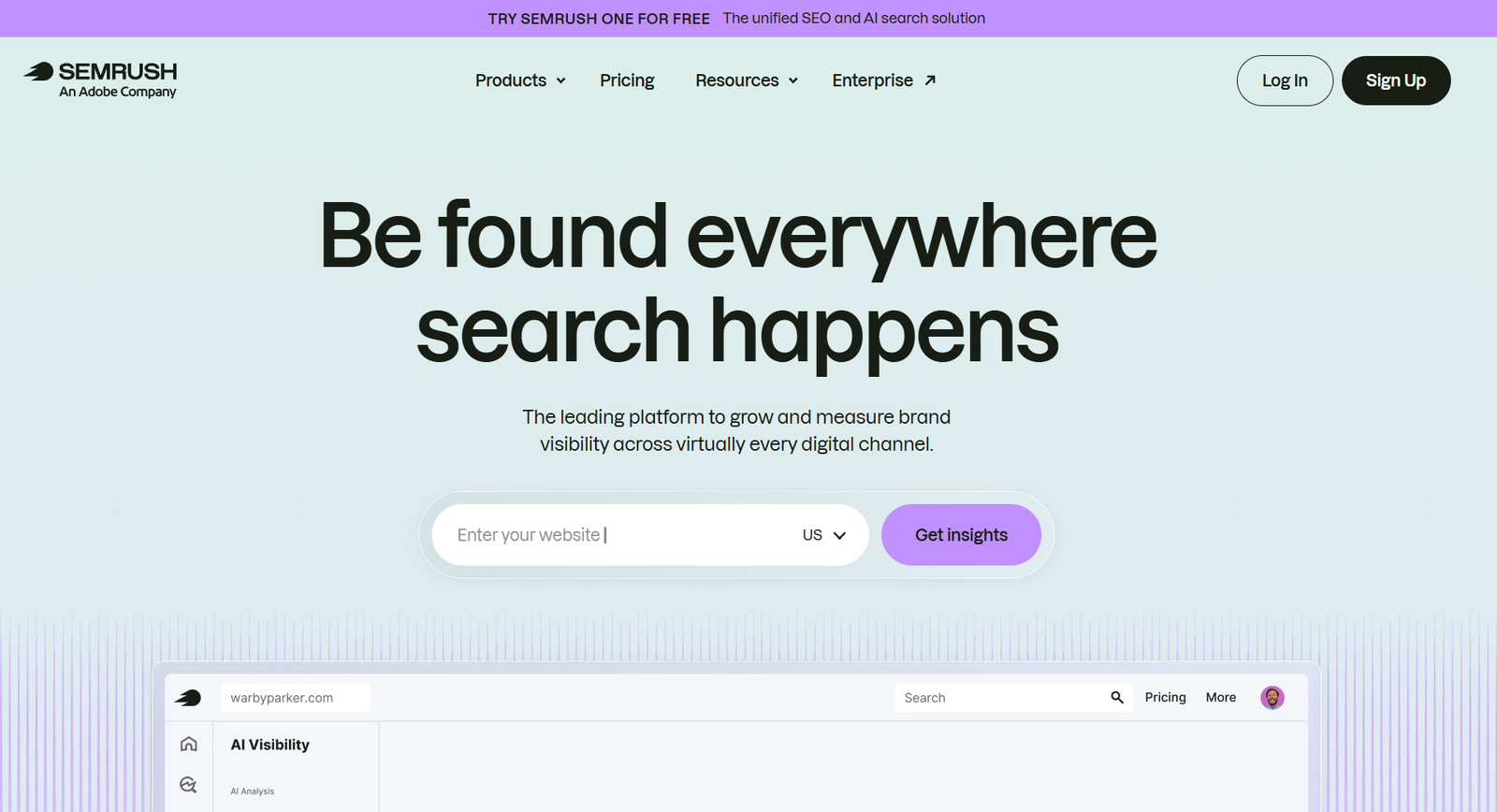
1. Semrush

Semrush is the closest thing to the Ahrefs competitors on the current market. It covers a wide variety of tools, such as keyword research, backlink analysis, technical audit, and rank tracking, and it has a full PPC and content marketing toolkit that Arefs doesn’t really compete with. It also includes a dedicated competitor analysis module, market explorer, and much more for macro-level market comparisons, which push its competitor research a step further than Ahrefs’ own comparison features.

  • Pros: Widest range of features than any tool on this list, strong content, and ppc specific tools with data that updates daily.
  • Cons: Backlink index is a bit smaller than ahref and the sheer number of features can overwhelm users.
  • Best for: Teams that want one complete platform to replace Ahrefs and a separate tool for content and PPC
  • Pricing: Plans start around $139/month, with a free trial available. 
  • Verdict: Best one in the market to replace Ahrefs with

2. SE Ranking

SE Ranking is not only cheaper than ahrefs it has a connected database, but organic search, AI visibility tools, and social metrics all in a single dashboard rather than in separate sections with separate reports. And every plan includes the AI features with no extra cost, which is still a paid add-on on some competing platforms like Semrush.

  • Pros: Strong ratio of price to feature, AI visibility index included by default
  • Cons: Backlink database doesn’t match Ahrefs’ depth for large-scale link research. 
  • Best for: Agencies who want client-centric reporting withou enterprise level pricing.
  • Pricing: Around $52–65/month, depending on plan. 
  • Verdict: Covers most of what day-to-day client work requires 

3. Moz Pro

Moz Pro has a great reputation for measuring domain authority and page authority metrics that have now become industry shorthand even outside Moz’s own platform. Its more easy for beginners than ahrefs and its on of the only tools that is offering a genuine 30-day free trial.

  • Pros: Easy to use, beginner-friendly UI, well-known and trusted for authority metrics, and solid on-page recommendations
  • Cons: Smaller link index than Ahrefs or semrush which limits the research on deep competitive backlink analysis
  • Best for: Marketers who are learning seo and want a very easy learning curve
  • Pricing: Starts around $49/month. 
  • Verdict: A good one for beginners, but not a full replacement for heavy backlinking work

4. Majestic

If your Ahrefs competitor research is really just backlink research, than majestic is a specialist worth knowing about. It skips the all-in-one suite entirely and focuses on link quality through trust flow and citation flow metrics that many link builders still treat as a second option, along with Ahrefs ‘ own domain rating.

  • Pros: Deep research focused on backlink data with useful metrics that are not replicated elsewhere, with competitive historical index
  • Cons: No keyword research, rank tracking, or audit tools. This is for backlinks onl.y
  • Best for: Link builders and seo professionals who already have a keyword research tool and need a second data source for backlink research and finding relevant collaborators.
  • Pricing: From about $50/month for limited access, up to $400/month for full API access. 
  • Verdict: Best for competitor backlink analysis, but not a standalone Ahrefs competitor and replacement.

5. SpyFu

SpyFu has built its name as a “spy on your competitor tool” and has stayed the most closest to that identity. Its standout feature is the Ad History, which shows you years of competitors’ PPC activity, like which keywords they’ve bought, which ad copy is performing well, and how their strategy has changed over time.

  • Pros: Leading tool for PPC history, AI tools included in the standard plan, and it is a budget-friendly entry point for monitoring competitors’ PPC strategies.y
  • Cons:  Backlinks and technical seo audit have less depth than those in Ahrefs
  • Best for: For those teams that care much about competitors’ paid strategy as their organic one
  • Pricing: Starts at $39/month. 
  • Verdict: A very sharp tool focused on PPC competitive intelligence, use if PPC intelligence is part of your job

6. Serpstat


Serpstat is a pack of keyword research, audits, positions tracking, competitor analysis, and backlinks tools into one dashboard at a price that is well below ahreafs. It will not outdo Ahrefs in any single category, but for teams that need “good enough data everywhere ” it’s a legitimate pick up for the value it provides

  • Pros: Full feature apreadt a t fraction of Ahrefs ’ cost, clean and easy to use interface
  • Cons: Navigation can be less intuitive and a bit difficult for someone coming from Ahrefs, semrush or a similar tool; it has a smaller backlink index, and entry plans do not contain the daily report feature
  • Best for: Smaller startups or agencies that need broad coverage without paying for things they won’t use
  • Pricing: Team plans around $209/month. 
  • Verdict: Choose when your budget matters more than best-in-class data


7. Surfer SEO

Surfer seo takes a totally different angle; it’s built around content optimization rather than backlinks and keyword research. Its scoring system tells you what page needs to be competitive for the given query based on what is already ranking in the serp which is a marketer’s gap. Ahrefs never tried to fill.

  • Pros: Strong content scoring and serp ranking tools, good WordPress and Google Docs integration
  • Cons: Less data on backlinks and competitors, pricing gets higher quickly once you add collaborative users
  • Best for: Content agencies whose bottleneck is writing page  that ranks, not finding what to target
  • Pricing: Starts around $89/month. 
  • Verdict: Combine it with a research-focused tool, rather than replacing Ahrefs with this outright 

8. Ubersuggest

Ubersuggest is a good tool, but it trades its depth for accessibility. It covers the core basics, keyword ideas, competitors’ domain overviews, and simple site audits at a price point that makes it approachable for solo operators and small sites finding their positions.

  • Pros: Low cost, simple enough for newcomers, and a decent starting point for finding keyword ideas
  • Cons: Data depth and update frequency lag behind ahreafs, especially for competitive niches.
  • Best for: Beginners or single-site owners who don’t need high-grade agency-level data.
  • Pricing: Plans from around $12–40/month. 
  • Verdict: A fine tool for first-time users, most users outgrow it once their website starts to scale

9. Nightwatch

Nightwatch focuses on one job and does it well, rank tracking. Daily updates, local SERP tracking, and white-label reporting make it a strong fit for agencies whose main day-to-day need is monitoring movement, not running deep one-off audits.

  • Pros: Reliable daily rank data; strong local SEO tracking; clean agency reporting. 
  • Cons: Not a backlink or keyword-research replacement on its own. 
  • Best for: Agencies and in-house teams whose core need is accurate, frequent rank monitoring. 
  • Pricing: Plans generally start in the $30–60/month range, depending on keyword volume. 
  • Verdict: Best paired with a separate backlink tool rather than used as an all-in-one.

Your Research Is Only Half the Strategy

Once you know which pages and domains you’re missing, the next step is earning placements on sites that actually move the needle: relevant, editorially vetted, and built to last. That’s the part we handle, through guest posts and manual outreach rather than link farms or bulk placements.

Talk to us about your link-building strategy 

Comparison Table for Quick Insights

Tool Best For Starting Price Standout Feature Main Limitation
Semrush All-in-one replacement + PPC/content ~$139/mo Keyword Gap, Backlink Gap, Market Explorer Slightly smaller backlink index
SE Ranking Agencies wanting AI visibility included ~$52/mo AI visibility on every plan Backlink depth trails Ahrefs
Moz Pro Beginners ~$49/mo 30-day free trial, DA/PA metrics Smaller link index
Majestic Backlink specialists ~$50/mo Trust Flow & Citation Flow No keyword/rank/audit tools
SpyFu PPC competitor intel ~$39/mo Ad History database Thinner backlink/audit depth
Serpstat Budget all-in-one ~$209/mo (team) Full feature spread, low cost Less intuitive navigation
Surfer SEO Content optimization ~$89/mo Content scoring, SERP alignment Weak on backlinks/competitor data
Ubersuggest Solo sites/beginners ~$12/mo Low cost, simple UI Data depth lags in competitive niches
Nightwatch Rank tracking ~$30/mo Daily updates, local SEO tracking Not a full research replacement

Conclusion

There is no single best ahrefs competitors I the market; there’s a best one for the specific gap you are trying to close. If cost is the issue, Semrush or SE ranking will get you most of the way there. If backlink depth is your goal, then Majestic still holds up. If you want to analyze AI visibility or content optimization, several of these tools do things ahrefs does not attempt at all.

It is also worth noting that the cleanest switch is not always one-for-one. A lot of teams find out later that no single ahref competitor covers everything Ahrefs does, and instead end up pairing two focused tools, a dedicated rank tracker like nightwatch alog with a backlink specialist like Majestic.

This combination often costs less than ahrefs all in one pricing while covering the workflows that actually get used week to week. Whether you’re doing a quick Ahrefs competitor analysis or deeper Ahrefs competitor research, the goal is the same: match the tool to the job, not the other way around.

And none of this is a case for abandoning Ahrefs completely, either. 

Its backlink index is still one of the largest and most frequently refreshed in the industry, and its site explorer remains a genuine benchmark most of these tools get measured against. Start from your actual bottleneck and problem statement, not the list, and the right pick gets a lot easier.

Frequently Asked Questions

Is there a free Ahrefs alternative? 

Not a fully free one, but Ubersuggest offers a limited free tier and several tools that offer free trials that are long enough to test against your one workflow before committing to a paid plan.

What is the closest tool to Ahrefs? 

Semrush is generally considered the closest one-to-one match, since it covers the same core workflows as ahrefs such as keyword research, backlink audits, and rank tracking, while adding a broader marketing toolkit

Why are people leaving Ahrefs in 2026? 

The three most common reasons are the credit-based pricing model that makes the costing unpredictable, organic traffic estimates that don’t always matches google analytics or Search Console, and limited native tools for AI search visibility.

What does Ahrefs still do better than its competitors? 

Raw backlink index size and freshness. Most of the tools on this list are strong in a specific category, but few match ahrefs overall link data depth if that’s your main use case.

Complete Guide to SEO Audit Services and Why Your Company Needs Them in 2026

You can publish content every week, fix a few keywords, even build backlinks, and still wonder why your site is not moving up in rankings. That is usually the moment when people realize something deeper is off. You cannot fix what you have not properly examined. That is where SEO Audit Services come in.

Professional SEO Audit Services do more than point out obvious errors. 

It provides a detailed overview of your technical setup, content quality, user experience, and many more things, helping you to find the real reason behind traffic drops 

Search engines change constantly. Competitors improve their strategies. Pages get outdated. Links break. 

Without Regular audit work, small issues pile up and slowly drag your SERP ranking down. Seo Audit Services help you identify these problems, and prioritize on things that need instant improvement.

What Are SEO Audit Services and Why Your Company Needs Them

If you want predictable organic growth, you need more than content and keywords. You need clarity.  Seo Audit Services gives you clarity, they give you a structured backend evaluation supported by data on how your website performs in search engines and where you lack.

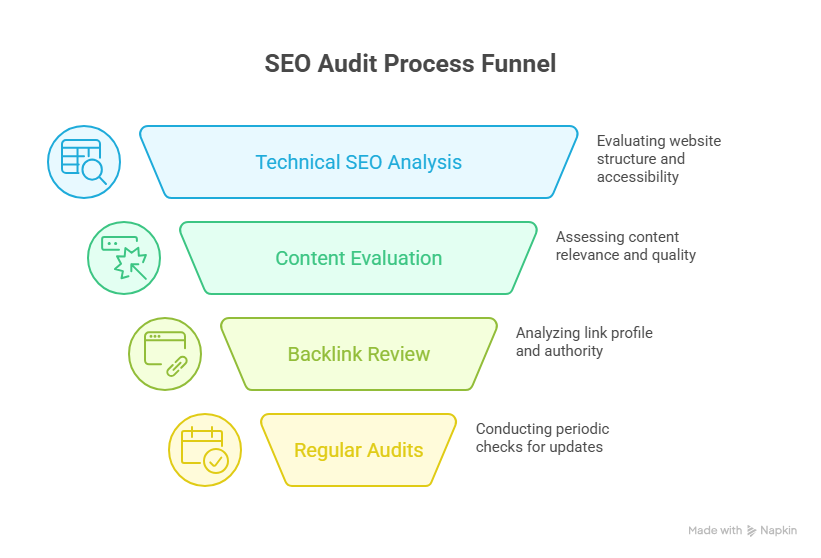
seo audit funnel

Seo audit services are a complete analysis of three main areas: technical seo audit seo services, on-page content, and backlinks. Each of these directly affects how search engines crawl and understand your site to rank it accordingly

1. Technical SEO Audit Services

Search engines want clean structure and accessibility, and a professional audit checks things like index status of your pages, site speed, core web vitals, mobile friendliness, internal linking, and duplicate content.

If search engines cannot properly access or identify your pages, your ranking goes down, no matter how good your content is. Technical findings are also very important; they are usually backed by data from tools such as Google Search Console (GSC), Google Analytics (GA4), and by a specific crawling software.

2. Content and On-Page Evaluation

Content Evaluation is not just for keywords, but also for search intent. You must evaluate the depth of content, accuracy, and usefulness in the actual market. Strong seo auditing services  assess things like these in a detailed manner, and some of them are listed below

  • If your page is providing infor of what users are actually searching for or not
  • Keyword cannibalization issues
  • Lacking depth or outdated content
  • Meta titles and descriptions
  • Internal linking flow
  • Content hierarchy and readability

Search engines always prioritize content that is helpful and trustworthy, via E-E-A-T guidelines. E-E-A-T stands for experience, expertise, authoritativeness, and trust.

An seo audit checks if your pages lack the expertise or authority as per EEAT guidelines.

It also shows opportunities to improve high-performing pages and low-performing content.

3. Backlink and Authority Review

Backlinks are still a major ranking factor in 2026. SEO audits check in detail which domains you are referring to, the quality and distribution of your backlinks, and the anchor text and signals that matter for overall authority.

Low-quality links or links placed to manipulate rankings can harm your credibility in the long term, while strong, relevant backlinks increase trust.

A proper, detailed backlink review protects your domain and helps you prepare the best backlink building strategy.

4. Regular Audits Matter

Algorithms for searches are always changing. Competitors make improvements to their websites. As platforms change and content expands over time, technical problems arise. Without regular SEO audit services, issues worsen covertly and reduce your visibility.

Regular audits help you:

  • Detect ranking drops early
  • Recover from penalties or algorithm impacts
  • Improve user experience and site performance
  • Align content with current search intent
  • Prioritize actions based on impact

In terms of experience and expertise, the benefit of SEO Audit Services is that it helps to convert random data into actionable steps. Rather than carrying out random search engine optimization, you get to work with organized information that is informed by actual data.

For businesses that depend on organic traffic, this approach helps to mitigate risks while also ensuring that their position as a leader is maintained.

How SEO Audit Services Improve Rankings and Organic Traffic

Improving rankings is rarely about one big change. Usually, growth comes from identifying specific weaknesses, fixing them step by step, and focusing on what already works. This is how SEO Audit Services create measurable improvements in rankings and organic traffic

1. Turning Data Into Clear Actions

Professional SEO Audit Services depend on real performance data from sources like Google Search Console, analytics platforms, crawl reports, and ranking tools. Instead of guessing why traffic dropped, audits examine patterns. 

For instance, if a page gets 20,000 impressions per month but has a 1 percent click-through rate, the problem might not be ranking but poorly written meta titles or descriptions. According to industry studies, improving title tags can raise organic CTR by 5 to 20 percent depending on the niche. 

Small changes in snippets can lead to hundreds or even thousands of extra visits each month without affecting rankings.

Real-World Example

Take, for example, an eCommerce site that saw a 30 percent decline in organic search traffic over a period of three months. An in-depth SEO analysis identified the following key issues:

  • There were multiple product category pages that were accidentally set to noindex
  • The mobile page load times were causing Core Web Vitals to fall below best practices
  • There were several high-authority backlinks pointing to outdated redirected URLs

Once these issues were addressed, the site saw a restoration of traffic in eight weeks. Organic traffic saw a 42 percent increase from the nadir, and several category pages moved from positions 9-11 to the top five positions.

Such a restoration is not an isolated incident. Research indicates that fixing technical issues and consolidating duplicate URLs can have a profound impact on crawl efficiency, particularly on medium to large-scale sites.

2. Fixing Hidden Ranking Barriers

Some ranking obstacles are structural in nature. A website may inadvertently target the same keyword. Key pages may not have internal links from high-authority sections. Thin pages may weaken the overall domain quality.

SEO Audit Services can remove these obstacles and allow search engines to easily recognize which pages are most relevant. When internal linking is done correctly, some websites experience improved rankings without adding a single backlink.

3. Uncovering Growth Opportunities

Opportunity zones are also revealed through audits. For instance, studies have found that pages ranking between positions 8 and 15 are the easiest to move into the top five through optimization. A targeted update that enhances content depth, search intent, and internal linking can drive traffic dramatically because the top five positions account for the majority of clicks.

In fact, the first result on Google gets an average of 25 to 30 percent of all clicks, while positions further down on page one get significantly fewer clicks. Moving up a few positions can double or triple traffic for that keyword.

4. Aligning With Algorithm Updates

Google’s updates are increasingly favoring helpful, trustworthy, and technically sound websites. Websites that ignore user experience and have poor authority signals tend to be volatile after core updates.

SEO Audit Services assess whether your website meets these expectations by analyzing the quality of content, authority signals, performance metrics, and the health of the website structure. This approach helps prevent sudden drops in traffic and helps with steady growth.

Ok, but how do you track each update of Google’s algorithms? Well, you can use semrush sensor tool to track these updates.

But if you want a simple, cost-effective way, then

Here is a page by Search Engine Central to see the most recent algorithm updates by Google

Signs Your Business Needs SEO Audit Services

Not all websites require a complete overhaul. Sometimes, all a website needs is some clarity. The problem is figuring out whether your SEO issues are just temporary or if they are indicative of deeper structural issues.

The following are signs that your business needs SEO Audit Services.

1. Sudden or Gradual Traffic Drops

If your organic traffic starts dropping without any apparent reason, that’s a warning sign. A sudden drop in traffic may be due to technical issues, algorithm changes, manual penalties, or indexing problems. A steady drop in traffic may be due to increased competition, outdated content, or loss of authority signals.

If your analytics tools are showing a steady drop in traffic for a few weeks or months, it’s time to start investigating instead of just speculating.

2. Rankings Are Stuck or Declining

You are regularly publishing content but your target keywords are stuck on page two or three. Or, worse, they are declining.

This is a sign that something is holding back your performance. It could be internal competition, poor topical representation, misalignment with search intent, or superior competitors. Our SEO Audit Services will help you understand why your pages are not ranking in the top spots.

3. High Traffic but Low Conversions

In some cases, the traffic may be stable, but the leads or sales may not be improving. This indicates that there may be a misalignment between the user intent and the content, a lack of strong internal linking, or a poor page experience.

An audit may help determine if users are visiting the wrong pages, if the calls to action are hidden, or if the technical issues are impacting the usability. Organic traffic is relevant only if it is driving business results.

4. Slow Site Speed or Poor Mobile Experience

If your website is perceived as slow, users will notice. Search engines will too.

Bounce rates, dwell time, and mobile engagement are often associated with slow websites. With Google’s mobile-first indexing and emphasis on user experience, slow websites can negatively impact rankings without you even realizing it.

5. Indexing or Crawl Issues

If key pages are not showing up in search results or if there are crawl errors, excluded pages, or coverage issues in Google Search Console, there could be underlying structural issues.

Indexing problems make it impossible for search engines to fully understand your site. Without visibility, quality content cannot rank.

6. You Have Never Done a Formal Audit

Many companies are spending money on SEO without ever doing a review. If you have been creating content and building links for years without doing a review of the system as a whole, there is a good chance that inefficiencies are present.

SEO becomes more complicated as the size of the site increases. What was effective on your site with 50 pages may not be effective on your site with 500 pages.

How to Choose the Right SEO Audit Company

Now comes the important part, How to choose the right seo audit company. The right seo audit company will identify real problems, prioritize them correctly, and help with implementation.

This is how to rate your choices.

1. Proven Experience and Industry Understanding

Begin with experience. A good provider should have knowledge of various business models, types of search intent, and competitive scenarios. Inquire about the industries they have experience in and the types of websites they audit.

SEO is not a one-size-fits-all solution. The requirements of a startup blog are different from that of a SaaS business or an enterprise website.

2. Enterprise SEO Audit for Large-Scale Websites

If you are running a large website with hundreds or thousands of pages, you will require an enterprise SEO audit.

Enterprise SEO audits target crawl efficiency, log file analysis, scalable internal linking, structured data consistency, international SEO issues, and site architecture management.

Large-scale websites tend to have crawl budget waste and duplicate signals. An enterprise SEO audit will make sure that search engines rank your most valuable pages.

3. B2B SEO Audit for Long Sales Cycles

A B2B SEO audit needs a different perspective. B2B buyers have longer decision paths and may be searching for information before making contact.

A good B2B SEO audit looks at the depth of content, authority positioning, alignment with keyword intent, and lead-driven landing pages. It needs to examine how well your content is working to build trust and thought leadership, as opposed to purely driving traffic.

4. Transparent Reporting and Clear Documentation

Professional seo auditing services should include a structured SEO audit report template so you know how findings are organized. Request an SEO audit report sample before hiring.

Reports should clearly outline:

  • Identified issues
  • Business impact
  • Priority level
  • Step-by-step recommendations

Transparency shows confidence and accountability.

5. White Label SEO Audit for Agencies

If you are running a marketing agency or a consultancy business, a white label SEO audit can be an excellent solution for you.

With a white label SEO audit, you can offer Professional seo auditing services with your own branding while benefiting from the expertise of a white label SEO audit provider in the background. A reliable white label SEO audit provider will offer you in-depth reports and insights that you can present to your clients with confidence.

6. Proven Results and Case Studies

Finally, look for evidence. 

Have they assisted clients in recovering from traffic losses? 

Have they improved search rankings? 

Have they increased qualified leads?

A company such as backlinksmatters.com, for instance, is one that specializes in authority-driven strategies and structured audits that identify not only technical issues but also competitive gaps. What is most important, however, is not only the identification of issues but also the demonstration of how recommendations resulted in improvements.

Conclusion

SEO improvement does not result from speculation. It results from understanding. Even with regular content and link development, things can go wrong if there are technical problems, authority issues, or content mismatches.

Seo auditing services are a systematic and data-driven analysis process that reveals hidden problems and points to actual opportunities for growth. They can help you prioritize, adjust to changes in the algorithm, and safeguard your rankings before small problems turn into big losses.

For any business that relies on organic search traffic, regular audits are not a recommendation. They are a necessity.

B2B SEO Services: Definitive Guide for Businesses In 2026

How are B2B SEO services different from generic SEO? 

How will it help my business? 

Are you a business owner who has these and many other questions? This article will make it easy for you grasp this concept. 

Don’t worry, we will go one step at a time. 

In simple terms, Business-to-business (B2B) SEO is the process of increasing your website’s visibility by improving the quality and quantity of traffic.  It means to make your website more attractive to increase its visibility. 

Business owners use this technique to attract more organic visitors to their sites. B2B SEO is about finding what the targeted organic audience wants and delivering exactly what they want.

B2B SEO plays a crucial role in the ever-evolving business landscape of 2026. As organisations strive to stay competitive and relevant, effective SEO strategies are important, especially curated for B2B audiences. 

In the article, we will break down what B2B SEO is, how it is different from generic SEO, B2B SEO vs B2C SEO, why B2B SEO services are essential in 2026, and what services they offer.

Let’s Begin…

What are B2B SEO Services?

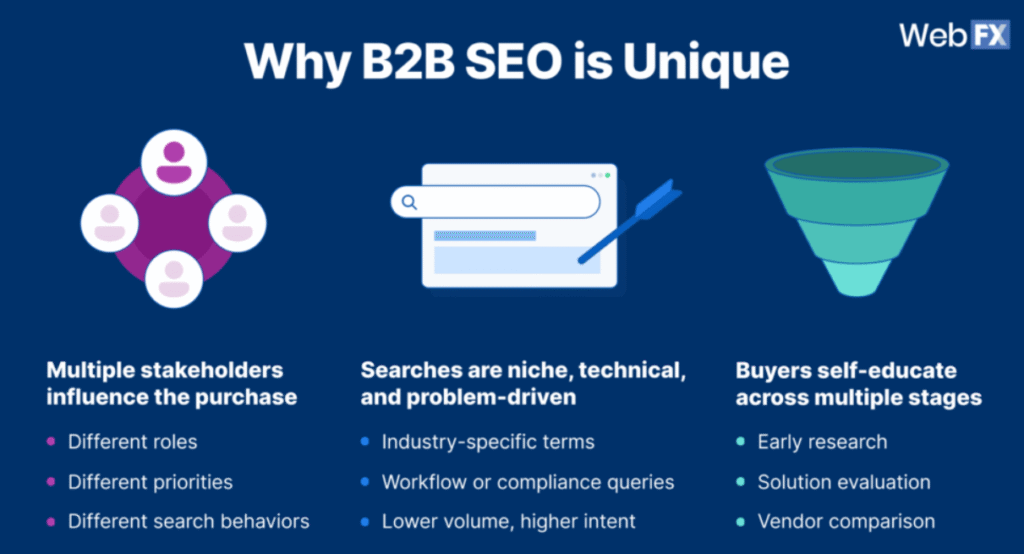
B2B SEO is a strategy where the main objective is, to attract organic search engine traffic and keyword rankings for B2B websites. It is the science of reaching professionals who are interested in your solutions via search engines. 

B2B SEO focuses on – 

  • Keywords that have no volume but high value or search intent 
  • Publishing in-depth and authoritative content about the industry
  • Lead generation is given more importance than impulse purchases
  • Technical SEO is the key

b2b seo

Let us also understand the B2B industries that could benefit from B2B SEO Services. Commonly, industries where customers research extensively before making a purchase decision adopt B2B SEO Services. 

  1. SaaS (Software as a Service) – Companies that offer extensions, services, subscription models, plugins, etc., often require detailed product comparisons or a demo. 
  2. Manufacturers – Manufacturing businesses looking for bulk buyers or corporate clients. 
  3. IT or Technology Services – Companies that offer IT consultations, cybersecurity, or software development solutions. 
  4. Digital Marketing Agencies – These agencies often rely on organic traffic to attract clients for long-term partnerships. 

There is one element common to all the mentioned industries, before making a purchasing decision, the potential customer will run thorough research. And that is exactly where B2B SEO services come into play. 

But why are B2B SEO serviecs are different from B2C SEO services? Let’s unwind that in the next section…

Want To Learn More About Seo? Read Our Guide on SEO Funnels

B2B SEO Services Vs B2C SEO Services – Differences 

SEO is SEO. 

At its core, it is the process of attracting organic traffic to the website that you are aiming to rank over the SERP (Search Engine Results Page). However, marketing activities work differently in the B2B world; there are some tweaks to the said principles. 

Although both B2B and B2C SEO’s main objective is to enhance the search ranking of websites, their goals, execution, strategies, and key performance indicators (KPIs) are different. 

Here are some core differences to understand – 

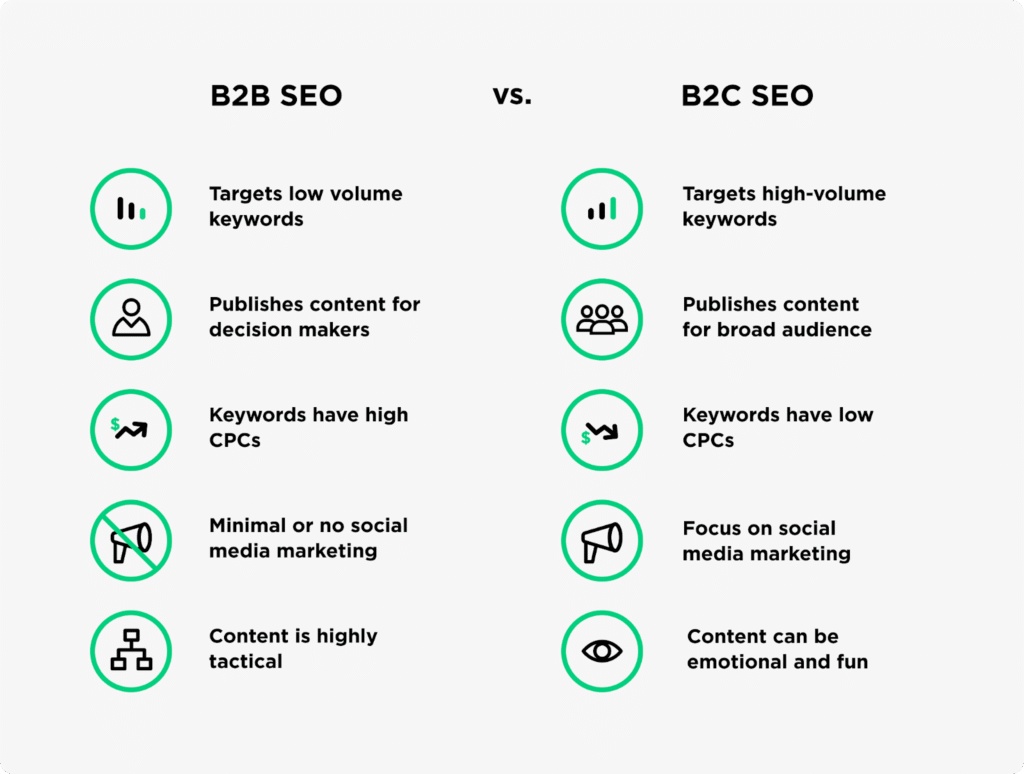
b2b vs b2c seo

  • Target Audience: B2B SEO targets professionals, bulk buyers, procurement teams, and decision makers. On the other hand, B2C SEO targets consumers’ personal purchase decisions. 

B2B SEO targets low-volume keywords. 

  • Content Depth: B2B SEO focuses on in-depth content such as detailed blogs, comparison articles, demos, and user cases. Meanwhile, B2C SEO solely relies on short-form blogs, engaging product pages, and reviews.

B2B SEO publishes content for decision makers. 

  • Keyword Strategy: B2B SEO primarily focuses on keywords with low search volume but high business value. But B2C SEO focuses on high-search-volume keywords, as well as product-focused keywords.

B2B SEO targets keywords with high CPCs (cost per click). 

  • Promotions: B2B SEO emphasizes no social media promotions, whereas B2C SEO’s main focus is promoting products on social media platforms. 

B2B SEO preaches minimal or no social media promotions. 

  • Main Objective: B2B SEO focuses on lead generation, while the B2C SEO’s objective is direct sales.

B2B SEO publishes tactical content that moves the audience towards lead generation. 

Why Is Having A B2B Seo Agency Essential In 2026?

In 2026, the B2B customers’ buying behaviour has changed. The competition has increased, the customers are more informed, and traditional lead-generation channels are becoming expensive. 

In some aspects, B2B SEO has not changed. We are still spending time generating helpful content for our audience. But one significant change that has taken place: customer queries are being answered by AI. 

This is why B2B SEO Services are just not optional, but essential for consistent growth. 

b2b seo services

B2B Buyers Start Their Research on Search Engines: Before connecting with a B2B seller or a vendor, B2B buyers usually – 

  • Research about different solutions 
  • Read in-depth articles about the solutions 
  • Compare providers 

If your website doesn’t appear during this research phase, you are losing valuable sales, and you are definitely invisible to high-intent potential buyers. B2B SEO ensures that your website appears early in the decision-making process, not after they have already shortlisted the competitors. 

Cost Efficiency vs Paid Ads: Another issue faced by B2B industries is that; the cost of paid advertisements has increased significantly in 2026, especially for competitive B2B industries.

B2B SEO Services provides – 

  • Long-term organic traffic
  • Eliminates the need for paid advertisements 
  • One well-ranked B2B website can deliver leads for years.

Understanding the Changing Google Algorithms: B2B SEO Services are crucial because Google changes its Algorithm very frequently. It is next to impossible for a B2B business owner to run a business and also keep track of the algorithms. 

Search Engines are now prioritizing – 

  • Expert-level topical content 
  • Trust signals like backlinks
  • Optimize content for Google’s AI Overview summaries 

For B2B businesses looking for ways of consistent growth, B2B SEO is no longer “nice to have”; it is a necessity, a “must-have”. 

What’s Included In B2B SEO Services?

One core objective of B2B SEO Services is to attract high-intent business leads and convert them into profitable sales. Instead of solely focusing on increasing traffic, each activity is planned around authority, search intent, and finally, long-term growth. 

b2b seo services

Here is the complete list of all the activities that are included in B2B SEO Services – 

Keyword Research: B2B SEO starts with analyzing keywords that are used by bulk-buyers or decision makers, not by casual shoppers. These keywords include – 

  1. High-value & Long-tail search terms 
  2. Commercial keyword with high search intent 
  3. Keywords to match different stages of the buyer’s journey

The end goal is getting quality traffic to the website, not just quantity. This ensures that the traffic is conversion-ready. 

Technical SEO: Technical SEO is responsible for ensuring that your website is easy for search engines to rank, understand, and crawl. 

This includes – 

  1. Site Health 
  2. Mobile responsiveness check 
  3. Fixing crawling and indexing issues 
  4. Enhancing internal links 

On-page SEO: Everything you do on your website to increase its visibility is called on-page SEO. There are three types of On-Page SEO:

  1. Crawling is the discovery process by which search engines send out a team of robots to find out the updated content or new content. The database is called CAFFEINE. The trick here to get caught by these crawlers is to keep updating the content on the page or website.
  2. Indexing is the process of storing and organizing the crawled information for future reference.
  3. Ranking is the process that provides the pieces of content that will be the best answer to a searcher’s query, which means that results are ordered from most relevant to Least relevant. At all times be relevant.

Content Creation: This is another important service provided by B2B SEO agencies, especially for long sales cycles. 

The type of content created by B2B SEO agencies – 

  1. Long-form content about the solutions 
  2. Comparision articles 
  3. Real-World use cases 
  4. SEO-optimized blogposts 

Link Building: If your B2B SEO agency has made people naturally talk about or link to your websites, this means they have done half the job. Backlinks play a crucial role here. It is like a web reference to the main web source, website, or web page, giving the viewer the clarity that is often required during the research of any topic. Backlinks are a significant part of any content-creating process.

Tracking & Reporting: Measuring performance is essential for continuous and consistent growth.

This includes – 

  1. Tracking and analyzing keyword performance 
  2. Monitoring conversions and leads
  3. Taking actionable steps based on the insights 

How To Choose The Best Seo Companies For Small Business?

When it comes to boosting your B2B business, it is important to choose the correct B2B SEO Service provider. The right service provider helps you get noticed by the people who are interested in what you have to offer. 

best seo agency

It is important to note that not all SEO agencies understand the B2B market. If you choose the wrong agency, it can result in poor-quality leads and increased traffic. 

These are some essential points to consider – 

1. Experience with B2B SEO

The service provider you choose should understand that B2B SEO is different from B2B SEO. 

They should have experience in working with – 

  • B2B businesses
  • Low-volume and high-value keywords 
  • Long-tail keywords 
  • Curating long-form educational content for decision makers

Tip: You can ask agencies to show case studies of the work they have done for other B2b industries. 

2. Realistic Expectations

SEO takes time, especially for B2B industries. Be aware of agencies that –

  • Guarantees instant lead generation 
  • Promises #1 ranking in 2 days 
  • Avoid discussions regarding challenges or timelines 

Tip: A trustworthy B2B SEO agency will be transparent with the timelines and deliver consistent growth. 

3. Ethical Link Building Activities 

Creating backlinks is essential in B2B SEO, and it should be done ethically. Choose agencies that – 

  • Builds ethical backlinks from reputable websites
  • Uses white-hat SEO. This refers to SEO techniques, best practices, and strategies that abide by the Search Engine rule; its primary focus is to provide value to the audience.
  • Avoids spammy links 

Why Choose Backlinksmatter?

Backlinksmatters is a B2B SEO agency that helps you dominate search results with consistent, data-backed SEO campaigns designed to increase rankings, leads, and revenue. 

From technical white-hat SEO strategies to high-authority backlinks, they look after everything. What will be your job? To convert generated leads and make profitable sales. 

Their track record speaks for itself; they have consistently delivered exceptional results. 

Want to Build Authority Without Chasing Collaborators?

Backlinks Matters focuses on relevant, industry-specific placements that support long-term authority rather than quick wins.

Frequently Asked Questions (FAQs) 

What are the four types of SEO?

The four types of SEO – 

  • On-Page SEO (On-page SEO is everything you do on your website to increase its visibility),
  • Off-Page SEO (it refers to actions taken outside your website to impact rankings on search engine results pages),
  • Technical SEO (enhances the site structure), and 
  • Local SEO (targeting the local audience through Google Business Profiles).

What are 4 types of B2B?

The four types of B2B are producers, resellers, government, and institutions. Understanding these businesses helps B2B SEO agencies build strategies around such industries. 

How important is SEO for B2B?

B2B SEO services play a crucial role in the ever-evolving business landscape of 2026. As organisations strive to stay competitive and relevant, effective SEO strategies are important, especially curated for B2B audiences. 

PBN Links in Modern SEO: Reality, Risk & Relevance (2026 Guide)

PBN links are still a hot topic in SEO. Even in 2026, it is still a topic that triggers a debate: Are PBN links effective? Should I consider this strategy? Are they risky?  Or this strategy is no longer in practice in the era of AI search and advanced spam detection.

​In this article, we are going to take a deep dive into discussing PBN (Private Blogs Network) links in modern  SEO. No matter whether you are a business owner, marketer, SEO analyst, or content creator. We will try to cover all the details regarding PBN links, what strategies were used earlier for them, and now over the period of time.

Why Are PBN Links Still Discussed in SEO Today?

PBN link methods are still a hot topic to discuss in today’s SEO because it acts as a kick start for newly established websites. Lots of marketers are still wondering whether PBN links are still an effective strategy in an actively evolving SEO environment. Like many marketers, SEO professionals have used PBN link tactics successfully in the past.

But also, there is a high risk with this method, as it can lead towards the long term SEO consequences. 

No doubt it increases the domain authority (DA) and search rankings of websites quickly, but at very high risk, as soon as Google detects the PBN links, the website has to face some consequences, such as:- 

  • Manual penalties and algorithmic demotions in ranking( it would be visible on your associated Google Search Console).
  • Deindexing of all the links that are coming from the PBN websites and overnight vanish all your rankings gained with your SEO.
  •  It may hinder your partner’s and clients’ trust, and also result in a loss of reputation in the market.


Why SEO Professionals Still Experiment With PBN Links?

Some SEO professionals continue to use PBN link tactics despite their known risks. As organic link building through outreach, internal linking, and all these kinds of methods take time to reflect the results. Since the marketers have certain deadlines to meet, they still experiment with PBN links, but these experiments undergo precautions, controlled and calculated.

These PBN links are typically tested on non-critical or low-priority websites so that, even if Google detects and penalises them, there is no negative impact on the core business or its primary online assets.

Are PBN Links a Legacy Tactic or an Ongoing SEO Shortcut?

PBN links are considered a legacy tactic lately, but some marketers or SEO specialists view them as an SEO shortcut. Earlier, PBN links were highly effective because search engines relied heavily on link volume with anchor texts. But now things have changed, Google algorithms have evolved to focus on link quality, relevance, and trust.

Now PBN strategy of building website authority serves as a reference point of outdated SEO practices rather than a growth strategy. Sustainable SEO success is now based on EEAT (Experience, Expertise, Authoritativeness, and Trustworthiness). It helps search engines like Google to determine whether the content is reliable, relevant and helpful to the end user.

What are PBN links?

PBN links (Private blog network links) are the backlinks formed by a network of websites owned by the same individual or organisation. These are groups of websites or expired domains consisting of backlink authority to pass the link to the main website.

The link that points from the website networks to the main website is called a PBN link. This tactic is used by the owners/marketers/SEO just to improve ranking, not intentionally to help users. That is why Google considers it a policy violation and considers it spam.

Google considers PBN links as a kind of “link scheme” (to trick Google’s ranking algorithm) because it passes the authority to the main website. A website links to another website in order to provide related and useful content to the end user. 

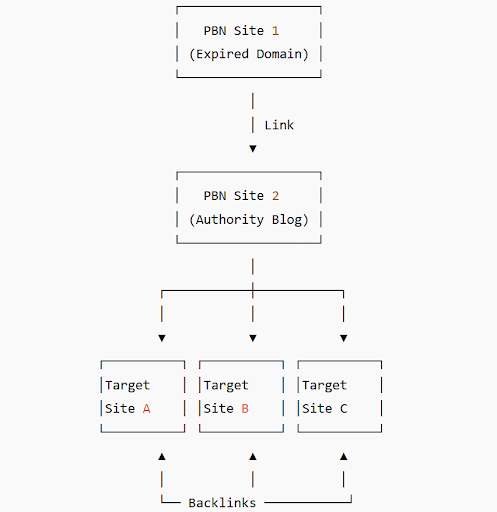
PBN flow

With the help of the above image, we are going to take a deep dive in order to understand the working of PBN links.

So, the above figure is about how the link is flowing from a PBN website (expired domain) and how authority and link equity are artificially distributed from multiple controlled websites to a target website.

  1. So, as you can see in the above figure, the link is flowing from the multiple PBN websites (It could be multiple), these are the expired domain websites with existing backlink authority, in the graph, they appear as multiple source points linking outward. 
  2. All outgoing links from PBN sites that are intentionally placed by the SEO professionals, as they control: Anchor text, Link placement (contextual, footer, sidebar), Link frequency and timing. These controlled behaviours are flagged by Google as they are unnatural.
  3. The main site is sitting at the end of the graph, as you can see (the target website), it receives the backlinks from several PBN websites in order to boost authority artificially, as they are detectable by the search engines.
  4. You can also see several PBN sites linking to each other before linking to the target site. This is done intentionally to simulate relevance and strengthen perceived authority, but it increases footprint risk if patterns are identified.

How PBN Links Are Different From Natural Editorial Links

The main difference revolves around intent and autonomy. Natural editorial links are given by independent publishers because the content is helpful to their audience. These links are motivated by relevance, trustworthiness, and authentic endorsement. 

On the other hand, PBN links are intentionally placed by the site owner. The linking site and the linked site are not truly independent of one another, despite appearances. This absence of genuine editorial decision-making makes PBN links unnatural from the perspective of search engines.

Want to Build Authority Without Chasing Collaborators?

Backlinks Matters focuses on relevant, industry-specific placements that support long-term authority rather than quick wins.

The Real Intent Behind Building PBN Links

The real intent behind PBN links is control. Control over anchor text, link placement, link velocity, and the number of referring domains. This level of control allows SEOs to influence ranking signals faster than traditional link-building methods. PBNs are often used to bypass the time, effort, and uncertainty involved in earning organic backlinks through content marketing or digital PR.

However, this control comes at the cost of long-term trust, making PBNs a short-term tactic rather than a sustainable SEO strategy.

Ownership-Controlled Links vs Earned Authority Links

PBN links

Ownership-controlled links are those that are completely controlled by the same individual or organisation that controls both linking and receiving websites. The main purpose is to transfer the authority and get ranked over search results, not to recommend helpful content to the user.

Earned authority links, on the other hand, are a result of merit. They are created to provide links to useful, trustworthy, or authoritative content. These links build long-term credibility and remain in favour of algorithm updates, making them the foundation of sustainable SEO growth.

How PBN Links Work in Search Engine Ranking Systems?

PBN links manipulate authority signals based on links in an artificial way in order to improve rankings. Search engines use backlinks to check the website’s credibility, relevance, and authority. PBNs are created to take advantage of this system by directing link equity from several websites that seem independent but are actually managed by a single entity.

Within a PBN structure, SEO professionals use old or expired domains consisting of accumulated backlinks. These domains are restored with new content so that they can appear legitimate and can be directly linked to the targeted website using strategically chosen anchor text and placements.

Why PBN Links Can Temporarily Influence Rankings

When PBN links are first discovered, algorithms may initially assign value based on historical authority, relevance, and link context. This creates a sudden rise in ranking, leading some SEO practitioners to believe the strategy is effective. However, search engines started to analyse link patterns, ownership footprints, and unnatural behaviours. PBN links are either devalued or penalised. When this happens, ranking gains disappear, sometimes suddenly.

BUT!!!

True SEO success comes from earned authority links that build trust over time, according to algorithm updates. PBN-driven results, by contrast, are temporary and unstable, making them unsuitable for long-term, growth-focused SEO strategies.

How Google Evaluates PBN Links in 2026

Google uses a combination of advanced link assessment, pattern recognition, and AI-enhanced spam-detecting algorithms to examine PBN links. In contrast to previous years, Google no longer relies entirely on manual penalties to address manipulative link building. Rather, it gradually reduces the value of questionable connections in a covert way, reducing their efficacy without alerting the owner of the page.

Google looks at things including anchor text distribution, hosting circumstances, link growth pace, domain ownership trends, and previous linking activity. Google may ignore links entirely if a group of websites seems to be run by a single organisation and are primarily used to transfer authority. Although manual punishments can still be applied in more severe circumstances, this strategy is no longer the main one.

Common Footprints That Expose PBN Links

Even with careful construction, the majority of PBNs leave noticeable traces. By examining both technological and content-based trends among connecting websites, Google detects these signals.

Similar IP ranges, DNS patterns, shared hosting providers, and frequent use of CMSs or themes are examples of technical footprints. Combined patterns greatly raise the likelihood of discovery, even if these signals might not cause action on their own.

Content footprints are just as important. Strong signs of a PBN include thin content, irregular posting frequency, repetitive templates, and strange outbound linking behaviour. It becomes hard to ignore a pattern when several websites post generic material yet link out with well-optimised anchor text.

Link velocity and anchor text modification are two more significant footprints. Common warning signs that reveal PBN activity include links heading mostly to a single target website, frequent keyword-rich anchors, and abrupt spikes in backlinks.

The Real Cost of Using PBN Links

The actual price of PBN connections goes much beyond their initial ranks. Maintaining a PBN entails ongoing costs for things like hosting, content production, domain renewals, and security monitoring. The expense of keeping a network “hidden” is going up as its efficacy decreases as Google’s identification gets better.

Instead of spending money on the PBN links maintenance, if spent on content creation, organic link building and other authority-building collaborations, then the benefits would be permanent.

From a brand perspective, the risk is even higher. If PBN usage becomes associated with a business, it can damage trust with clients, partners, and stakeholders. For agencies and B2B brands, this reputational risk often outweighs any short-term SEO gains.

Final Verdict: Are PBN Links Worth the Risk in 2026?

In today’s SEO environment, PBN links are no longer a reliable source of growth. While they may still deliver temporary ranking fluctuations in low-competition or experimental scenarios, they fail to provide consistent, scalable, and sustainable results.

Earned authority links and trust-based signals surpass PBNs in every important criterion for long-term SEO performance, particularly in competitive or brand-driven environments: stability, visibility, credibility, and resistance to algorithm modifications.

To put it briefly, PBN linkages are risky and have diminishing returns. Using deceptive link strategies turns into a long-term liability rather than a quick fix as search engines continue to place a higher priority on legitimate authority and user value.

#1 WordPress SEO Services Company: Increase Traffic & Boost Results

In today’s digital-first world, simply having a WordPress website is not enough. With millions of websites competing for attention, businesses need a strategic approach to stand out, attract the right audience, and convert visitors into customers. That’s where professional WordPress SEO services come in.

A dedicated WordPress SEO services company helps businesses improve search visibility, drive consistent organic traffic, and achieve measurable growth. Whether you are a small business, SaaS brand, or enterprise organization, SEO tailored specifically for WordPress can unlock long-term success.

Why WordPress SEO Matters in 2026

WordPress continues to dominate the internet, powering over 40% of all websites globally. Its flexibility, scalability, and extensive plugin ecosystem make it the platform of choice for businesses of all sizes. From blogs and corporate websites to SaaS platforms and enterprise portals, WordPress remains the backbone of modern web development.

However, as WordPress adoption grows, so does competition. Search engines have become more sophisticated, prioritizing user experience, technical performance, and content quality more than ever before. Simply installing an SEO plugin is no longer enough to rank.

This is why WordPress SEO services are critical in 2026. They combine technical optimization, content strategy, and authority building to help WordPress websites rank higher, load faster, and convert better. Businesses that invest in professional SEO gain a competitive edge that compounds over time.

What Are WordPress SEO Services?

WordPress SEO services are specialized optimization strategies designed specifically for WordPress-powered websites. These services focus on improving search engine visibility while leveraging WordPress’s unique architecture, themes, and plugins.

Unlike general SEO, WordPress SEO takes platform-specific factors into account. This includes optimizing WordPress themes, managing plugin conflicts, improving database performance, and ensuring clean URL structures. It also involves tailoring content and metadata to work seamlessly with WordPress SEO tools.

Businesses that benefit from WordPress SEO services include:

  • Small and medium-sized enterprises (SMEs) looking for cost-effective growth
  • Local businesses aiming to dominate regional searches
  • SaaS companies competing in high-intent keyword spaces
  • Enterprises managing large WordPress websites with thousands of pages

Why Choose a Dedicated WordPress SEO Services Company?

Hiring a dedicated WordPress SEO services company provides far more value than generic SEO support. WordPress-specific expertise ensures that every optimization effort aligns with the platform’s best practices.

A specialized company understands how WordPress plugins, themes, hosting, and WordPress core updates impact SEO. They can identify technical bottlenecks, improve performance, and prevent issues that commonly hurt rankings.

More importantly, professional WordPress SEO services are designed for long-term ROI. Instead of quick fixes, they focus on sustainable growth, scalability, and adaptability as search algorithms evolve. This makes them ideal for businesses planning to grow steadily over time.

Core WordPress SEO Services We Offer

A comprehensive WordPress SEO strategy combines multiple services working together. Each component plays a vital role in improving rankings, traffic, and conversions.

On-Page SEO Services for WordPress

On-page SEO services are the foundation of any successful SEO strategy. For WordPress websites, this starts with content optimization that aligns with search intent and user expectations.

Professionally optimized content includes keyword mapping, structured headings, internal linking, and readability enhancements. Metadata such as title tags and meta descriptions are crafted to improve click-through rates from search results.

User experience is another critical factor. WordPress on-page SEO focuses on improving navigation, mobile responsiveness, and page load times. A fast, user-friendly website not only ranks better but also keeps visitors engaged longer.

Off-Page SEO & Link Building Services

backlinks matters

                                                           Source backlinksmatters

Off-page SEO plays a critical role in building authority and trust for your WordPress website. Our off-page SEO and link-building services focus on acquiring high-quality, relevant backlinks through ethical, white-hat practices.

We implement strategic link-building campaigns that include guest posting, niche edits, digital PR, and brand mentions. Our SEO outreach services help your WordPress site earn authoritative links that improve domain strength, keyword rankings, and long-term credibility.

By combining on-page optimization, technical SEO, and off-page link building, we deliver a complete WordPress SEO solution that drives sustainable traffic growth and measurable results.

Build Long-Term SEO Authority with High-Quality Backlinks

Backlinks Matters delivers relevant, industry-specific link placements that support sustainable SEO growth and long-term rankings

Technical WordPress SEO Optimization

Technical SEO ensures that search engines can properly crawl, index, and understand your WordPress website. This includes optimizing site structure, fixing crawl errors, and managing duplicate content issues.

Core Web Vitals play a major role in rankings. Technical WordPress SEO focuses on improving loading speed, interactivity, and visual stability across all devices. Clean code, optimized images, and efficient caching are essential here.

Schema markup and indexing strategies further enhance visibility by helping search engines display rich results. This leads to higher click-through rates and improved organic performance.

Advanced WordPress SEO Optimization Service​ for Growth

WordPress SEO Services

For businesses looking to scale aggressively, advanced SEO strategies are essential. These solutions go beyond basic optimization and focus on authority, automation, and competitive dominance.

Enterprise SEO Services for Large WordPress Websites

Enterprise SEO services are designed for large WordPress websites with extensive content libraries and complex structures. Managing thousands of pages requires advanced keyword segmentation, content governance, and technical precision.

Enterprise SEO includes automation tools for audits, reporting, and performance tracking. It also focuses on advanced internal linking strategies and data-driven optimization to ensure every page contributes to overall growth.

These services are ideal for enterprises, large publishers, and high-growth SaaS platforms operating on WordPress.

Local SEO Services for WordPress Businesses

Local businesses rely heavily on location-based visibility. It focuses on optimizing Google Business Profiles, creating geo-targeted landing pages, and building local citations.

Location-based keywords help businesses appear in “near me” and regional searches. Optimized WordPress pages combined with local SEO strategies drive high-intent traffic that converts into real customers.

For small businesses, these services often outperform paid ads in terms of ROI, making them essential for sustainable growth.

SEO Outreach Services: Building Authority for WordPress Sites

Backlinks remain one of the strongest ranking factors in SEO. High-quality backlinks signal trust, authority, and relevance to search engines.

SEO outreach services focus on acquiring backlinks through ethical, white-hat methods. This includes guest posting, editorial placements, and digital PR campaigns that build genuine authority.

A strong outreach strategy not only improves rankings but also increases brand visibility and referral traffic. For WordPress websites competing in crowded niches, link building is often the differentiator between page one and page two rankings.

How WordPress SEO Services Increase Traffic & Boost Results

Professional WordPress SEO services deliver measurable results across multiple dimensions. Improved keyword rankings lead to higher organic traffic, while optimized content attracts users who are actively searching for solutions.

Beyond traffic, SEO enhances conversion rates by improving site usability and aligning content with user intent. Visitors spend more time on the site, engage with key pages, and are more likely to take action.

The real-world impact of WordPress SEO is long-term and compounding. Unlike paid advertising, organic growth continues to deliver value even after initial investments.

Industries That Benefit from WordPress SEO Services

WordPress SEO services are versatile and adaptable across industries.

Service-based businesses benefit from lead-focused optimization and local SEO strategies.
eCommerce brands improve product visibility and transactional traffic.
SaaS companies rely on SEO for scalable, high-intent user acquisition, often working with a specialized SaaS SEO agency.
Local businesses gain consistent foot traffic and inquiries through regional searches.
Enterprises leverage enterprise SEO services to manage large-scale growth and brand authority.

How to Choose the Right WordPress SEO Services Company

Selecting the right SEO partner is crucial for success. Experience with WordPress-specific challenges is a key indicator of expertise.

A reliable SEO company uses advanced tools, provides transparent reporting, and follows ethical SEO practices. Avoid agencies that promise instant rankings or use black-hat techniques.

Custom strategies tailored to business goals separate professional providers from generic agencies. Many of the best SEO companies for small businesses focus on flexibility, communication, and measurable outcomes.

WordPress SEO Services: Pricing & Engagement Models

Pricing models vary based on business size and goals. Monthly SEO plans are ideal for long-term growth and consistent optimization.

Project-based SEO works well for website launches, migrations, or audits.
Enterprise SEO plans are customized for large organizations with complex requirements.

The right pricing model aligns with growth objectives, the level of competition, and desired outcomes.

(FAQs)

How long does WordPress SEO take?
SEO is a long-term strategy. Initial improvements may appear within 3–4 months, while significant growth typically takes 6–12 months.

Is WordPress good for SEO?
Yes, WordPress is highly SEO-friendly when properly optimized with the right themes, plugins, and strategies.

Do plugins replace SEO services?
No. Plugins assist with implementation, but professional SEO expertise is required for strategy, analysis, and growth.

Is SEO a one-time or ongoing process?
SEO is ongoing. Search algorithms, competitors, and user behavior constantly change, requiring continuous optimization.

Conclusion: Grow Faster with Professional WordPress SEO Services

Professional WordPress SEO services provide businesses with a powerful growth engine. From technical optimization and content strategy to SEO outreach services and enterprise SEO services, a comprehensive approach delivers sustainable results.

By partnering with an experienced WordPress SEO services company, businesses gain expertise, scalability, and a competitive advantage in search results.
If you want to increase traffic, boost rankings, and drive consistent growth, investing in professional WordPress SEO is the smartest move you can make in 2026.

Cyber Security SEO Guide: Best Ranking Strategies for Security Websites

Cybersecurity is a busy space. Every company says that they are the safest, smartest, and are using the most advanced industry methods, but when user searches for answers or a security solution, merely a fraction of websites actually show up.

That gap in visibility is why cybersecurity seo matters

Let’s clear the doubts, cybersecurity seo is not about gaming search engines or stuffing keywords like a big jar of chocolate cookies, it is about making sure that your website provides genuine solutions and cybersecurity content that is trusted both by users and search engines.

This is much more difficult in cybersecurity than in most industries, like eCommerce and Saas because the topics are technical and require both technical and good writing skills, and that’s why  Google expects a high level of credibility.

So in this article, we will break down what cybersecurity seo actually means, how Google checks the cybersecurity websites, and what practical measures you can take to increase your ranking in the search, without going into the shady tactics that hurt trust.

Let’s begin

What is Cyber Security SEO?

Cybersecurity SEO is simply the practice of optimizing a website that provides cybersecurity and data protection services, so it can rank in Google search results while also maintaining high standards, such as accuracy in information, trust, and content depth.

Unlike traditional SEO, cybersecurity SEO addresses topics that directly impact people’s digital security, data, and business. This is why Google considers it high-stakes content; search engines are much more cautious when ranking this type of content because wrong information can cause real harm. As a result, shallow blogs, plagiarized content, and claims without facts rarely perform well.

Cyber Security SEO

                                                                                                        [Image Source: Freepik]

Let’s see the 3 main things that cyber security is about.

First, clarity. Complex and hard to grasp ideas for a general audience, like threat models, encryption zero day vulnerabliies should be explained in a way that is easy to understand for an audience who has nearly zero knowledge of cybersecurity.

Second, credibility is also a must; Google looks closely at those websites that are publishing content, how experiences they appear, and if other trusted websites reference them, through backlinks.

Third, and the most important, search intent. A person who is searching for “ransomware protection” wants something completely different from someone who is searching “enterprise endpoint security software.”

A good cyber security SEO is always up to mark in technical accuracy with search intent. This helps search engines to understand what your website is offering, who is your target audience and why it deserves to rank.

When this is executed well, it does not water down expertise and makes it easier to find.

How Does Google Rank CyberSecurity Websites?

Google is very careful when ranking cybersecurity websites. The reason is simple, as I explained before, that people rely on this information to protect their systems data and sometimes their entire businesses. Because of that, Google put much stricter standards, compared to less sensitive topics like “food recipes” or “binge-worthy shows.”

One of the biggest factors is trust. Google checks for clear signals that a cybersecurity website provides information that is factually correct, and the author knows what they are talking about. This includes accurate content, transparent authorship (Author Bio), and signs of real-world experiences.

Pages that explain who is behind the website, what their background is, and how their knowledge is useful usually performs better on the search engine over time. And this can be easily achieved by adding an author bio in your articles and showcasing expertise.

Content quality also plays an important role. Google prefers a detailed explanation that goes a bit into depth and beyond the surface level. In this  field, it is very important to demonstrate the ability to research deeply into the topic, make your articles a bit more detailed, don’t just state the fact or go over them briefly, dive deeper into them, and explain them to your audience in an extensive manner

Other websites that refer to your website can boost domain authority and give you more credibility, and by reference, I mean backlinks. It is a very significant sign of expertise if authoritative cybersecurity websites, research organization or tech magazines are linking back to your website. These backlinks tells Google that your website is an integral part of a fully established network in the field, thus increasing your chances of ranking well in search engines.

Finally, usability and technical health of the websites are also very important. Your pages need to load reliably, work responsively on all devices,s and should be easy to navigate. Even many strong cybersecurity websites struggle to rank well solely due to the reason that their website is slow, confusing, or structured in a poor manner.

If we summarize everything in this section in one line, Google ranks cybersecurity websites by asking a few questions.

Is this accurate? Is this trustworthy? Is this useful for the searcher? Cyber Security SEO is about answering yes to all three.

5 Tips To Rank Your Cybersecurity Website

Ranking a cybersecurity website is not about some clever, shady tricks; it’s more like following a structured strategy.

Cyber Security SEO rewards those websites that are consistent, accurate, and focused on long-term growth.

Here are 5 practical tips to actually move the needle of your rankings.

1. Keyword Research for Cyber Security SEO

Keyword research is a must, not only in cybersecurity SEO but also in traditional SEO. In the initial stages, you should not focus on how vendor describe their products; start with understanding how people actually search.

People with different occupations, like security professionals, founders, and decision makers, all use different languages. Your main focus should be on bridging that gap without diluting accuracy.

 Focus on intent before keyword volume, for instance, a keyword like “cybersecurity frameworks for small businesses” can bring less search than a broader term, but it attracts the right audience. Long tail keywords often perform better in cybersecurity because these types of searches are more specific and problem-driven

Stop chasing every trending term; instead, build a cluster around core cybersecurity topics, like a pillar page. Such as ransomware, cloud security, or endpoint protection.  

This helps Google understand topical depth and add your sites to the list of serious resources instead of in a collection of unrelated pages.

2. Building Authority With Backlinks in SEO for CyberSecurity

Backlinks matter a lot in SEO for Cyber Security, but quality matters much more than quantity. A single link from a trusted security blog, any research-based publication, or even a tech outlet can outweigh dozens of low-quality links from random websites with low DA (Domain Authority).

Also Keep in mind that authority is built through contribution, not manipulation. Publishing research-based, technical background analysis gives others a reason to reference your works. 

Building Authority With Backlinks

If you believe you have good articles and resources, then you can manually approach them for a mutual collaboration, or if you want to save the hassle, you can purchase the backlinks from a trusted source that provides genuine backlinks from the most relevant websites in your industry. 

A great source for purchasing high-quality backlinks is Backlinks Matters

Want to Build Authority Without Chasing Collaborators?

Backlinks Matters focuses on relevant, industry-specific placements that support long-term authority rather than quick wins.

3. Technical SEO for CyberSecurity

As we have discussed before, Technical SEO for CyberSecurity companies is non-negotiable for cybersecurity websites. If your site takes ages to load, is broken, or insecure, then it can directly undermine trust.

Technical SEO for CyberSecurity

                                                                                                     [Image Source: WordStream]

Don’t get overwhelmed. Start with the basics. 

  • Pages should load quickly
  • Pages should work properly on mobile devices and tablets
  • Follow a clean website’s structure
  • Your website should be secured with SSL (Https)

Apply these basic but essential tips, because broken links, crawling errors, or messy URLs can send a negative signal to search engines.

Clear schema and sitemaps, proper indexing, and logical internal links that connect the source and referred article can help Google understand your content better.

In SEO for cybersecurity, technical health supports credibility. How do you expect to provide good security services to your users, if your own websites take ages to load and have technical issues

A website that looks careless rarely ranks well, no matter how strong the content is, so make sure to consider the basics of technical SEO for cybersecurity, and perform regular checks with tools like PageSpeed Insights

4. Build Credibility With Guest Posts

Guest Posting is one of the most effective ways to build authority in Cyber Security SEO, only if it’s done properly. Your goal here should not be to just get backlinks; you should be more focused on getting visibility from the right circles.

Choose those platforms or websites for guest posting that are highly respected and recognized in the cybersecurity or broader tech niche. What is most important here is to show proficiency instead of being promotional.

Well, research your ideas, do a detailed technical analysis before publishing content, because they are far better than sales-oriented articles.

Readers seeing your name or your brand mentioned on reputable websites has a good impact on Google, too. With time, this helps you to build authority and trust without pressure. 

5. Measuring Performance

Measuring Cyber Security SEO performance is also important and goes beyond just checking rankings. Traffic alone does not tell the full story.

How do you expect to know if your cybersecurity seo strategies are working or not if you don’t continuously measure the performance? 

Regularly track which pages attract qualified visitors, how long they stay (using the bounce rate metric), and what action they take next (use heatmap tools like clarity).

Measuring Cyber Security SEO performance

                                                                                                  [Image Source: Engage Intractive]

Look at search queries in Google Search Console to see if your content is matching the users’ search intent. If the audience doesn’t stay long, then something is lacking or too complicated to understand

Conducting performance review regularly can help you identify which approaches works and which need improvement

Keep in mind that cybersecurity seo is not a one-off task; it is an everyday cycle of experimenting, understanding, and readjusting your cybersecurity seo strategies based on factual data

Final Words

So we have reached the end of this article. What is the conclusion you should draw from this article?

The conclusion is that SEO for Cyber Security is not like looking at algorithms or copying the stuff you saw work in some other industry. It is more like earning visibility and trust from your users and from Google itself.

Those websites that consistently rank in the top position are concerned with their audience. 

They publish content that reflects the real understanding of the field, maintain a technically sound website, and build authority by contributing to the wider field of cybersecurity by publishing guest posts and building authority through backlinks.

None of this happens overnight, that’s the point

If you approach SEO for Cyber Security with patience and honesty, the results tend to compound.