How Our Client Spent $5,000 on SEO Link Building Services: What Happened When They Outsourced Backlinks

Most businesses don’t waste money on backlinks because they don’t believe in SEO. They waste it because they believe the wrong promises.

Spend five minutes searching for SEO link building services, and you’ll find hundreds of agencies claiming they can deliver hundreds of backlinks, sky-high Domain Authority scores, and first-page rankings. On paper, it all sounds convincing. In practice, the results are rarely that straightforward.

We’ve seen websites with thousands of backlinks struggle to outrank competitors with a fraction of that number. The difference usually isn’t budget, it’s strategy. A handful of relevant, editorially earned links can do more for a website than dozens of placements on sites that exist solely to sell backlinks.

That became obvious when one of our clients came to Backlinks Matters with a $5,000 budget already set aside for link building. They weren’t new to SEO, and they weren’t chasing shortcuts. They had invested in content, cleaned up technical issues, and built a solid website. Yet their rankings had stalled, and the authority needed to compete simply wasn’t there.

Like many businesses, their first instinct was to compare providers based on numbers. 

How many backlinks would they get? 

What Domain Authority would those sites have? 

How quickly could the campaign start? 

Those questions make sense, but they don’t tell you whether the investment will actually move the needle or whether the SEO link building services you’re paying for are built around long-term results rather than backlink volume. 

So instead of focusing on how many links we could build, we started by asking a different question: which links were actually worth building?

Key Takeaways

  • Quality beats quantity, without exception. A handful of placements from relevant, credible sites will consistently outperform a much larger collection of weak ones. The number on a report means very little if the links aren’t doing real work.
  • Strategy is the actual variable. Budget is just a resource. Without a clear objective behind every placement, even a generous budget gets absorbed without producing anything durable. The thinking has to come before the spending.
  • Page selection is half the job. Sending authority to pages that already have ranking potential produces compounding returns. Spreading links across an entire site without prioritization dilutes everything and moves nothing.
  • The timeline is longer than most people want it to be. Quality backlinks don’t expire after a campaign ends. They keep contributing to authority and rankings for months, sometimes years, after they go live. That’s the nature of the investment.
  • The partner matters more than the price. A SEO link building service worth working with understands what you’re actually trying to achieve, builds a strategy around that, and measures success by outcomes, not by how many placements it can deliver in a month.

The Client’s Situation Before Spending $5,000 On SEO Link Building Services

They didn’t need convincing when they reached out. Link building wasn’t a foreign concept to them, they’d already bought into why it mattered. What they hadn’t figured out was why the SEO link building services wasn’t working.

The site had been running for years. Content was going out regularly, the technical foundation was solid, pages were indexed properly, and load times weren’t a concern. On paper, everything looked like it was in order.

But growth had quietly stalled.

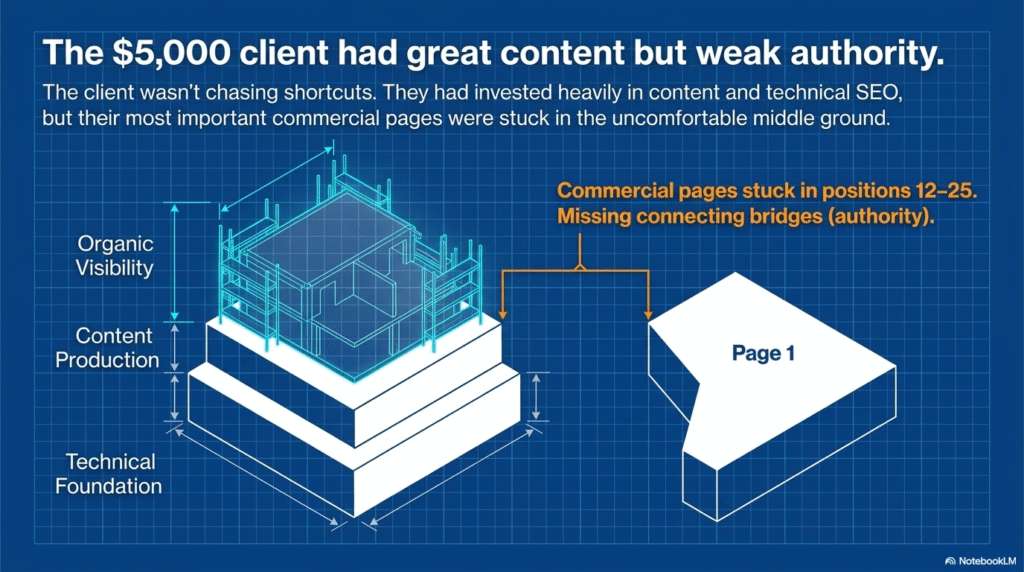
Certain blog posts held their own for longer-tail searches. The pages that actually generated revenue were a different story. Service pages, commercial landing pages, most of them were sitting somewhere between positions 12 and 25. 

Near enough to the first page to feel like a small push would get them there. Far enough away that almost no one was finding them organically.

The reason wasn’t hard to identify once we looked at the competitive landscape. The sites outranking them weren’t doing it with sharper content. 

They had simply accumulated more trust, links from relevant publications, niche sites, and industry resources that had been building over time.

Our client’s backlink profile had a different shape. Links existed, but there wasn’t much logic behind how they’d been built. Some pointed at pages that were already performing reasonably well. Others came from domains with no real connection to the client’s industry. 

The result was a profile that looked active on the surface but wasn’t doing much structural work, something we often see with businesses that rely on a generic link building SEO service rather than a tailored strategy. 

The gap wasn’t volume. It was intent.

A Website That Had Great Content but Weak Authority

What made this project straightforward in one respect was that we didn’t need to fix anything before starting. The content team had already put in the work, useful articles, thorough service pages, topics their audience actually searched for. From a content standpoint, the site was genuinely ready to compete.

The problem was that search engines didn’t have enough external signals to prefer it over more established competitors.
great content but week authority

When two sites offer content of similar quality, Google has to lean on something else to break the tie. Backlinks are still part of how it makes that call. 

Without enough credible, relevant sites pointing to the client’s key pages, climbing for competitive terms wasn’t going to happen through publishing alone. More content would have just meant more pages sitting in the same uncomfortable middle ground.

Why They Decided to Outsource Link Building 

They had tried doing it themselves first. Outreach went out, guest post pitches were sent, a few direct conversations with site owners happened. It wasn’t a complete failure, some things came through, but the pace made it unsustainable.

Relationship-based link building isn’t something you can rush. Identifying the right sites takes time. Getting responses takes longer. Then there’s the content to write, the follow-ups to send, the back-and-forth over placement details. The hours added up faster than their team could absorb them without pulling focus from everything else.

That left a fairly simple decision: keep grinding through a process that was eating resources and moving slowly, or hand it to people who do this specifically.

They went with the second option. The budget was $5,000, and the objective was uncomplicated, build authority where it would actually make a difference, and do it in a way that held up over time rather than producing a short burst of movement that faded, they wanted to avoid cycling through different providers offering affordable SEO link building services without a clear strategy behind the work. 

Where the First Dollars Went (And the Early Mistakes)

The client didn’t throw money at the problem blindly. They approached it the way most reasonable businesses do, researched providers, compared pricing, read through reviews, and made what looked like informed decisions at every step.
Where the First Dollars Went

Early reports gave them reason to feel good about it. New backlinks were showing up, domain authority numbers looked healthy, and things appeared to be moving in the right direction.

Then the question started surfacing in every conversation:

Why weren’t the rankings actually changing?

Once we got into the details of where the budget had gone, the answer became harder to ignore.

Choosing SEO Link Building Service Providers

They’d worked with several providers across the campaign, some focused on guest posting services, others running outreach campaigns, a few offering fixed packages with guaranteed placements. None of those approaches are wrong by nature. The issue was that no one was connecting the dots between them.

Each provider was doing their own thing. Without a shared strategy, backlinks were getting acquired based on availability rather than purpose. The links existed. They just weren’t working toward anything in particular.

The Budget Breakdown

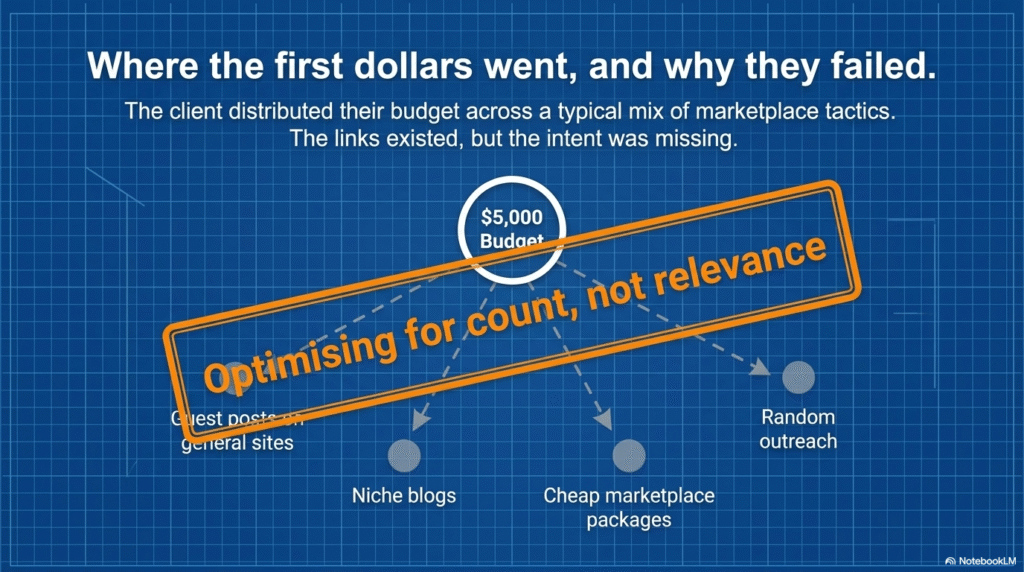
Spend ended up distributed across a fairly typical mix of tactics:

  • Guest posts on general-interest websites
  • A handful of niche blog placements
  • Outreach-based link acquisition
  • Lower-cost packages from link marketplaces

Looked at individually, none of these line items seem unreasonable. Looked at together, they tell a different story. The budget had been spread thin across average opportunities when it should have been concentrated on the placements most capable of actually shifting rankings.

What Wasn’t Working

Three things stood out once we went through everything properly.

  • The campaign had been optimizing for link count rather than link relevance. 
  • A lot of the placements came from sites with acceptable authority scores but no meaningful connection to the client’s industry. 
  • And the pages that needed support most, the commercial pages responsible for driving leads, had been largely overlooked. Authority was landing on pages that didn’t need it while the ones that did stayed exposed.

None of this was permanent damage. But it explained clearly why the return hadn’t materialized.

The one thing working in their favor was that the budget wasn’t gone yet. 

With a more strategic approach to link building and SEO services, there was still plenty of opportunity to turn the campaign around. 

Need a Link Building Strategy That Actually Supports Rankings?

Buying more backlinks isn't always the answer. The right strategy starts with understanding which pages deserve authority, which websites are worth earning links from, and how every placement fits into your long-term SEO goals.

How We Changed the Strategy

Understanding where the money had gone was only half the work. What surprised the client wasn’t our analysis , it was our first recommendation.

We told them to stop buying backlinks.

Not permanently. But until there was a clear reason behind every placement, spending more wasn’t going to fix what the previous spend had gotten wrong. 

That’s a mistake we often see with businesses cycling through different SEO link building services without an overarching strategy 

So before anything else moved forward, we went back to basics , audited the existing profile, mapped out which pages had realistic ranking potential, and figured out where the remaining budget would actually do something useful.

Quality Over Quantity

The most significant shift was pulling focus away from volume entirely.

By that point, the client had already seen firsthand that accumulating links doesn’t automatically translate into rankings. So instead of chasing numbers, we got selective. 

Every placement had to come from a site with genuine relevance to their industry , not just a strong domain authority score, but a real editorial connection to the niche. 

That’s the difference between buying backlinks and investing in a strategic SEO link building service.

SEO link building service

We also raised the bar on content quality. A backlink that exists purely for SEO purposes tends to look like one. 

The placements we went after had to make sense for the publication, serve the reader, and sit naturally within the surrounding content. 

Prioritizing the Right Pages

Deciding where links should point turned out to be just as important as deciding where they came from.

Rather than distributing authority across the site broadly, we ran keyword analysis to find the URLs that were already knocking on the door of page one , pages sitting in that frustrating range where a meaningful push could actually get them somewhere. Those became the primary targets.

Commercial landing pages led the priority list. A small set of supporting resources came next, chosen specifically because they reinforced the internal linking structure around those core pages.

The result was a much tighter campaign. Every link had a destination. Every destination had a reason.

Building Links That Actually Made Sense

The biggest change was in how we evaluated opportunities before saying yes to them.

Domain authority stopped being the first question we asked. Instead, the filter looked more like this:

  • Does this site have a genuine connection to the client’s industry?
  • Is the content it publishes original and worth reading?
  • Would this placement look reasonable to someone who had never heard of SEO?
  • Is this a site worth being associated with on its own merits?

That set of questions ruled out a lot of options , and that was exactly the point.

By the end of the campaign, the total link count was lower than what the client had originally anticipated. But what they had was a profile that made sense, with placements that were relevant, credible, and far better positioned to compound in value over time. That’s exactly what businesses should expect from professional link building and SEO services, rather than simply looking for the most affordable SEO link building services available. 

That’s when the shape of the campaign really changed. The metric we were working toward stopped being links acquired and became something harder to game: authority actually earned.

What Happened After 90 Days?

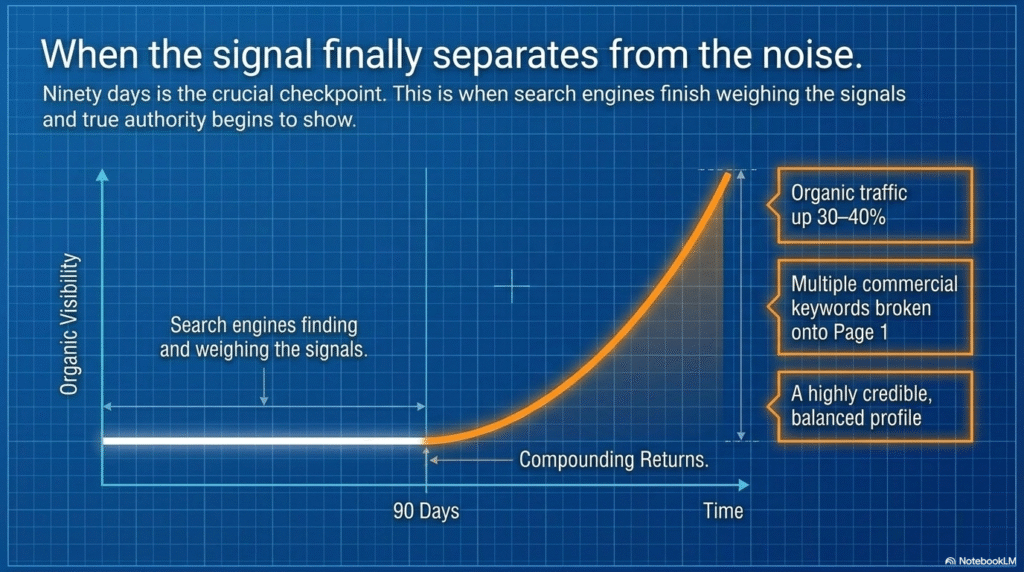
From the start, we were upfront about one thing: even the best SEO link building services don’t produce results the moment links go live. Search engines need time to find them, weigh them, and factor them into how a site gets evaluated. Expecting visible movement in the first few weeks sets up the wrong benchmark entirely.

So ninety days was always the first real checkpoint, not because the campaign would be finished, but because that’s roughly when the signal starts separating from the noise.
seo link building services

Several of the priority keywords had reached the first page. Others had moved meaningfully closer without quite getting there yet. Organic traffic was climbing steadily, and the pages that had received strategic link support were consistently outperforming the ones that hadn’t been part of the campaign.

Against where the site had started, the movement looked like this:

  • Organic traffic up roughly 30–40%
  • Multiple commercial keywords breaking onto page one
  • Broader visibility across related search terms
  • A backlink profile that was more balanced and credible than before
  • Stronger authority on the landing pages that drove most of the business value

But the result that mattered most wasn’t something a dashboard could capture cleanly.
seo tools for digital agencies

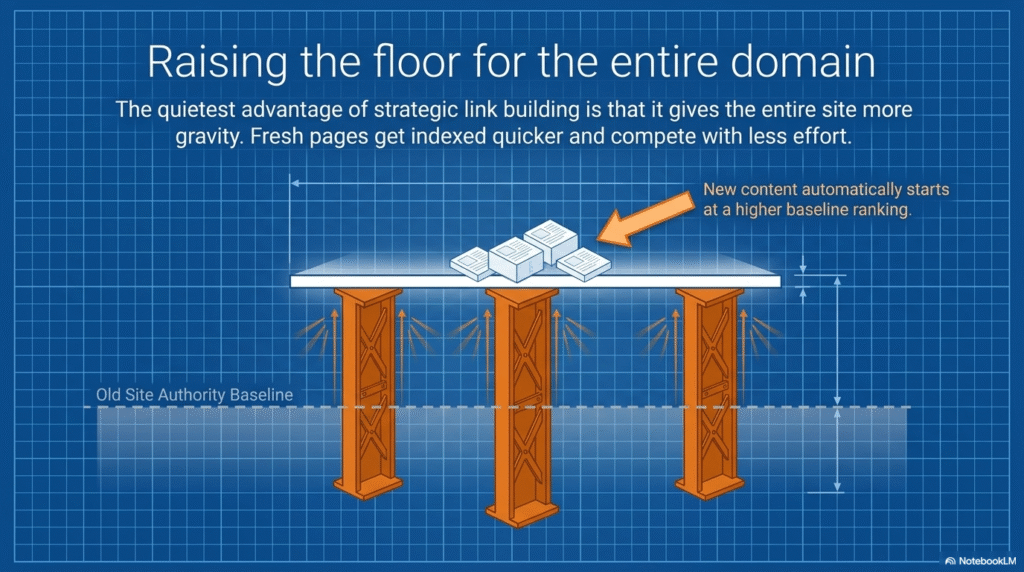
New content started performing faster.

With more domain authority behind the site, fresh pages were getting indexed quicker, picking up visibility sooner, and competing with less effort than they’d needed before. That’s one of the quieter advantages of building links properly, the benefit doesn’t stay contained to the pages you targeted. It raises the floor for everything else the site publishes.

The campaign also confirmed something we come back to often with clients: link building doesn’t work well as a standalone exercise. The gains here came partly from the links themselves, but also from the fact that they were landing on well-structured pages with content worth ranking. Each element reinforced the others.

Looking back, the traffic increase and the ranking improvements were meaningful. But the more durable win was that the client walked away with something to build on, a backlink profile with integrity, a clearer strategy, and a site that was genuinely better positioned than it had been when we started.

That tends to outlast any individual campaign result.

Want Backlinks That Keep Delivering Long After They're Published?

The best backlinks don't just bump rankings for a month—they build the kind of authority that compounds over time. A well-placed link today can still be generating organic growth a year from now.

Which Backlinks Actually Delivered ROI?

Not every link pulled equal weight, and that gap turned out to be one of the more instructive parts of the whole campaign.

The placements that consistently moved the needle shared a recognizable pattern. They came from sites with a genuine connection to the client’s niche. They were published on blogs with real editorial standards, places that actually cared what went on their pages. And they pointed to URLs that already had the underlying potential to rank; they just needed something behind them.

The links that didn’t perform were just as predictable in hindsight. Generic guest posts on broad-topic sites, low-cost packages, placements from domains with no relevance to the industry, these added to the count without adding to the campaign. Rankings didn’t respond to them. Traffic didn’t either.

The lesson isn’t complicated: a small number of well-chosen backlinks will almost always do more than a large number of forgettable ones. Always invest in a professional link building SEO service, the quality of the placements will always matter more than the quantity. 

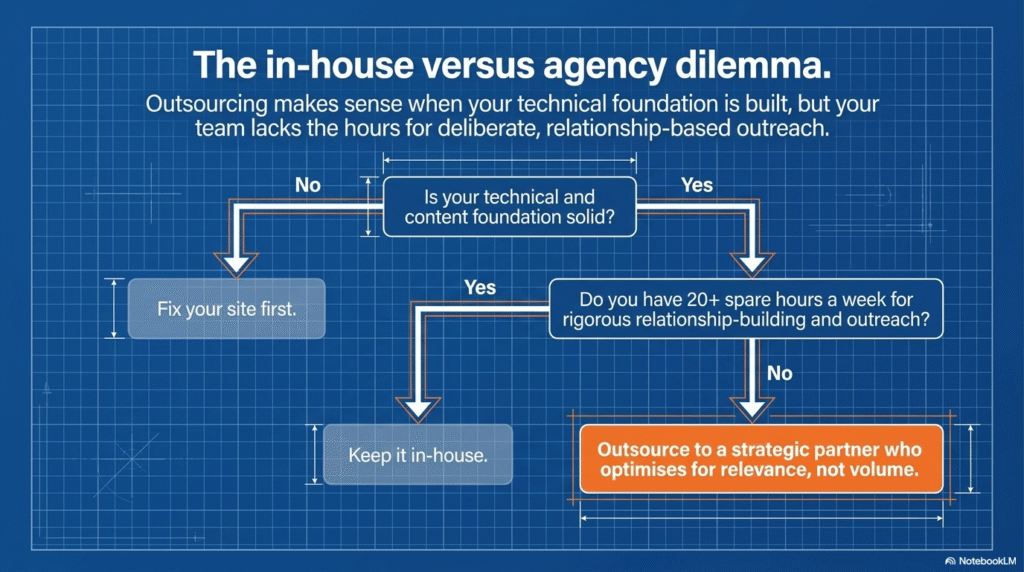
Should You Outsource SEO Link Building Services?

Outsourcing backlinks building starts making sense when the content foundation is already there but the authority to compete for meaningful keywords isn’t. 

Building links properly in-house requires time, consistent outreach, and relationships that take months to develop, most marketing teams don’t have spare capacity for that, and pulling focus from other priorities usually costs more than it saves.

The more important question isn’t whether to outsource. It’s who you hand it to.
in house seo link building agency

What separated the work we did on this campaign wasn’t link volume. It was the process that determined which links were worth pursuing in the first place, keyword analysis before outreach, deliberate page prioritization, and a genuine filter for niche relevance rather than just domain metrics. 

No fixed packages, no chasing numbers for their own sake. Just a clear line between what would build lasting authority and what would only look good in a report.

If you’re evaluating link building and SEO services, the questions worth asking are straightforward: 

  • How does the strategy connect to your actual business goals? 
  • How are individual placements chosen? 
  • Does quality have a real ceiling, or is volume still the primary metric? 

The answers to those questions tend to predict fairly accurately whether the investment holds up over time.

Conclusion

Was the $5,000 worth it?

It was, but not for the reason most people would assume.

It wasn’t the volume of links acquired that made the difference. What turned the campaign around was a shift in thinking: away from link building as a numbers exercise and toward link building as a deliberate, long-term component of SEO.

The results weren’t overnight. Rankings didn’t double in a week, and traffic didn’t spike dramatically in the first month. What happened instead was steadier and more useful, stronger authority on the pages that mattered, better visibility for competitive keywords, and a backlink profile that was actually built to hold up rather than just look good at the end of a reporting period.

The lesson for anyone weighing a similar investment is simple enough. Don’t open the conversation by asking how many backlinks you’ll get. Ask whether they’ll be relevant. Ask whether the strategy connects to real business goals. Ask whether the team you’re working with is optimizing for your long-term growth or just filling a package quota.

A well-directed budget can accomplish more than a much larger one spent without intention. The inverse is also true, the wrong approach can quietly consume serious money without leaving anything behind worth keeping.

At Backlinks Matters, every campaign starts with that distinction in mind. The research comes first, then the targeting, then the outreach, in that order, every time. Because the point was never to build more links than the competition.

It was to build the kind of authority that keeps working long after the campaign is finished.
15 Best Cloud Storage Alternatives for Secure File Sharing in 2026

Whether you are working from a home office, own a startup or are part of a remote team, the need is the same. You need a reliable way to store and share files without worrying about who else can get their hands on them. 

OneDrive, iCloud, Dropbox or Google Drive have been the key players in the Cloud Storage space for many years. In 2026, there are many people asking the right questions like: 

What are the Cloud Storage Alternatives?

Who owns my data? 

Can I trust the platform with sensitive documents?

Are there better cloud storage alternatives that give better control?

The answer is a simple Yes! There are plenty of them in the market today and it may be confusing as to which will be the right one for you. This guide covers 15 Best Cloud Storage Alternatives that are designed with privacy, security and ease of use.

Why Look for Cloud Storage Alternatives?

The biggest names in cloud storage are easy to use, but they come with tradeoffs. Many scan your files to serve ads or improve their own products. Some have dealt with data breaches. Others make it hard to leave once you’re in.

If you share medical records, financial documents, legal files, or sensitive business data, you need more than a household name. The platform should be built with protection as its core. Here are 15 cloud storage alternatives to try. 

1. Proton Drive

Best for: People who take privacy seriously

Your files are locked on your device before they ever reach Proton’s servers. Even Proton cannot open them. The service is based in Switzerland, which has some of the strongest data protection laws in the world.

There is a free plan with 1 GB of storage. Paid plans are fairly priced. The app works well on your desktop as well as on your mobile with an easy-to-navigate interface. All the files and filenames are encrypted and independently audited by Securitum. They are also ISO 27001 and SOC 2 Type II certified. 

2. Tresorit

Best for: Businesses handling sensitive files every day

Not even Tresorit can open your files without your permission. That is the foundation on which the whole service is built. It is the most widely used cloud storage by law firms, hospitals and financial teams across the globe.

You get secure sharing links, the ability to wipe files from lost devices and a full activity log. Plans work for both solo users and larger teams. Tresorit offers the best-in-class encryption and is audited by ETH Zurich, Ernst & Young and Computest. It is one of the top performers in independent adversarial testing.

3. Sync.com

Best for: Simple, private storage and one of the best cloud storage alternatives for small businesses

Sync.com is a Canadian company with servers inside Canada. Every file is encrypted before it leaves your device, so your data stays yours. The free plan gives you 5 GB of storage to start.

Shared links can be password-protected and set to expire on a date you choose. It works well for personal use and small business file sharing alike. SOC 2 Type II and HIPAA BAA are available. Some metadata weaknesses were flagged in the ETH Zurich audit.

Need a Proven Cyber Security SEO Strategy?

Explore our Cyber Security SEO Guide to learn how cybersecurity businesses can improve search visibility, attract qualified leads, and build long-term authority online.

4. Internxt

Best for: Businesses that are looking for open-source and decentralized storage

Internxt splits your business files into small encrypted chunks and spreads them across multiple servers. No single server holds your complete file, which makes it much harder for anyone to get to your data.

The code is open-source, so security researchers can check how it works. It has public audits. You can either go for a free tier plan or a paid one. Paid plans are fairly priced. If transparency is of utmost importance to you, then Internxt is the best fit. 

5. pCloud

Best for: Lifetime storage and large media files; Ideal cloud storage services for photographers

pCloud allows you to pay once and own the storage for life. Choose this option if you do not want to deal with monthly bills. It is a rare option in this market and a great deal if you are looking to stick to the same service long-term. 

It handles photos, videos and large files well. Zero-knowledge is only available with the paid Crypto folder add-on which locks your files on your device before they upload. The rest of your storage is AES-256, but keys are held by pCloud. It runs on Windows, macOS, iOS and Android. 

6. MEGA

Best for: Large free storage and sending big files fast

MEGA gives you 20 GB of free storage right away, more than almost any other service at this price point. All files are encrypted end-to-end and MEGA has no way to read them. It has a public audit. 

It can be a solid choice if you need to move large files in quick time. There is also a built-in chat feature. Paid plans help scale up well for teams that need more storage. 

Note: Ownership history has raised trust concerns for some users.

7. Box

Best for: Enterprise teams in regulated industries

Box is a known name in business file sharing for good reason. It meets HIPAA, GDPR and SOC 2 standards, which makes it a go-to for healthcare, finance and legal teams who cannot afford to get compliance wrong. It connects with Microsoft Office, Google Workspace, Slack and Salesforce.

Box offers managed encryption and it holds the keys. Enterprise customers can bring their own keys (BYOK), but it is not zero-knowledge by default. Pricing sits on the higher end, but the feature set backs it up for larger organizations.

8. Nextcloud

Best for: Full control over where your data lives

Nextcloud lets you run your own cloud storage on your own server. Your data never touches a third-party machine. That is about as much control as you can get. 

It is free to download. You will need a server or a hosting plan to run it, which takes some setup. When self-hosted, you control everything. Third-party-hosted Nextcloud depends on the host’s setup. Calendars, contacts and video calls are built in.

9. Backblaze B2

Best for: Developers and teams storing large amounts of data without spending much

Backblaze B2 stores data at a fraction of what Amazon S3 or Google Cloud Storage charges. It is built for developers, small businesses and content creators who need a lot of storage without a big monthly bill. It offers AES-128 server-side encryption. Backblaze holds the keys. SOC 2 Type II certified but not zero-knowledge.

It is not a drag-and-drop file-sharing tool like Google Drive. It works best with apps like Cyberduck or Rclone. For raw storage at low cost, it is one of the best deals in 2026.

10. Egnyte

Best for: Teams that split work between office servers and the cloud

Egnyte ties your local file servers to cloud storage in one place. It is a practical option for companies that need cloud access but still continue to run files on-site for speed and compliance. Egnyte is not zero-knowledge by default, but supports customer-managed encryption keys via AWS KMS or Azure Key Vault. It is SOC 2, ISO 27001, HIPAA certified.

A lot of construction, media and life sciences businesses use this. You get fine-grained permissions, audit trails and built-in ransomware protection. It is a business tool with business-level pricing.

11. Icedrive

Best for: Clean design and proper privacy for those on a budget

Icedrive is popular for its simple interface and strong security. It uses Twofish zero-knowledge encryption

The free plan gives you 10 GB. Paid plans cost less than most rivals. The desktop app works like a virtual drive you can drag files in and out of. A good pick if you want something simple without compromising on privacy.

Note: ETH Zurich 2024 audit flagged Icedrive for metadata manipulation and file injection risks. Use with caution.

12. Filen and Cryptee

Best for: Users who want end-to-end encrypted storage with zero compromise

Filen is an open-source zero-knowledge encryption cloud storage service based in Germany. Every file, folder name and note is encrypted on your device before it goes anywhere near their servers. Filen cannot read your data. There is a generous free plan and the paid tiers are priced lower than most comparable services. The desktop and mobile apps are clean and fast.

Cryptee takes a slightly different angle. It is built primarily for zero-knowledge encrypted photo storage and document editing. You can write, edit and store documents inside Cryptee without anything leaving your device unencrypted. It is a good option for journalists, researchers and anyone who keeps sensitive notes or personal media that should not be exposed.

Together, these two cover different ends of the privacy storage market: Filen for general file storage and Cryptee for documents and photos.

13. Citrix ShareFile

Best for: Professional services firms that share sensitive client files on a regular basis

Citrix ShareFile is the one for your industry if file security is non-negotiable for you. Mostly attorneys, accountants and healthcare providers use this to send and receive sensitive documents with clients in a safe way. Citrix ShareFile is not zero-knowledge encryption. It has strong compliance (HIPAA, FINRA, SOC 2, SEC), but ShareFile can access your data. It is primarily built for client portals and not for raw encryption.

You can get customizable client portals along with e-signature support and fine-grained access permissions. Pricing reflects the business focus, but for regulated industries, the feature set earns its cost. 

14. Filebase

Best for: Developers who are looking for decentralized storage with a familiar interface

Filebase stores all your data across a decentralized network of providers. You can interact with it through a standard S3-compatible interface. It automatically encrypts all data at rest using AES-256 bit encryption by default. It is not a true zero-knowledge provider. If you require true zero-knowledge, you must encrypt your data before uploading it. 

The best thing about Filebase is that you get the reliability of distributed storage without having to learn a new set of tools. It is priced competitively and works well for static sites, backups and developer projects.

15. SpiderOak One Backup

Best for: Users who need the highest level of file privacy

SpiderOak operates on a strict no-knowledge policy. Every file is encrypted on your own device before it is uploaded. No one at SpiderOak can read your data, not even if you ask them to. 

It is more of a backup tool than a live file-sharing platform, but it does support shared folders and version history. It is a trusted option for people in legal, medical and government work where file confidentiality is not optional.

Note: There is no recovery if you lose your password.

Read More About:- Top Cybersecurity SEO Agencies Guide

Final Thoughts

The best cloud storage alternative is the one that fits how you actually work. Not every business needs military-grade encryption. But every person sharing sensitive files deserves to know that their data is protected.

In 2026, there are a lot of cloud storage options. Take security seriously. Pick a platform that respects your privacy. And do not stay with a service just because it is familiar; better cloud storage alternatives exist and many of them are easier to use than you might think. 

FAQs

What is the best alternative to iCloud storage?

From our vetted-out list, Proton Drive is the one for you. It is fully-encrypted, works on all devices and it cannot access your files. MEGA and Sunc can be your next best alternatives. 

Where can I get 1TB free cloud storage?

Honestly, no legitimate service offers 1TB free in 2026. Realistically, MEGA gives 20 GB, Internxt and Icedrive give 10 GB each. For 1TB without monthly bills, pCloud’s one-time lifetime plan is the closest honest answer.

Is Proton Drive really secure?

Yes, Proton Drive is very secure. Here is why: all your files are encrypted on your device before upload, even Proton cannot read it. It is independently audited by Securitum and is also ISO 27001 and SOC 2 Type II certified. Its geographical presence in Switzerland gives another layer of legal protection. 

Which is the cheapest and best cloud storage?

From the list shared here, Sync.com offers 2TB storage for as less as $8 a month. It also offers zero-knowledge encryption and is the best value. If you prefer a one-time payment option, pCloud can save money in the long-term. Backblaze B2 at $6 per TB a month can be your choice for bulk storage

What is the best free cloud storage option?

If you want to choose the best free cloud storage from the options given above, MEGA offers 20 GB free along with end-to-end encryption. Proton Drive, Internxt and Icedrive also offer free tiers along with strong privacy.


Outsource Backlink Building or Boost Ad Budgets: Finding the Right Marketing Mix

Outsource backlink building and paid advertising; both are beneficial for the business. If one helps generate instant leads, then the other helps build long-term organic growth. Finding the right balance between the two without exceeding the budget is the key to achieving revenue goals while maintaining brand visibility.

Introduction 

Backlinks and paid advertising both seem fascinating for the business. The dilemma begins when you find yourself constantly second-guessing whether to invest in outsourced backlink building or digital advertising to grow your business. 

Both digital marketing strategies have their own pros and cons. You just need to determine when to prioritize outreach vs when to prioritize paid advertising. At the end of the post, you’ll know exactly when to use these strategies for your business. 

Outsource Backlink Building vs. Paid Ads: Understanding the Key Difference

Outsource backlink building and paid advertising are the digital marketing strategies B2B businesses use to drive traffic and achieve desired ROI. Let’s evaluate the key differences to better understand them. 

What is Outsource Backlink Building? 

Outsource backlink building in digital marketing is the process of delegating backlink acquisition to expert link-building service providers. Businesses hire freelancers and agencies that specialize in acquiring inbound links to increase organic visibility and traffic. 

Link-building agencies have industrial connections and expertise that help you secure relevant link placements and improve your website’s authority and organic traffic. It streamlines and accelerates the entire outreach process.

What Is Paid Advertising? 

Paid advertising is the systematic process of buying ad placements on search engines, social media platforms, community forums, and publishers’ websites through reliable advertising networks to reach the target audience at the peak moments and maximize conversions.

Outsourcing Backlink Building and Paid Ads: The Pros and Cons You Can’t Miss… 

Delegating backlink acquisition and running online ads offers numerous benefits for the business. Some of them are listed below:

Outsourcing Backlink Building: Pros and Cons 

Pros  Cons 
You’ve an expert handling the entire link-building process.  It takes longer to show relevant results. 
You can constantly acquire high-authority backlinks.  If the outsource backlink building agency lacks expertise in your niche, you may struggle to acquire premium backlinks.
You can invest your time and efforts in other marketing strategies.  Outbound links may come from low DA sites that add little to no value to your SEO.
You don’t have to train your employees on the best SEO practices.   If the link-building service provider uses black-hat SEO tactics for outreach, you may incur penalties from search engines.
You don’t have to spend hours in the learning or hiring process. Link building through outsourcing requires months of consistent dedication, making it a more expensive digital marketing strategy.

Paid Advertising: Pros and cons 

Pros  Cons 
You can drive traffic to your website the moment you launch your campaigns.  Once you stop investing your budget, the flow of leads and conversions will automatically come to a halt.
You can perform precise targeting to reach the target audience.  In competitive markets like iGaming, finance, and healthcare, and in Tier-1 segments, the cost per click (CPC) tends to be high, which increases the overall cost per acquisition (CPA).
You can choose the actions you want to pay for, such as impressions, clicks, or conversions. Ad fatigue among users increases if frequency capping is not set accurately. 
You can easily find a cost-effective online advertising network based on your needs.  Consumers are increasingly skeptical of paid ads, often viewing them as biased or purely profit-driven. 

When to Prioritize Paid Ads vs. Outsourcing Backlink Building for Maximum Marketing Impact

Evaluate your business objectives, budget, target audience, market competition, and current needs to find the sweet spot and allocate your digital marketing budget precisely. You can prioritize paid ads and outsourced backlink acquisition when you want the following: 

Prioritize Paid Ads When: 

  • You need immediate conversions. 
  • You have a specific audience to target.
  • Your SEO presence is lacking. 
  • You have a dedicated budget for creative testing and optimization. 
  • Your industry keywords are harder to rank with organic SEO. 
  • You have a new business, product, or offer to promote. 
  • You need to run retargeting ads to reduce abandonment rates. 
  • You have dedicated landing pages with ad assets. 
  • You want to capture the audience’s attention with time-sensitive offers for seasonal events.  
  • You’re ready to invest in a self-serve advertising platform. 

Prioritize Outsourcing Backlink Building When: 

  • Your main objective is to build long-term sustainability and have sufficient budget for it. 
  • You want to improve search rankings and domain authority.
  • You have a lot of valuable content for link exchange. 
  • You can articulate, vet, and stay updated with the emerging SEO trends to ensure you’re paying for the right link placements. 
  • You don’t want immediate conversions. 
  • Your selected marketing niche is highly competitive and has high CPCs. 
  • Your SEO has broken down, and you need an expert who can perform white-label SEO techniques. 

Need a Proven Cyber Security SEO Strategy?

Explore our Cyber Security SEO Guide to learn how cybersecurity businesses can improve search visibility, attract qualified leads, and build long-term authority online.

-> Paid advertising is ideal for those targeting quick conversions and short-term traffic goals. You can appear across platforms and moments where your audience spends most of their time to strengthen brand recall, build trust, and generate revenue. 

-> Using link building is like quietly working behind the scenes to achieve long-term stability. Even if you stop allocating budget to the strategy, the earned link placements will continue to drive traffic to your website, helping you attract more potential leads and maintain your domain authority.  

Tip. Focus on strong internal linking, not just outbound links; it will help you engage your acquired traffic for longer and build trust.  Use a performance-driven PPC advertising network that allows daily budget control, scheduling, and postback tracking, such as 7SearchPPC

Find Your Right Marketing Balance! 

Allocate your budget based on your objectives. If you need instant leads and conversions, allocate more budget to paid advertising; otherwise, if you want to improve your organic ranking, traffic, and DA, allocate budget to backlinks. To determine whether the distributed digital marketing budget aligns with your business objectives, you can measure cost-per-action (CPA) and organic traffic growth. 

If your CPA is increasing and organic traffic remains stagnant, it indicates a need to reevaluate and adjust your marketing budget.  

Both strategies complement each other when budgeted thoughtfully. But if you randomly assign your marketing budget to any strategy, you might struggle to achieve the desired outcomes for your business. If needed, you can use both strategies simultaneously to increase conversions and build long-term domain authority.

Frequently Asked Questions (FAQs)

1. What are the effective ways to build outbound backlinks for the business? 

Create a list of websites with moderate to high domain authority and zero spam scores to approach for guest posts, mentions, and direct backlinks, or partner with a reliable outsource backlink building agency.

2. What are the digital marketing strategies that pay off for small businesses? 

Display advertising, SEO (Search Engine Optimization), content marketing, email marketing, social media marketing, white-label link building, and referral marketing are the digital marketing strategies that pay off for small businesses.

3. Should B2B businesses leverage outsource backlink building and paid ads altogether? 

Yes, using both digital marketing strategies is a smart move for B2B businesses, as it helps balance long-term and short-term revenue objectives.

4. What should I consider when choosing between outsourcing backlink building and paid advertising? 

Evaluate your business goals, target audience, budget, market competition, and expected revenue, and determine whether you have an immediate or long-term goal to fulfill.  

5. Should I stop spending ad budget if my SEO starts showing positive results? 

No, not completely. You can reduce your advertising budget during the off-season and gradually increase it for major events to quickly attract high-intent traffic and increase your ROI.

6. What to look for in an outsourced link-building service provider? 

Evaluate their market reputation, white-label SEO packages, pricing, and support availability when choosing your outsourced link-building service provider. 

Why Top Cybersecurity SEO Agencies Combine SEO and Paid Ads for B2B Growth

In high-ticket industries like cybersecurity or SaaS, B2B buyers go through multiple interactions before making a purchase. Paid ads deliver immediate visibility and capture buyers looking for a solution, while SEO builds long-term authority and engages buyers facing problems. This is why top cybersecurity SEO agencies focus on creating content that attracts prospects throughout the buyer journey and helps build trust before a purchase decision is made.

Neither strategy alone is sufficient; paid ads are costly and temporary, while SEO is slow. Combining both creates a powerful funnel that maximizes visibility, builds trust, and generates qualified leads throughout the buyer journey.

High-ticket B2B buyers across industries such as SaaS, cybersecurity, industrial equipment, and healthcare technology don’t make decisions quickly. Most of them spend time researching options, comparing dealers, and seeking proof before making a decision. 

Paid ads can get you in front of these buyers early, but visibility alone rarely builds the trust needed to close complex deals. SEO establishes authority and captures buyers throughout their research journey, but it takes time to deliver results.

Through this blog, you will understand the importance of utilizing both SEO and paid ads, and how combining both can drive success in high-ticket industries. 

The Role of Buyer Intent in Cyber Security SEO

Before diving too deep, it’s important to understand the differences in buyer psychology that necessitate the use of both paid and SEO strategies. Here, we have taken cybersecurity services as an example, which is firmly part of the high-ticket B2B industry. 

The Problem-Aware Buyer

In the digital marketing funnel, this type of buyer knows something is wrong or could go wrong, but hasn’t yet identified the solution they need. Business leaders may read about rising cyberattacks and think, How exposed are we? They’re not yet looking to purchase anything. They’re searching for understanding.

Queries from this buyer look like:

  • How do cyberattacks target financial institutions? 
  • Signs your organization has a security gap

This buyer is not ready to be sold to. They need education, context, and expertise. Here, running a paid ad is unnecessary. What converts them at this stage is powerful content that meets their needs, which is exactly what top cybersecurity SEO agencies are built to deliver. 

The Solution-Aware Buyer

This buyer has done their research. They know the problem and the solution they need, and now they’re actively evaluating service providers. A person who has completed an internal risk audit is searching very differently, for example: 

  • Top cybersecurity companies to invest in
  • Best security compliance software 

This buyer has the intent to purchase. They’re moving fast, and they’re ready to engage. Waiting for organic content to rank for these high-intent terms is too slow. This is where a B2B advertising platform delivers immediate results, keeping your cybersecurity brand right in front of buyers who are actively ready for solutions.

What we gain from this: Top cybersecurity SEO agencies capture buyers who are still forming their understanding. Paid ads capture buyers who have already formed it. 

Need a Proven Cyber Security SEO Strategy?

Explore our Cyber Security SEO Guide to learn how cybersecurity businesses can improve search visibility, attract qualified leads, and build long-term authority online.

Why Paid Ads Alone Are Not Enough 

Paid advertising is effective in reaching the targeted audience and maximizing revenue, making it valuable for reaching high-ticket B2B buyers early in their journey. 

However, relying exclusively on paid ads creates significant limitations that can undermine long-term growth. Here are some of the reasons that help you know why paid ads alone are not sufficient to convert B2B buyers.

1. Most Often it’s Costly

High-ticket industries are expensive to advertise in. If you have ever used paid ads, you know this very well. Keywords in sectors such as cybersecurity, technology, and SaaS are costly because they have high cost-per-click (CPC) rates. 

Even with a cost-effective advertising network, the competitiveness of these niches means your budget is consumed faster than in other niches. 

2. Trust Barriers 

B2B buying is never an impulse-driven process; a company CFO doesn’t click an ad and immediately sign a million-dollar contract. The B2B buying cycle is lengthy and time-consuming, making instant conversions highly unlikely. 

That’s why, in high-ticket industries, advertising plays a crucial role beyond direct conversions. Ads help buyers recognize your brand, trust your business, and feel more confident about buying from you when they’re ready. 

3. Paid Ads Don’t Build Long-Term Assets

The moment you stop spending on advertisements, your visibility and traffic will drop instantly. Unlike content marketing or SEO, which continue to attract leads over time, paid advertising only delivers results while your campaigns are running.

This means growth often depends on a steady advertising budget, making it harder to maintain momentum without ongoing investment.

Why SEO Alone Can Be Too Slow for Revenue Growth

SEO is one of the most effective ways to build long-term visibility, authority, and trust in high-ticket B2B markets. However, relying only on organic traffic can create challenges for businesses that need consistent lead generation and faster revenue growth.

1. Takes Time to Rank for Competitive Keywords

Unlike paid advertising, SEO does not deliver immediate results; it takes time. When investing in SEO, you will never get results instantly for your business. Targeting a competitive keyword like “best cybersecurity solutions for enterprise” could take 6 to 12 months. 

2. Competitive Industries Are Difficult to Rank In

Many high-ticket B2B industries are saturated with established brands that have invested heavily in SEO for years. Competing against these established brands requires effort, resources, and patience.

Even when content is well-optimized, breaking into top search positions can be challenging without strong domain authority.

3. Local Businesses Perform Better on Searches 

Before you go for SEO, keep in mind that whenever a business looks to purchase a product or service, they will always get results near their location. When businesses search for products or services, search engines often display local providers first, especially for location-based queries.

While local SEO can generate highly qualified leads, businesses operating in competitive markets may find it difficult to achieve immediate visibility through organic search alone.

The Strategic Advantage of Combining Paid Ads and SEO

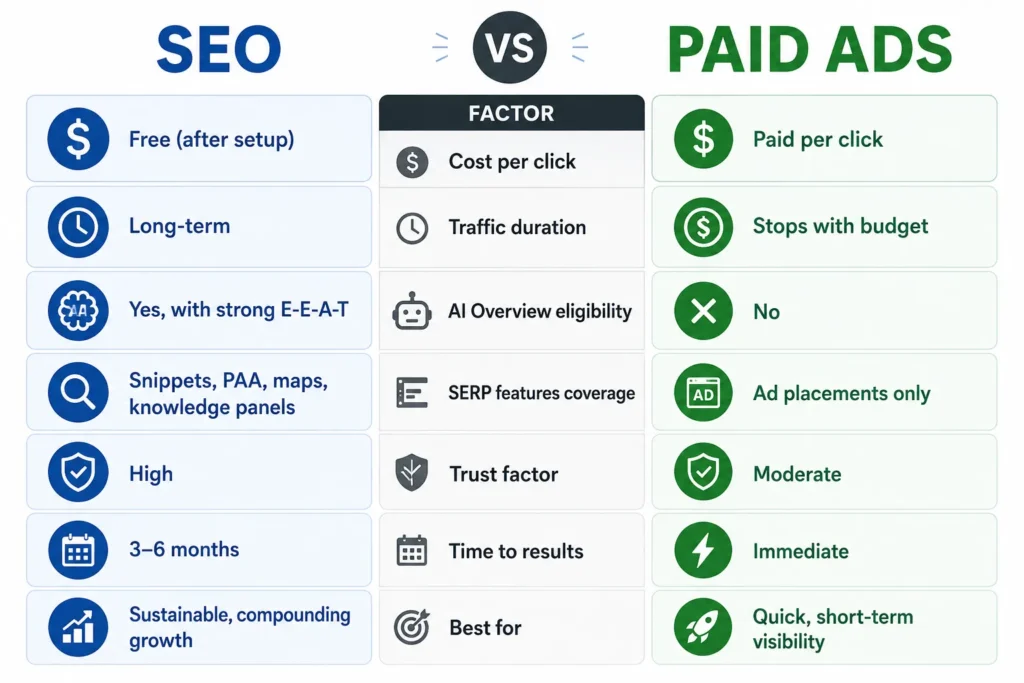
seo vs paid ads

The best thing high-ticket industries can do to convert B2B buyers is to use both paid ads and SEO, as this combination is effective for long-term success. Here are some of the advantages that both paid ads and SEO offer when used strategically. 

Increased Visibility Across Multiple Touchpoints

High-ticket B2B buyers rarely convert after a single interaction. They may click a paid ad, then visit the website, leave to conduct further research on another platform, and return weeks later via an organic search result. 

A high-quality traffic network ensures that the buyers landing on your pages through paid channels are genuinely relevant, making every touchpoint more valuable. By utilizing both paid advertising and organic methods, your brand remains visible throughout the research process. 

Increase Trust and Build Authority

Building credibility among buyers is a very crucial factor, as once done correctly, it will yield long-term success. Buyers are more likely to trust companies they repeatedly encounter across different channels. 

Paid ads help establish visibility instantly. At the same time, SEO strengthens your authority by providing valuable content that buyers can discover during their research process. When businesses see your company appearing in both paid search results and organic rankings, it reinforces your expertise and market presence. 

Generate Higher-Quality Leads

Combining both paid ads and SEO allows businesses to capture leads at different stages of the buyer’s journey. Paid ads can target those actively searching for a solution and engage them to take action, while SEO attracts people seeking information or educational content. 

Both approaches ensure your business reaches potential customers at the awareness, consideration, or decision stage. Always remember that when advertising, look for the perfect PPC advertising solution to drive high-value leads. You can select a PPC advertising network such as 7SearchPPC or Google Ads to achieve better results. 

Maximize Visibility, Generate Qualified Leads, and Drive Sustainable Growth

When combining paid ads and SEO, businesses can stay visible throughout the buyer’s journey, attract more leads, and achieve long-term growth. By integrating paid advertising with niche SEO, companies can create a powerful marketing ecosystem that consistently attracts, nurtures, and converts valuable B2B prospects.

Frequently Asked Questions (FAQs) 

Q1: Which is more effective, paid ads or SEO for promoting b2b business?

Ans: Both are effective in their own terms. Paid ads are best when you want instant results, but if you’re aiming for long-term success or cost effectiveness, then SEO is the perfect choice for that. 

Q2: Which digital advertising network is perfect for running paid ads for promoting cybersecurity? 

Ans: There are many platforms for running paid ads, and choosing the best one is essential. 7SearchPPC and Google Ads are excellent options for successful ad campaigns. 

Q3: Why is advertising so costly when it comes to high-ticket industries? 

Ans: Since these niches are already expensive and highly competitive, the overall CPA is higher. Bids for high-value keywords are typically higher in high-ticket industries than in other niches. 

Q4: How do top cybersecurity SEO agencies offer better lead generation?

Ans: When you choose the best cybersecurity SEO agencies, they help you with better lead generation through creating content tailored to different stages of the buyer journey. They optimize websites for relevant keywords, improve technical SEO, and build authority through industry-focused content.

Q5:Is it beneficial to use both SEO and paid ads for cybersecurity marketing?

Ans: Both SEO and paid ads can be used for cybersecurity marketing, as they are effective for your brand, whether you want immediate results or long-term success.