

Most people are convinced they understand the concept of how search engines work. You enter the search query, and you get search results. But in 2026, what is behind the pages you see looks really different from what it did a few years ago.
It’s being driven by artificial intelligence.
The results page you see today is not just a list of links. There are AI-generated summaries, direct answers, and cited sources coming over everything else.
But still, the businesses winning in search right now, and in the past, have not let go of their foundational search engine basics. Despite everything AI does, the underlying structure and methodology for how a search engine discovers and evaluates your content remains exactly the same.
This guide walks you through the internet search engine basics from scratch, what has changed actually now in 2026, and what impact it will have on your website.
What Are Search Engine Basics?
Source:– geeksforgeeks
Simply put, the function of a search engine is to enable people to discover information on the internet. You enter a query, and the search engine scans through trillions of websites to deliver the most appropriate results.
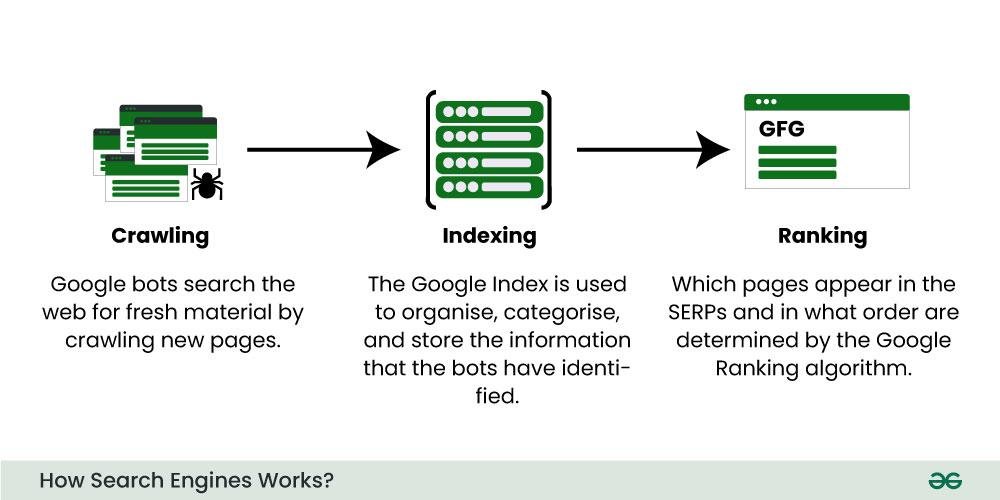
These three things are the basic functions of a search engine: crawl, index, and rank, and have been since time immemorial, including the AI-powered ones.
Crawling: This process begins when search engines discover any new content. Crawlers, also known as bots or spiders, are automatic pieces of software that travel around the internet by accessing link after link from one site to another.
Indexing: In this next phase, any content which is discovered while crawling will be compiled and stored in a huge database which can be rapidly searched and recalled.
Ranking: It’s the last step. The user types the query, the search engine retrieves relevant pages from its index, and orders them according to hundreds of signals – relevance, authority, page quality, and more.
The search engine basics should not be missed because, without them, any SEO effort that you undertake does not build upon solid grounds. You cannot optimise what you do not know.
Types of Search Engines in 2026
Not all search engines work the same way or serve the same purpose. In 2026, there are three main categories worth knowing.
Traditional Search Engines
These are probably the first search engines people think about. Even now, Google, Bing and Yahoo still process most of the search requests happening across the world. All three of these search engines thoroughly scan the web, compile very large indexes, and deliver ordered sets of results. Google still dominates, though Bing has started catching up due to its tight integration with various Microsoft AI-based software tools.
Classic search engine examples here include Google, Bing, Yahoo, Baidu, and DuckDuckGo.
Vertical or Niche-Specific Search Engines
These index content within a category, such as YouTube for videos, Amazon for products, LinkedIn for professional information, or Zillow for property listings. Each of these could be considered a search engine in its own.
Quite a lot of those belong to niche search engines. Here are 10 examples of search engine types to give you some perspective: YouTube, Amazon, Pinterest, Booking.com, LinkedIn, Etsy, Indeed, Yelp, Houzz, and Zillow. Working these requires a different set of SEO skills entirely.
AI-Powered Search Engines
Perplexity, Google AI Overviews, ChatGPT Search and Microsoft Copilot bring several pages together, stitch together the content and respond to your query right on the Search Engine Results Page (SERP).
The person doesn’t even have to navigate to your webpage, and you have answered the question in a “zero-click” scenario, as SEO professionals have named it. Your page can have great organic rankings, but since the answer was shown above the fold of your page, the user never visits the site to navigate your content.
How Do Search Engines Work
Here’s how search engines work in a step-by-step process for the clear sake of knowing what happens when someone types in a query.
Discovery: A crawler lands on a different URL because of a submission via a sitemap, or they clicked a link to another page. This is why sitemaps and internal linking matter.
Crawling: The bot crawls the page’s content, code, and links. It verifies the headings, text, imagery, and speed of the page. The basics of how search engines actually crawl your site are essential here; failing this initial phase with robots.txt blocking your site or internal dead links is what most people struggle with first.
Indexing: Provided the content is crawlable and adheres to quality criteria, the search engine will add it to its index. Some thin-content pages or pages with no defined subject, or duplicate textual content on some pages may never be indexed or given a poor rank.
Ranking: When someone searches, the engine compares your query against its index of the web and passes it through its algorithm to determine the result. What comes out is an ordered list or, with modern AI search engines, a compiled answer from numerous indexed pages.
Display: The results show up on the page. Usually, in traditional search, this is a ranked list. For AI search, it’s going to be a paragraph, and there are citations underneath it.
The next step depends on the previous one. If your site is not crawlable, then your site is not indexable. If your site is not indexable, then your site is not rankable. The degree of understanding search engine basics will show you what you should be looking at when things start going wrong.
Key Search Engine Ranking Factors in 2026
Although the same ranking factors were important five years ago and still are important today, there are some factors that have been introduced since 2026.
Content quality and depth are the leading contributors. This is because search engines have a preference for the page which properly answers your queries, rather than those full of keywords.
E-E-A-T (Experience, Expertise, Authoritativeness, Trustworthiness) is now at the core of how Google judges content. It counts regardless of the subject matter.
Backlinks remain incredibly powerful. Search engines perceive an authoritative link that is related to your content as evidence that you’ve produced content worth referring to. Getting a significant number of backlinks needs a strong backlink-building methodology.
Page experience metrics like site speed, mobile use, and the Core Web Vitals impact ranking. If your site is slow to load, it cannot compete.
Structured data is becoming increasingly prevalent because of the boom in AI search. If your content is properly structured, there will be a higher chance that the AI search engines can understand and reference your work in AI-driven responses.
Topic authority is a new and more essential concept. Websites that produce in-depth content are valued over those that publish single articles on obscure topics.
That’s when the Search engine basics come into play. These factors – content, authority, technical health and links – are far from trends. They are the non-negotiables.
Why AI-Built Websites Lack SEO Basics
Many businesses are relying heavily on AI in 2026 to create websites and push content quickly. But speed is not the same as structure.
Often, what AI tools leave behind is all the technical groundwork required by search engines. Pages go live without headings arranged hierarchically, missing or random internal links, non-specific meta-descriptions, and incomplete crawl paths.
This content could be perfectly readable for a human, but for the search engine bot, on the other hand, this page looks like a mess with zero signals of the core subject of the site, no proper structure and no sign of high authority on the page.
This is precisely the reason why learning search engine basics has become the absolute most crucial requirement in 2026. Even though AI can churn out all your website content much faster, it cannot substitute for clever and effective strategies necessary for developing a website that search engines will actually use to index and list your site above other search results.
SEO Challenges in 2026
This move towards AI-driven search also comes with challenges and issues that didn’t exist before.
The number one challenge is zero-click results. Google’s AI Overviews now provide answers to many searches even before a user ever scrolls to organic results. Many websites that depend on top-of-the-funnel traffic see a lot of their traffic decline.
Personalised results may make it hard to know where you truly stand. When two people do the exact search from two unique locations, and with varied search histories, it can result in different result pages.
Search is evolving with conversational queries. People no longer type simple keywords but fully formed questions when they search. You need to structure your content in this way, too, instead of merely targeting keywords.
Content saturation is real. With the ability for AI to publish at nearly zero cost and zero time, websites are clogged with so much content. To even stand out, one needs to have real value, a unique perspective, & well built off-page SEO signals.
The Future of Search Engines
There’s one clear direction for Search: the engine does more of the work, and the user does less. You don’t have to type in a well-formed search query and scroll through links; you ask, and the Search engine does the rest.
A big part of this transition is multimodal search. It means people search using an image, a video or a voice input rather than using only text. If you optimise content only for typed queries, you are missing a growing portion of how people search.
AI agents are going even further. AI tools crawl websites, bring information together from different sources and give you an answer at the end. You don’t have to click or go to any pages; you get one single output.
For website owners, it’s a whole different game in what a successful presence on a search engine actually is. It’s no longer about appearing on page one; it’s now about becoming a source that AI engines know they want to reference when generating their answer.
It takes four things to get there: in-depth, accurate content on a subject; excellent technical foundations so search engines can crawl a page easily; proper schema that helps AI tools read and comprehend your content; and a backlink profile that signals authority.
All businesses willing to invest in guest post services and build out their off-page authority will be set up for a bright future.
FAQs
What are search engine basics?
The basics of a search engine (and SEO fundamentals) can be defined as a sequence of procedures to search for information, collect, analyse, and show the relevant material. Search engines comprise of 3 primary steps: Crawling, Indexing and Ranking
Why are search engine basics important for SEO?
If you do not know the basics of how search engines work, you may be prone to certain technical SEO mistakes which cause your content to disappear from the search index totally.
Is SEO replaced by AI?
No. Although search results have changed through AI, the underlying work of crawling, indexing, and ranking is all still there. In a way, SEO is transforming rather than disappearing.
What is a search engine and its types?
Search engine: it is a software that retrieves information from the web based on a query a user has typed in the search bar. Generally, there are three categories of search engines: the ‘basic’ or’ general’ ones like Google or Bing, the’ vertical’ or’ special’ ones like Amazon and then the ‘AI’ ones like Perplexity or ChatGPT Search.
Final Word
The way people search has changed significantly. AI is now part of every major search engine, and the results page looks nothing like it did a few years ago. But the search engine basics, crawl, index, and rank, are still running underneath.
The current top-performing sites in search create thorough, in-depth content on topics, receive good links from credible resources and have the proper technical structure. That’s what had been working all of prior to AI search.
If ranking in 2026 is a priority for you, stick to the fundamentals. Make sure your site can be crawled. Write content that people and search engines both find useful. Build links that carry real weight.