Search Engine Basics in 2026: Everything Has Changed with AI Search

Most people are convinced they understand the concept of how search engines work. You enter the search query, and you get search results. But in 2026, what is behind the pages you see looks really different from what it did a few years ago.

It’s being driven by artificial intelligence.

The results page you see today is not just a list of links. There are AI-generated summaries, direct answers, and cited sources coming over everything else. 

But still, the businesses winning in search right now, and in the past, have not let go of their foundational search engine basics. Despite everything AI does, the underlying structure and methodology for how a search engine discovers and evaluates your content remains exactly the same.

This guide walks you through the internet search engine basics from scratch, what has changed actually now in 2026, and what impact it will have on your website.

What Are Search Engine Basics?
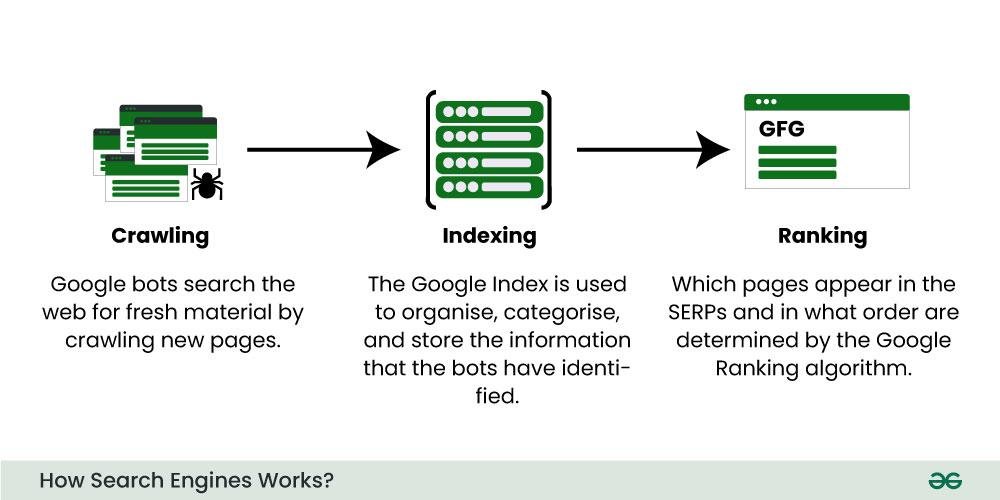
how search engine works

Source:– geeksforgeeks

Simply put, the function of a search engine is to enable people to discover information on the internet. You enter a query, and the search engine scans through trillions of websites to deliver the most appropriate results. 

These three things are the basic functions of a search engine: crawl, index, and rank, and have been since time immemorial, including the AI-powered ones. 

Crawling: This process begins when search engines discover any new content. Crawlers, also known as bots or spiders, are automatic pieces of software that travel around the internet by accessing link after link from one site to another. 

Indexing: In this next phase, any content which is discovered while crawling will be compiled and stored in a huge database which can be rapidly searched and recalled.

Ranking: It’s the last step. The user types the query, the search engine retrieves relevant pages from its index, and orders them according to hundreds of signals – relevance, authority, page quality, and more. 

The search engine basics should not be missed because, without them, any SEO effort that you undertake does not build upon solid grounds. You cannot optimise what you do not know.

Types of Search Engines in 2026

Not all search engines work the same way or serve the same purpose. In 2026, there are three main categories worth knowing.

Traditional Search Engines

These are probably the first search engines people think about. Even now, Google, Bing and Yahoo still process most of the search requests happening across the world. All three of these search engines thoroughly scan the web, compile very large indexes, and deliver ordered sets of results. Google still dominates, though Bing has started catching up due to its tight integration with various Microsoft AI-based software tools.

Classic search engine examples here include Google, Bing, Yahoo, Baidu, and DuckDuckGo.

Vertical or Niche-Specific Search Engines

These index content within a category, such as YouTube for videos, Amazon for products, LinkedIn for professional information, or Zillow for property listings. Each of these could be considered a search engine in its own. 

Quite a lot of those belong to niche search engines. Here are 10 examples of search engine types to give you some perspective: YouTube, Amazon, Pinterest, Booking.com, LinkedIn, Etsy, Indeed, Yelp, Houzz, and Zillow. Working these requires a different set of SEO skills entirely.

AI-Powered Search Engines

Perplexity, Google AI Overviews, ChatGPT Search and Microsoft Copilot bring several pages together, stitch together the content and respond to your query right on the Search Engine Results Page (SERP).

The person doesn’t even have to navigate to your webpage, and you have answered the question in a “zero-click” scenario, as SEO professionals have named it. Your page can have great organic rankings, but since the answer was shown above the fold of your page, the user never visits the site to navigate your content.

How Do Search Engines Work 

Here’s how search engines work in a step-by-step process for the clear sake of knowing what happens when someone types in a query. 

Discovery: A crawler lands on a different URL because of a submission via a sitemap, or they clicked a link to another page. This is why sitemaps and internal linking matter.

Crawling: The bot crawls the page’s content, code, and links. It verifies the headings, text, imagery, and speed of the page. The basics of how search engines actually crawl your site are essential here; failing this initial phase with robots.txt blocking your site or internal dead links is what most people struggle with first.

Indexing: Provided the content is crawlable and adheres to quality criteria, the search engine will add it to its index. Some thin-content pages or pages with no defined subject, or duplicate textual content on some pages may never be indexed or given a poor rank.

Ranking: When someone searches, the engine compares your query against its index of the web and passes it through its algorithm to determine the result. What comes out is an ordered list or, with modern AI search engines, a compiled answer from numerous indexed pages.

Display: The results show up on the page. Usually, in traditional search, this is a ranked list. For AI search, it’s going to be a paragraph, and there are citations underneath it.

The next step depends on the previous one. If your site is not crawlable, then your site is not indexable. If your site is not indexable, then your site is not rankable. The degree of understanding search engine basics will show you what you should be looking at when things start going wrong.

Key Search Engine Ranking Factors in 2026

Although the same ranking factors were important five years ago and still are important today, there are some factors that have been introduced since 2026.

Content quality and depth are the leading contributors. This is because search engines have a preference for the page which properly answers your queries, rather than those full of keywords.

E-E-A-T (Experience, Expertise, Authoritativeness, Trustworthiness) is now at the core of how Google judges content. It counts regardless of the subject matter. 

Backlinks remain incredibly powerful. Search engines perceive an authoritative link that is related to your content as evidence that you’ve produced content worth referring to. Getting a significant number of backlinks needs a strong backlink-building methodology.

Page experience metrics like site speed, mobile use, and the Core Web Vitals impact ranking. If your site is slow to load, it cannot compete.

Structured data is becoming increasingly prevalent because of the boom in AI search. If your content is properly structured, there will be a higher chance that the AI search engines can understand and reference your work in AI-driven responses.

Topic authority is a new and more essential concept. Websites that produce in-depth content are valued over those that publish single articles on obscure topics.

That’s when the Search engine basics come into play. These factors – content, authority, technical health and links – are far from trends. They are the non-negotiables.

Why AI-Built Websites Lack SEO Basics

Many businesses are relying heavily on AI in 2026 to create websites and push content quickly. But speed is not the same as structure.

Often, what AI tools leave behind is all the technical groundwork required by search engines. Pages go live without headings arranged hierarchically, missing or random internal links, non-specific meta-descriptions, and incomplete crawl paths. 

This content could be perfectly readable for a human, but for the search engine bot, on the other hand, this page looks like a mess with zero signals of the core subject of the site, no proper structure and no sign of high authority on the page.

This is precisely the reason why learning search engine basics has become the absolute most crucial requirement in 2026. Even though AI can churn out all your website content much faster, it cannot substitute for clever and effective strategies necessary for developing a website that search engines will actually use to index and list your site above other search results.

SEO Challenges in 2026

This move towards AI-driven search also comes with challenges and issues that didn’t exist before. 

The number one challenge is zero-click results. Google’s AI Overviews now provide answers to many searches even before a user ever scrolls to organic results. Many websites that depend on top-of-the-funnel traffic see a lot of their traffic decline.

Personalised results may make it hard to know where you truly stand. When two people do the exact search from two unique locations, and with varied search histories, it can result in different result pages.

Search is evolving with conversational queries. People no longer type simple keywords but fully formed questions when they search. You need to structure your content in this way, too, instead of merely targeting keywords.

Content saturation is real. With the ability for AI to publish at nearly zero cost and zero time, websites are clogged with so much content. To even stand out, one needs to have real value, a unique perspective, & well built off-page SEO signals.

The Future of Search Engines

There’s one clear direction for Search: the engine does more of the work, and the user does less. You don’t have to type in a well-formed search query and scroll through links; you ask, and the Search engine does the rest.

A big part of this transition is multimodal search. It means people search using an image, a video or a voice input rather than using only text. If you optimise content only for typed queries, you are missing a growing portion of how people search. 

AI agents are going even further. AI tools crawl websites, bring information together from different sources and give you an answer at the end. You don’t have to click or go to any pages; you get one single output.

For website owners, it’s a whole different game in what a successful presence on a search engine actually is. It’s no longer about appearing on page one; it’s now about becoming a source that AI engines know they want to reference when generating their answer.

It takes four things to get there: in-depth, accurate content on a subject; excellent technical foundations so search engines can crawl a page easily; proper schema that helps AI tools read and comprehend your content; and a backlink profile that signals authority.

All businesses willing to invest in guest post services and build out their off-page authority will be set up for a bright future.

FAQs

What are search engine basics?

The basics of a search engine (and SEO fundamentals) can be defined as a sequence of procedures to search for information, collect, analyse, and show the relevant material. Search engines comprise of 3 primary steps: Crawling, Indexing and Ranking

Why are search engine basics important for SEO?

If you do not know the basics of how search engines work, you may be prone to certain technical SEO mistakes which cause your content to disappear from the search index totally.

Is SEO replaced by AI?

No. Although search results have changed through AI, the underlying work of crawling, indexing, and ranking is all still there. In a way, SEO is transforming rather than disappearing. 

What is a search engine and its types?

Search engine: it is a software that retrieves information from the web based on a query a user has typed in the search bar. Generally, there are three categories of search engines: the ‘basic’ or’ general’ ones like Google or Bing, the’ vertical’ or’ special’ ones like Amazon and then the ‘AI’ ones like Perplexity or ChatGPT Search.

Final Word

The way people search has changed significantly. AI is now part of every major search engine, and the results page looks nothing like it did a few years ago. But the search engine basics, crawl, index, and rank, are still running underneath. 

The current top-performing sites in search create thorough, in-depth content on topics, receive good links from credible resources and have the proper technical structure. That’s what had been working all of prior to AI search. 

If ranking in 2026 is a priority for you, stick to the fundamentals. Make sure your site can be crawled. Write content that people and search engines both find useful. Build links that carry real weight.
Outsource Backlink Building or Boost Ad Budgets: Finding the Right Marketing Mix

Outsource backlink building and paid advertising; both are beneficial for the business. If one helps generate instant leads, then the other helps build long-term organic growth. Finding the right balance between the two without exceeding the budget is the key to achieving revenue goals while maintaining brand visibility.

Introduction 

Backlinks and paid advertising both seem fascinating for the business. The dilemma begins when you find yourself constantly second-guessing whether to invest in outsourced backlink building or digital advertising to grow your business. 

Both digital marketing strategies have their own pros and cons. You just need to determine when to prioritize outreach vs when to prioritize paid advertising. At the end of the post, you’ll know exactly when to use these strategies for your business. 

Outsource Backlink Building vs. Paid Ads: Understanding the Key Difference

Outsource backlink building and paid advertising are the digital marketing strategies B2B businesses use to drive traffic and achieve desired ROI. Let’s evaluate the key differences to better understand them. 

What is Outsource Backlink Building? 

Outsource backlink building in digital marketing is the process of delegating backlink acquisition to expert link-building service providers. Businesses hire freelancers and agencies that specialize in acquiring inbound links to increase organic visibility and traffic. 

Link-building agencies have industrial connections and expertise that help you secure relevant link placements and improve your website’s authority and organic traffic. It streamlines and accelerates the entire outreach process.

What Is Paid Advertising? 

Paid advertising is the systematic process of buying ad placements on search engines, social media platforms, community forums, and publishers’ websites through reliable advertising networks to reach the target audience at the peak moments and maximize conversions.

Outsourcing Backlink Building and Paid Ads: The Pros and Cons You Can’t Miss… 

Delegating backlink acquisition and running online ads offers numerous benefits for the business. Some of them are listed below:

Outsourcing Backlink Building: Pros and Cons 

Pros  Cons 
You’ve an expert handling the entire link-building process.  It takes longer to show relevant results. 
You can constantly acquire high-authority backlinks.  If the outsource backlink building agency lacks expertise in your niche, you may struggle to acquire premium backlinks.
You can invest your time and efforts in other marketing strategies.  Outbound links may come from low DA sites that add little to no value to your SEO.
You don’t have to train your employees on the best SEO practices.   If the link-building service provider uses black-hat SEO tactics for outreach, you may incur penalties from search engines.
You don’t have to spend hours in the learning or hiring process. Link building through outsourcing requires months of consistent dedication, making it a more expensive digital marketing strategy.

Paid Advertising: Pros and cons 

Pros  Cons 
You can drive traffic to your website the moment you launch your campaigns.  Once you stop investing your budget, the flow of leads and conversions will automatically come to a halt.
You can perform precise targeting to reach the target audience.  In competitive markets like iGaming, finance, and healthcare, and in Tier-1 segments, the cost per click (CPC) tends to be high, which increases the overall cost per acquisition (CPA).
You can choose the actions you want to pay for, such as impressions, clicks, or conversions. Ad fatigue among users increases if frequency capping is not set accurately. 
You can easily find a cost-effective online advertising network based on your needs.  Consumers are increasingly skeptical of paid ads, often viewing them as biased or purely profit-driven. 

When to Prioritize Paid Ads vs. Outsourcing Backlink Building for Maximum Marketing Impact

Evaluate your business objectives, budget, target audience, market competition, and current needs to find the sweet spot and allocate your digital marketing budget precisely. You can prioritize paid ads and outsourced backlink acquisition when you want the following: 

Prioritize Paid Ads When: 

  • You need immediate conversions. 
  • You have a specific audience to target.
  • Your SEO presence is lacking. 
  • You have a dedicated budget for creative testing and optimization. 
  • Your industry keywords are harder to rank with organic SEO. 
  • You have a new business, product, or offer to promote. 
  • You need to run retargeting ads to reduce abandonment rates. 
  • You have dedicated landing pages with ad assets. 
  • You want to capture the audience’s attention with time-sensitive offers for seasonal events.  
  • You’re ready to invest in a self-serve advertising platform. 

Prioritize Outsourcing Backlink Building When: 

  • Your main objective is to build long-term sustainability and have sufficient budget for it. 
  • You want to improve search rankings and domain authority.
  • You have a lot of valuable content for link exchange. 
  • You can articulate, vet, and stay updated with the emerging SEO trends to ensure you’re paying for the right link placements. 
  • You don’t want immediate conversions. 
  • Your selected marketing niche is highly competitive and has high CPCs. 
  • Your SEO has broken down, and you need an expert who can perform white-label SEO techniques. 

Need a Proven Cyber Security SEO Strategy?

Explore our Cyber Security SEO Guide to learn how cybersecurity businesses can improve search visibility, attract qualified leads, and build long-term authority online.

-> Paid advertising is ideal for those targeting quick conversions and short-term traffic goals. You can appear across platforms and moments where your audience spends most of their time to strengthen brand recall, build trust, and generate revenue. 

-> Using link building is like quietly working behind the scenes to achieve long-term stability. Even if you stop allocating budget to the strategy, the earned link placements will continue to drive traffic to your website, helping you attract more potential leads and maintain your domain authority.  

Tip. Focus on strong internal linking, not just outbound links; it will help you engage your acquired traffic for longer and build trust.  Use a performance-driven PPC advertising network that allows daily budget control, scheduling, and postback tracking, such as 7SearchPPC

Find Your Right Marketing Balance! 

Allocate your budget based on your objectives. If you need instant leads and conversions, allocate more budget to paid advertising; otherwise, if you want to improve your organic ranking, traffic, and DA, allocate budget to backlinks. To determine whether the distributed digital marketing budget aligns with your business objectives, you can measure cost-per-action (CPA) and organic traffic growth. 

If your CPA is increasing and organic traffic remains stagnant, it indicates a need to reevaluate and adjust your marketing budget.  

Both strategies complement each other when budgeted thoughtfully. But if you randomly assign your marketing budget to any strategy, you might struggle to achieve the desired outcomes for your business. If needed, you can use both strategies simultaneously to increase conversions and build long-term domain authority.

Frequently Asked Questions (FAQs)

1. What are the effective ways to build outbound backlinks for the business? 

Create a list of websites with moderate to high domain authority and zero spam scores to approach for guest posts, mentions, and direct backlinks, or partner with a reliable outsource backlink building agency.

2. What are the digital marketing strategies that pay off for small businesses? 

Display advertising, SEO (Search Engine Optimization), content marketing, email marketing, social media marketing, white-label link building, and referral marketing are the digital marketing strategies that pay off for small businesses.

3. Should B2B businesses leverage outsource backlink building and paid ads altogether? 

Yes, using both digital marketing strategies is a smart move for B2B businesses, as it helps balance long-term and short-term revenue objectives.

4. What should I consider when choosing between outsourcing backlink building and paid advertising? 

Evaluate your business goals, target audience, budget, market competition, and expected revenue, and determine whether you have an immediate or long-term goal to fulfill.  

5. Should I stop spending ad budget if my SEO starts showing positive results? 

No, not completely. You can reduce your advertising budget during the off-season and gradually increase it for major events to quickly attract high-intent traffic and increase your ROI.

6. What to look for in an outsourced link-building service provider? 

Evaluate their market reputation, white-label SEO packages, pricing, and support availability when choosing your outsourced link-building service provider. 

Complete Guide to SEO Audit Services and Why Your Company Needs Them in 2026

You can publish content every week, fix a few keywords, even build backlinks, and still wonder why your site is not moving up in rankings. That is usually the moment when people realize something deeper is off. You cannot fix what you have not properly examined. That is where SEO Audit Services come in.

Professional SEO Audit Services do more than point out obvious errors. 

It provides a detailed overview of your technical setup, content quality, user experience, and many more things, helping you to find the real reason behind traffic drops 

Search engines change constantly. Competitors improve their strategies. Pages get outdated. Links break. 

Without Regular audit work, small issues pile up and slowly drag your SERP ranking down. Seo Audit Services help you identify these problems, and prioritize on things that need instant improvement.

What Are SEO Audit Services and Why Your Company Needs Them

If you want predictable organic growth, you need more than content and keywords. You need clarity.  Seo Audit Services gives you clarity, they give you a structured backend evaluation supported by data on how your website performs in search engines and where you lack.

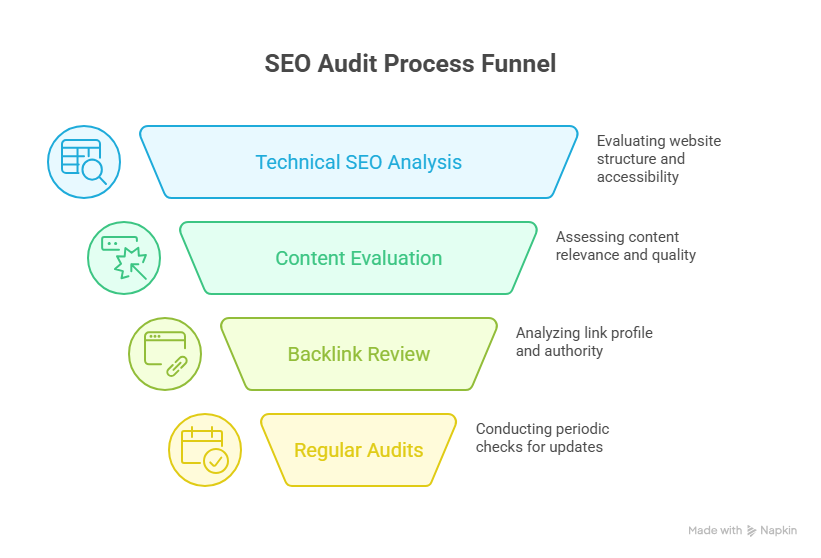
seo audit funnel

Seo audit services are a complete analysis of three main areas: technical seo audit seo services, on-page content, and backlinks. Each of these directly affects how search engines crawl and understand your site to rank it accordingly

1. Technical SEO Audit Services

Search engines want clean structure and accessibility, and a professional audit checks things like index status of your pages, site speed, core web vitals, mobile friendliness, internal linking, and duplicate content.

If search engines cannot properly access or identify your pages, your ranking goes down, no matter how good your content is. Technical findings are also very important; they are usually backed by data from tools such as Google Search Console (GSC), Google Analytics (GA4), and by a specific crawling software.

2. Content and On-Page Evaluation

Content Evaluation is not just for keywords, but also for search intent. You must evaluate the depth of content, accuracy, and usefulness in the actual market. Strong seo auditing services  assess things like these in a detailed manner, and some of them are listed below

  • If your page is providing infor of what users are actually searching for or not
  • Keyword cannibalization issues
  • Lacking depth or outdated content
  • Meta titles and descriptions
  • Internal linking flow
  • Content hierarchy and readability

Search engines always prioritize content that is helpful and trustworthy, via E-E-A-T guidelines. E-E-A-T stands for experience, expertise, authoritativeness, and trust.

An seo audit checks if your pages lack the expertise or authority as per EEAT guidelines.

It also shows opportunities to improve high-performing pages and low-performing content.

3. Backlink and Authority Review

Backlinks are still a major ranking factor in 2026. SEO audits check in detail which domains you are referring to, the quality and distribution of your backlinks, and the anchor text and signals that matter for overall authority.

Low-quality links or links placed to manipulate rankings can harm your credibility in the long term, while strong, relevant backlinks increase trust.

A proper, detailed backlink review protects your domain and helps you prepare the best backlink building strategy.

4. Regular Audits Matter

Algorithms for searches are always changing. Competitors make improvements to their websites. As platforms change and content expands over time, technical problems arise. Without regular SEO audit services, issues worsen covertly and reduce your visibility.

Regular audits help you:

  • Detect ranking drops early
  • Recover from penalties or algorithm impacts
  • Improve user experience and site performance
  • Align content with current search intent
  • Prioritize actions based on impact

In terms of experience and expertise, the benefit of SEO Audit Services is that it helps to convert random data into actionable steps. Rather than carrying out random search engine optimization, you get to work with organized information that is informed by actual data.

For businesses that depend on organic traffic, this approach helps to mitigate risks while also ensuring that their position as a leader is maintained.

How SEO Audit Services Improve Rankings and Organic Traffic

Improving rankings is rarely about one big change. Usually, growth comes from identifying specific weaknesses, fixing them step by step, and focusing on what already works. This is how SEO Audit Services create measurable improvements in rankings and organic traffic

1. Turning Data Into Clear Actions

Professional SEO Audit Services depend on real performance data from sources like Google Search Console, analytics platforms, crawl reports, and ranking tools. Instead of guessing why traffic dropped, audits examine patterns. 

For instance, if a page gets 20,000 impressions per month but has a 1 percent click-through rate, the problem might not be ranking but poorly written meta titles or descriptions. According to industry studies, improving title tags can raise organic CTR by 5 to 20 percent depending on the niche. 

Small changes in snippets can lead to hundreds or even thousands of extra visits each month without affecting rankings.

Real-World Example

Take, for example, an eCommerce site that saw a 30 percent decline in organic search traffic over a period of three months. An in-depth SEO analysis identified the following key issues:

  • There were multiple product category pages that were accidentally set to noindex
  • The mobile page load times were causing Core Web Vitals to fall below best practices
  • There were several high-authority backlinks pointing to outdated redirected URLs

Once these issues were addressed, the site saw a restoration of traffic in eight weeks. Organic traffic saw a 42 percent increase from the nadir, and several category pages moved from positions 9-11 to the top five positions.

Such a restoration is not an isolated incident. Research indicates that fixing technical issues and consolidating duplicate URLs can have a profound impact on crawl efficiency, particularly on medium to large-scale sites.

2. Fixing Hidden Ranking Barriers

Some ranking obstacles are structural in nature. A website may inadvertently target the same keyword. Key pages may not have internal links from high-authority sections. Thin pages may weaken the overall domain quality.

SEO Audit Services can remove these obstacles and allow search engines to easily recognize which pages are most relevant. When internal linking is done correctly, some websites experience improved rankings without adding a single backlink.

3. Uncovering Growth Opportunities

Opportunity zones are also revealed through audits. For instance, studies have found that pages ranking between positions 8 and 15 are the easiest to move into the top five through optimization. A targeted update that enhances content depth, search intent, and internal linking can drive traffic dramatically because the top five positions account for the majority of clicks.

In fact, the first result on Google gets an average of 25 to 30 percent of all clicks, while positions further down on page one get significantly fewer clicks. Moving up a few positions can double or triple traffic for that keyword.

4. Aligning With Algorithm Updates

Google’s updates are increasingly favoring helpful, trustworthy, and technically sound websites. Websites that ignore user experience and have poor authority signals tend to be volatile after core updates.

SEO Audit Services assess whether your website meets these expectations by analyzing the quality of content, authority signals, performance metrics, and the health of the website structure. This approach helps prevent sudden drops in traffic and helps with steady growth.

Ok, but how do you track each update of Google’s algorithms? Well, you can use semrush sensor tool to track these updates.

But if you want a simple, cost-effective way, then

Here is a page by Search Engine Central to see the most recent algorithm updates by Google

Signs Your Business Needs SEO Audit Services

Not all websites require a complete overhaul. Sometimes, all a website needs is some clarity. The problem is figuring out whether your SEO issues are just temporary or if they are indicative of deeper structural issues.

The following are signs that your business needs SEO Audit Services.

1. Sudden or Gradual Traffic Drops

If your organic traffic starts dropping without any apparent reason, that’s a warning sign. A sudden drop in traffic may be due to technical issues, algorithm changes, manual penalties, or indexing problems. A steady drop in traffic may be due to increased competition, outdated content, or loss of authority signals.

If your analytics tools are showing a steady drop in traffic for a few weeks or months, it’s time to start investigating instead of just speculating.

2. Rankings Are Stuck or Declining

You are regularly publishing content but your target keywords are stuck on page two or three. Or, worse, they are declining.

This is a sign that something is holding back your performance. It could be internal competition, poor topical representation, misalignment with search intent, or superior competitors. Our SEO Audit Services will help you understand why your pages are not ranking in the top spots.

3. High Traffic but Low Conversions

In some cases, the traffic may be stable, but the leads or sales may not be improving. This indicates that there may be a misalignment between the user intent and the content, a lack of strong internal linking, or a poor page experience.

An audit may help determine if users are visiting the wrong pages, if the calls to action are hidden, or if the technical issues are impacting the usability. Organic traffic is relevant only if it is driving business results.

4. Slow Site Speed or Poor Mobile Experience

If your website is perceived as slow, users will notice. Search engines will too.

Bounce rates, dwell time, and mobile engagement are often associated with slow websites. With Google’s mobile-first indexing and emphasis on user experience, slow websites can negatively impact rankings without you even realizing it.

5. Indexing or Crawl Issues

If key pages are not showing up in search results or if there are crawl errors, excluded pages, or coverage issues in Google Search Console, there could be underlying structural issues.

Indexing problems make it impossible for search engines to fully understand your site. Without visibility, quality content cannot rank.

6. You Have Never Done a Formal Audit

Many companies are spending money on SEO without ever doing a review. If you have been creating content and building links for years without doing a review of the system as a whole, there is a good chance that inefficiencies are present.

SEO becomes more complicated as the size of the site increases. What was effective on your site with 50 pages may not be effective on your site with 500 pages.

How to Choose the Right SEO Audit Company

Now comes the important part, How to choose the right seo audit company. The right seo audit company will identify real problems, prioritize them correctly, and help with implementation.

This is how to rate your choices.

1. Proven Experience and Industry Understanding

Begin with experience. A good provider should have knowledge of various business models, types of search intent, and competitive scenarios. Inquire about the industries they have experience in and the types of websites they audit.

SEO is not a one-size-fits-all solution. The requirements of a startup blog are different from that of a SaaS business or an enterprise website.

2. Enterprise SEO Audit for Large-Scale Websites

If you are running a large website with hundreds or thousands of pages, you will require an enterprise SEO audit.

Enterprise SEO audits target crawl efficiency, log file analysis, scalable internal linking, structured data consistency, international SEO issues, and site architecture management.

Large-scale websites tend to have crawl budget waste and duplicate signals. An enterprise SEO audit will make sure that search engines rank your most valuable pages.

3. B2B SEO Audit for Long Sales Cycles

A B2B SEO audit needs a different perspective. B2B buyers have longer decision paths and may be searching for information before making contact.

A good B2B SEO audit looks at the depth of content, authority positioning, alignment with keyword intent, and lead-driven landing pages. It needs to examine how well your content is working to build trust and thought leadership, as opposed to purely driving traffic.

4. Transparent Reporting and Clear Documentation

Professional seo auditing services should include a structured SEO audit report template so you know how findings are organized. Request an SEO audit report sample before hiring.

Reports should clearly outline:

  • Identified issues
  • Business impact
  • Priority level
  • Step-by-step recommendations

Transparency shows confidence and accountability.

5. White Label SEO Audit for Agencies

If you are running a marketing agency or a consultancy business, a white label SEO audit can be an excellent solution for you.

With a white label SEO audit, you can offer Professional seo auditing services with your own branding while benefiting from the expertise of a white label SEO audit provider in the background. A reliable white label SEO audit provider will offer you in-depth reports and insights that you can present to your clients with confidence.

6. Proven Results and Case Studies

Finally, look for evidence. 

Have they assisted clients in recovering from traffic losses? 

Have they improved search rankings? 

Have they increased qualified leads?

A company such as backlinksmatters.com, for instance, is one that specializes in authority-driven strategies and structured audits that identify not only technical issues but also competitive gaps. What is most important, however, is not only the identification of issues but also the demonstration of how recommendations resulted in improvements.

Conclusion

SEO improvement does not result from speculation. It results from understanding. Even with regular content and link development, things can go wrong if there are technical problems, authority issues, or content mismatches.

Seo auditing services are a systematic and data-driven analysis process that reveals hidden problems and points to actual opportunities for growth. They can help you prioritize, adjust to changes in the algorithm, and safeguard your rankings before small problems turn into big losses.

For any business that relies on organic search traffic, regular audits are not a recommendation. They are a necessity.

How to Choose the Right SaaS SEO Agency in 2026: A Complete Guide for B2B SaaS Companies

In 2026, SEO isn’t just about getting keywords rank at the top of the search results. It’s about how signals such as structure, authority, clarity, and trust are now interpreted across search engines, how AI search makes your business more visible, how it grows your business through products, and how to use a full-funnel strategy. Choosing the right SaaS SEO agency can directly influence your pipeline, CAC, and long-term growth.

Why Do B2B SaaS Companies Need a Specialized SaaS SEO Agency?

B2B SaaS companies operate in a very different environment compared to eCommerce, local businesses, or traditional B2B services.  That’s why working with a specialized SaaS SEO agency isn’t just helpful, it’s often necessary for scalable growth.

SEO is not a one-size-fits-all strategy. The approach that works for a traditional business (like a local store, manufacturer, or service company) is very different from what works for a SaaS (Software as a Service) company.

B2B SaaS companies need a specialized SaaS SEO agency because of the following reasons:

  • A SaaS SEO agency tracks SEO performance against monthly recurring revenue, customer lifetime value, customer acquisition cost, and sales qualified leads, to make sure that organic traffic directly contributes to maintaining and increasing the recurring revenue.
  • To help prospects move seamlessly from research to demo or trial, they develop structured content for the awareness, comparison, alternative, integration, and BOFU stages.
  • SEO content is designed to inform, develop, and influence over time because B2B SaaS buyers conduct in-depth research and involve a number of decision-makers.
  • To guarantee appropriate indexing and visibility, they oversee intricate SaaS architectures such as feature pages, dynamic templates, app subdomains, and crawl budgets.
  • To compete with well-funded SaaS rivals and prominent review sites like G2 and Capterra, they create content that is intent-driven and authority-driven.
  • They turn customer FAQs, feature updates, integrations, and sales objections into high-intent SEO assets that encourage conversions.
  • They build an organic growth engine for compounding, long-term results using programmatic SEO, internal linking systems, and content clusters.

What Does a SaaS SEO Agency Actually Do?

SaaS SEO agencies work beyond the keywords targeting and content publishing. It creates a business designed for organic growth by generating qualified leads, demo bookings, and recurring revenue for subscription-based software businesses.

Unlike traditional SEO firms, it aligns content, technical SEO, product positioning, and revenue metrics to support the full B2B buyer journey from awareness to conversion and retention.

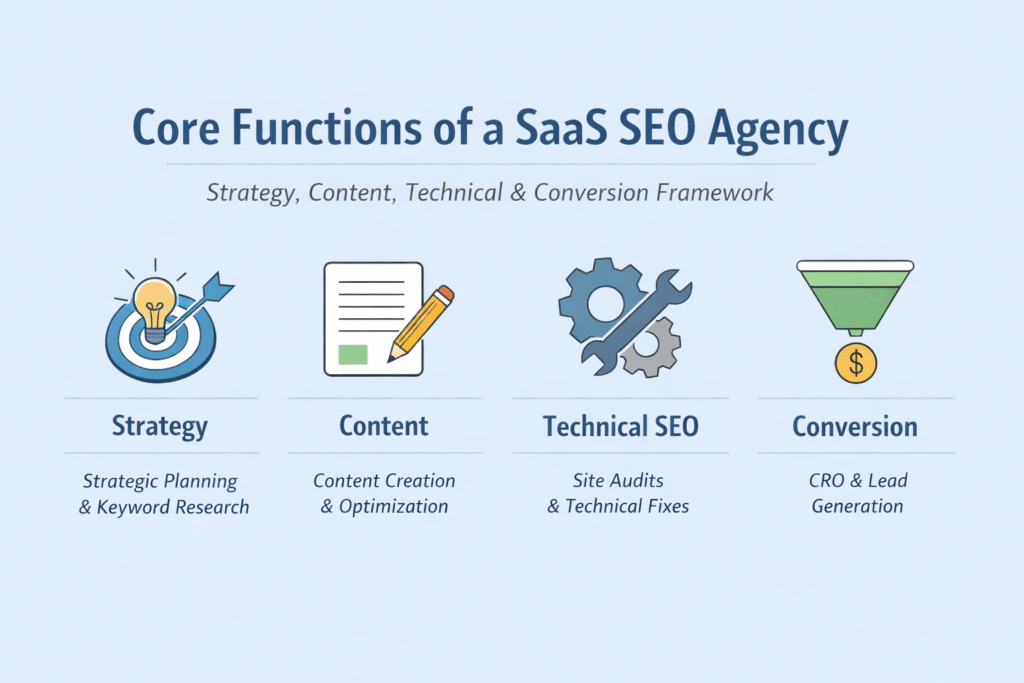
The Main Functions of a SaaS SEO Agency:

  • Creates an SEO Strategy Based on Revenue

links SEO efforts to pipeline, MRR, LTV, and CAC objectives rather than just traffic growth.

  • carries out in-depth keyword and intent research

finds comparison, integration, product-led, and high-intent keywords that draw in decision-makers as well as readers.

  • Produces Content for the Whole Funnel

creates BOFU landing pages, feature pages, use-case pages, comparison pages, “vs” pages, and awareness blogs to promote trials and demos.

  • Enhances SaaS Architecture Technical SEO

controls indexation, crawl budget, product templates, dynamic pages, app subdomains, and structured internal linking.

  • Increases Backlinks and Authority

acquires topical authority and high-quality backlinks to rival review sites like G2 and Capterra.

  • Develops Scalable and Programmatic SEO Systems

creates scalable landing page frameworks to promote compounding organic growth for use cases, locations, industries, and integrations.

  • Assists Sales and Product Teams

converts sales objections, product updates, and customer frequently asked questions into optimized content that accelerates the sales cycle.

  • Monitors Performance Using Revenue Measures

evaluates performance using more than just rankings or impressions; it also looks at pipeline contributions, revenue impact, demos, and SQLs.

Core Functions of a SaaS SEO Agency: Strategy, Content, Technical & Conversion Framework

functions of saas seo agency

Revenue-Oriented Keyword Approach

  • Targeting high-intent keywords that have a direct impact on demos, trials, and MRR (Monthly Recurring Revenue) rather than merely increasing sessions is known as the revenue-focused keyword strategy.
  • Keywords that are organized by funnel stage include BOFU (purchase intent), MOFU (solution evaluation), and TOFU (problem awareness) in order to direct users toward conversion.
  • Comparison pages, such as “X vs. Y,” are strategically created to attract high-intent traffic and buyers who are actively assessing competitors.
  • Alternative Pages: aims to attract unhappy rival users by focusing on “Best alternatives to X” searches.
  • In order to draw in solution-conscious prospects, feature-led SEO content creates SEO pages centered on the main features, advantages, and integrations of the product.

Content Strategy for SaaS

  • To increase topical authority and boost rankings, the Pillar + Cluster Model creates reputable pillar pages backed by interconnected cluster content.
  • Product-Led SEO aims to naturally direct traffic toward signups and demos by aligning content with product features and use cases.
  • Bottom-of-Funnel Landing Pages: These optimize high-intent pages that are centered around pricing, demos, trials, and solution-based queries.
  • Use Case Pages: These pages are tailored to a particular industry and role in order to draw in qualified leads who are looking for customized solutions.

Technical SEO for SaaS Websites

  • Site Structure for Scaling: To facilitate future growth and programmatic expansion, a logical, scalable URL and internal linking structure are designed.
  • In order to make sure search engines give priority to high-value pages, crawl optimization controls crawl budget, indexation, and technical directives.
  • Managing Dynamic Pages: Enhances template-driven and dynamically produced pages (such as industry pages or integrations) for appropriate indexation.
  • Core Web Vitals: Enhances user experience and rankings by improving site speed, stability, and performance.

Conversion Optimization

  • Demo Page Optimisation: Improves demo landing pages by adding trust signals, CTAs, compelling messaging, and reducing friction.
  • Trial Signups: Enhances signup and onboarding processes to boost the number of people who activate free trials.
  • Lead Magnet Offers: Captures and develops qualified leads through the use of gated resources (eBooks, templates, webinars).
  • Attribution tracking accurately measures the impact of demos, SQLs, and revenue by integrating SEO performance with CRM and analytics tools.

Key Traits of the Right SaaS SEO Agency

A right SaaS SEO agency provides a clear 6-12 month roadmap, laying out the full plan to ensure you’re in good hands. You’ll see real results in their work. They will not make false promises regarding instant results or vague growth over time. Instead, the right SaaS SEO agency will ensure you by showing similar SaaS clients’ case studies with real revenue impact, like increased qualified leads or pipeline growth, rather than just vanity metrics such as raw traffic.

Non-Negotiable Traits of B2B SaaS SEO Agency:

1. Proven B2B SaaS Case Studies

Reputable SaaS SEO firms need to display actual outcomes from other B2B SaaS businesses.

They are required to give evidence of:

  • Growth in natural traffic.
  • Increase in demo requests.
  • More people signed up for free trials.
  • A rise in Monthly Recurring Revenue.
  • Pipeline expansion from natural search

It is insufficient for an agency to display traffic screenshots with no effect on revenue.

A proficient B2B SaaS SEO firm links SEO initiatives to commercial outcomes.

2. Understanding of CAC, LTV & MRR

SaaS companies are supposed to understand the following matrices: 

  • CAC (Customer Acquisition Cost): The cost required to acquire a customer.
  • LTV (Lifetime Value): To understand how much revenue is generated per customer over time.

  • MRR (Monthly Recurring Revenue): To understand predictable recurring income.

The right SaaS SEO agency understands how SEO helps to:

  • Reduce CAC by lowering paid ad dependency

  • Increase LTV by targeting high-intent users

  • Grow recurring revenue through organic acquisition

If the agency talks only about rankings and backlinks, they may not understand SaaS growth.

3. Revenue Reporting, Not Just Rankings

Many agencies focus on Keyword rankings, Traffic increase, and Domain authority. But the best SaaS SEO agencies report Organic demo conversions, Trial signups, Sales-qualified leads (SQLs,) and Revenue influenced by SEO

Rankings are important, but revenue is the real goal.

Your SEO agency for SaaS should track performance from keyword → traffic → demo → revenue.

4. Strong Content and Technical SEO Team

SaaS websites are often complex. They include:

  • Product pages

  • Use case pages

  • Feature pages

  • Integration pages

  • Comparison pages

A strong SaaS SEO agency must have:

  • Content strategists

  • Technical SEO experts

  • SaaS-focused writers

  • Experience with structured site architecture

Content without technical SEO will not rank. Technical SEO without strong content will not convert.

You need both.

5. Transparent Process and Clear Communication

The right SaaS SEO agency works with transparency.

They should provide:

  • A clear strategy

  • Monthly deliverables

  • Regular reporting

  • Clear KPIs

  • Ongoing performance updates

You should always know what work is being done and how it supports your SaaS growth.

6. Clear 6–12 Month SEO Roadmap

For SaaS businesses, SEO takes time. A competent SaaS SEO company will offer a detailed roadmap for the next six to twelve months.

This roadmap ought to comprise:

Months 1-2: 

  • Audit of the website
  • Research on competitors
  • Strategy for keywords
  • Technical solutions

Months 3–6: 

  • Release content at the bottom of the funnel
  • Make product pages more efficient.
  • Begin constructing links.
  • Scale content clusters in months six through twelve
  • Establish authority
  • Boost conversion rates
  • Investing in SEO takes time. There is no clear direction in the absence of a roadmap.

Best SaaS SEO Agencies in the US

Backlinks Matters: For White Label Link Building

backlinksmatters the backlink building agency

Backlinks Matters is a dedicated link building and SEO services agency focused on helping businesses improve their search engine visibility and organic rankings through high-quality backlink acquisition, outreach, and content marketing.

They have specialization in building relevant, permanent do-follow backlinks that strengthen domain authority and drive sustainable traffic growth.

Their Services include:

  • Seo Outreach 
  • White label link building
  • Niche edit service
  • Keyword research service
  • Guest Posting Service
  • Blogger outreach service
  • Link building service
  • In-house link-building service
  • Outsource link building service

Apart from these services, they offer customized SEO packages as per the client’s requirements.

TrustPilot Ratings: 4.0 / 5

TripleDart: For Revenue-Driven SaaS Marketing

tripledart

TripleDart is a B2B SaaS SEO company that uses performance-driven SEO, content, and demand-generation tactics to produce quantifiable outcomes.

They specialize in building scalable organic acquisition systems that align SEO with product positioning, sales funnel stages, and revenue metrics like MRR and pipeline contribution.

Their Services include:

  • SaaS SEO strategy
  • Content marketing for SaaS
  • Product-led growth marketing
  • Demand generation
  • Paid media for SaaS
  • SEO + Content integration
  • Conversion-focused landing pages
  • Marketing analytics & attribution

Apart from these services, they offer customized SaaS growth frameworks tailored to different funding stages

Trustpilot Ratings: 4.8 / 5

Quoleady: SaaS Content Marketing Agency

quoleady

Quoleady is a SaaS-focused SEO and content marketing agency that uses authority backlinks and thoughtful, outstanding content to help software companies scale organic growth.

They specialize in thought-leadership content, data-driven link building, and SEO content strategies that attract high-intent traffic and support long sales cycles typical in B2B SaaS.

Their Services include:

  • SaaS SEO
  • Content strategy development
  • SEO blog writing
  • White-hat link building
  • Guest posting
  • Digital PR
  • Content repurposing
  • Landing page optimization

Apart from these services, they provide tailored content marketing programs designed specifically for SaaS startups and scaling tech companies.

Trustpilot Ratings: 4.9 / 5

How Long Does SaaS SEO Take to Show Results?

There is no magic trick to get instant results. SaaS SEO is a long-term growth strategy; it requires time to build authority,  improve rankings, and earn trust from search engines. Typically, SaaS companies begin seeing early signs of progress within 3 to 6 months, while meaningful pipeline and revenue impact usually takes 6 to 12 months.

Initially, they focus on technical optimization, keyword research aligned to the sales funnel, competitor analysis, and publishing high-intent content. All these efforts are not for the traffic increase.

As the months go by, optimized pages start to rank for pertinent keywords, particularly bottom-of-funnel queries that lead to free trial signups and demo requests. Strong internal linking, regular content publishing, and the acquisition of high-quality backlinks all contribute to the development of domain authority by the six to twelve-month mark.

This is the time when SaaS SEO starts booming, organic traffic increases, ranking improves faster, and the channels start contributing to conversions and customer acquisition. Then, after a year of executing these efforts, SEO would become the best channel among all.

Wrapping it up: Choosing the Right SaaS SEO Agency

SaaS SEO is no more about simply ranking the keywords, It’s more about building a revenue-driven, full-funnel organic growth engine that directly impacts pipeline, CAC, LTV, and MRR(Monthly Recurring Revenue). SaaS SEO agencies work in a complex buying environment where multiple stakeholders research deeply before booking a demo or getting a trial. That is why choosing the right SEO agency is critical nowadays. 

The ideal SaaS SEO agency creates a robust technical architecture, builds intent-driven content across awareness to BOFU stages, comprehends SaaS economics, and links every SEO endeavor to quantifiable business results.

B2B SEO Services: Definitive Guide for Businesses In 2026

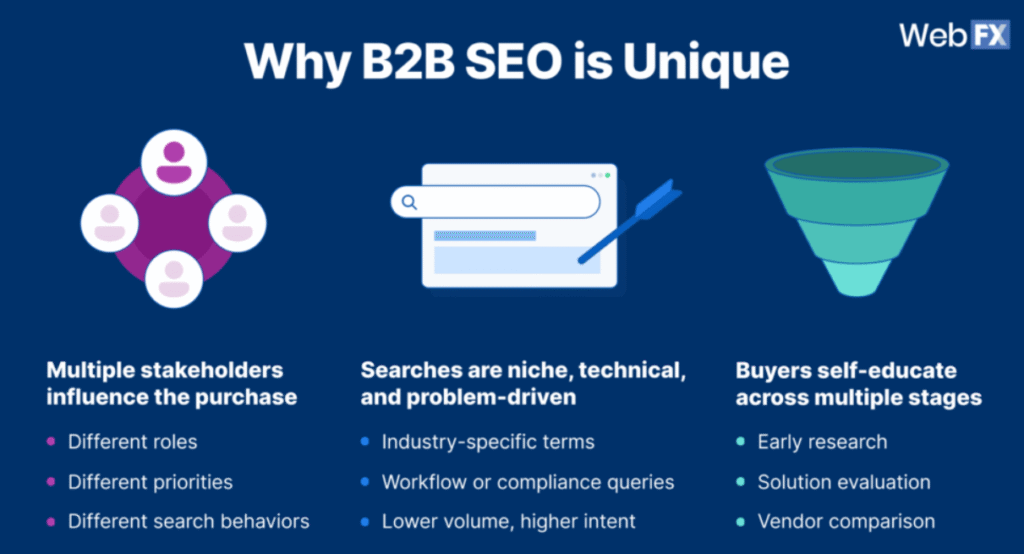
How are B2B SEO services different from generic SEO? 

How will it help my business? 

Are you a business owner who has these and many other questions? This article will make it easy for you grasp this concept. 

Don’t worry, we will go one step at a time. 

In simple terms, Business-to-business (B2B) SEO is the process of increasing your website’s visibility by improving the quality and quantity of traffic.  It means to make your website more attractive to increase its visibility. 

Business owners use this technique to attract more organic visitors to their sites. B2B SEO is about finding what the targeted organic audience wants and delivering exactly what they want.

B2B SEO plays a crucial role in the ever-evolving business landscape of 2026. As organisations strive to stay competitive and relevant, effective SEO strategies are important, especially curated for B2B audiences. 

In the article, we will break down what B2B SEO is, how it is different from generic SEO, B2B SEO vs B2C SEO, why B2B SEO services are essential in 2026, and what services they offer.

Let’s Begin…

What are B2B SEO Services?

B2B SEO is a strategy where the main objective is, to attract organic search engine traffic and keyword rankings for B2B websites. It is the science of reaching professionals who are interested in your solutions via search engines. 

B2B SEO focuses on – 

  • Keywords that have no volume but high value or search intent 
  • Publishing in-depth and authoritative content about the industry
  • Lead generation is given more importance than impulse purchases
  • Technical SEO is the key

b2b seo

Let us also understand the B2B industries that could benefit from B2B SEO Services. Commonly, industries where customers research extensively before making a purchase decision adopt B2B SEO Services. 

  1. SaaS (Software as a Service) – Companies that offer extensions, services, subscription models, plugins, etc., often require detailed product comparisons or a demo. 
  2. Manufacturers – Manufacturing businesses looking for bulk buyers or corporate clients. 
  3. IT or Technology Services – Companies that offer IT consultations, cybersecurity, or software development solutions. 
  4. Digital Marketing Agencies – These agencies often rely on organic traffic to attract clients for long-term partnerships. 

There is one element common to all the mentioned industries, before making a purchasing decision, the potential customer will run thorough research. And that is exactly where B2B SEO services come into play. 

But why are B2B SEO serviecs are different from B2C SEO services? Let’s unwind that in the next section…

Want To Learn More About Seo? Read Our Guide on SEO Funnels

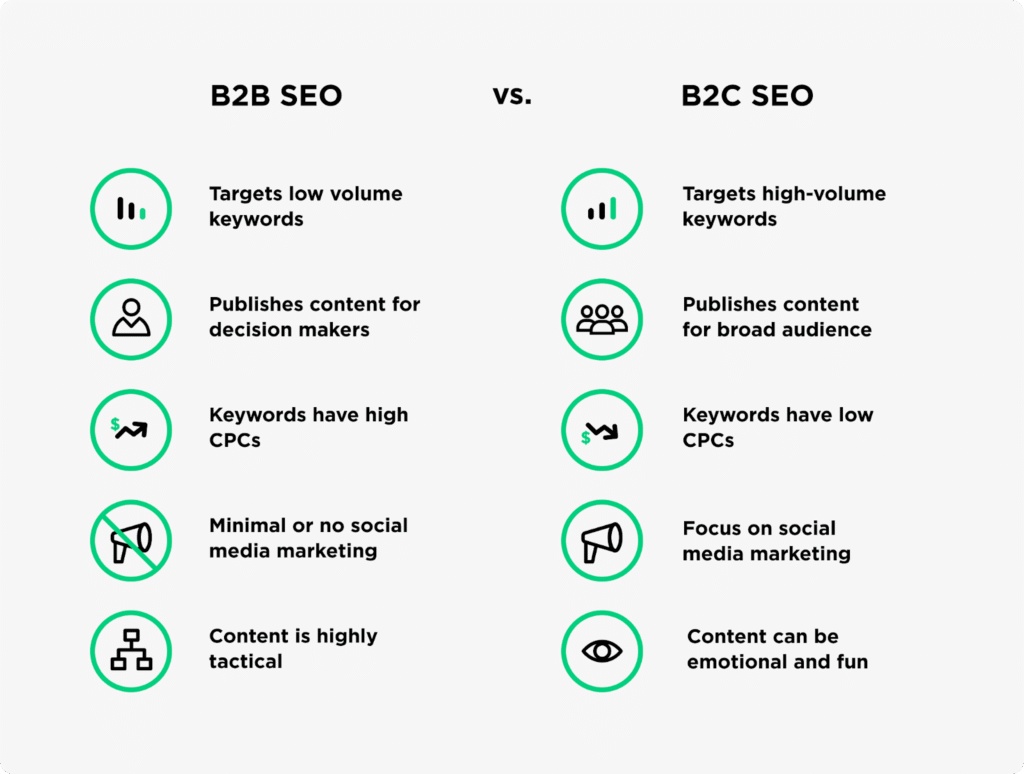
B2B SEO Services Vs B2C SEO Services – Differences 

SEO is SEO. 

At its core, it is the process of attracting organic traffic to the website that you are aiming to rank over the SERP (Search Engine Results Page). However, marketing activities work differently in the B2B world; there are some tweaks to the said principles. 

Although both B2B and B2C SEO’s main objective is to enhance the search ranking of websites, their goals, execution, strategies, and key performance indicators (KPIs) are different. 

Here are some core differences to understand – 

b2b vs b2c seo

  • Target Audience: B2B SEO targets professionals, bulk buyers, procurement teams, and decision makers. On the other hand, B2C SEO targets consumers’ personal purchase decisions. 

B2B SEO targets low-volume keywords. 

  • Content Depth: B2B SEO focuses on in-depth content such as detailed blogs, comparison articles, demos, and user cases. Meanwhile, B2C SEO solely relies on short-form blogs, engaging product pages, and reviews.

B2B SEO publishes content for decision makers. 

  • Keyword Strategy: B2B SEO primarily focuses on keywords with low search volume but high business value. But B2C SEO focuses on high-search-volume keywords, as well as product-focused keywords.

B2B SEO targets keywords with high CPCs (cost per click). 

  • Promotions: B2B SEO emphasizes no social media promotions, whereas B2C SEO’s main focus is promoting products on social media platforms. 

B2B SEO preaches minimal or no social media promotions. 

  • Main Objective: B2B SEO focuses on lead generation, while the B2C SEO’s objective is direct sales.

B2B SEO publishes tactical content that moves the audience towards lead generation. 

Why Is Having A B2B Seo Agency Essential In 2026?

In 2026, the B2B customers’ buying behaviour has changed. The competition has increased, the customers are more informed, and traditional lead-generation channels are becoming expensive. 

In some aspects, B2B SEO has not changed. We are still spending time generating helpful content for our audience. But one significant change that has taken place: customer queries are being answered by AI. 

This is why B2B SEO Services are just not optional, but essential for consistent growth. 

b2b seo services

B2B Buyers Start Their Research on Search Engines: Before connecting with a B2B seller or a vendor, B2B buyers usually – 

  • Research about different solutions 
  • Read in-depth articles about the solutions 
  • Compare providers 

If your website doesn’t appear during this research phase, you are losing valuable sales, and you are definitely invisible to high-intent potential buyers. B2B SEO ensures that your website appears early in the decision-making process, not after they have already shortlisted the competitors. 

Cost Efficiency vs Paid Ads: Another issue faced by B2B industries is that; the cost of paid advertisements has increased significantly in 2026, especially for competitive B2B industries.

B2B SEO Services provides – 

  • Long-term organic traffic
  • Eliminates the need for paid advertisements 
  • One well-ranked B2B website can deliver leads for years.

Understanding the Changing Google Algorithms: B2B SEO Services are crucial because Google changes its Algorithm very frequently. It is next to impossible for a B2B business owner to run a business and also keep track of the algorithms. 

Search Engines are now prioritizing – 

  • Expert-level topical content 
  • Trust signals like backlinks
  • Optimize content for Google’s AI Overview summaries 

For B2B businesses looking for ways of consistent growth, B2B SEO is no longer “nice to have”; it is a necessity, a “must-have”. 

What’s Included In B2B SEO Services?

One core objective of B2B SEO Services is to attract high-intent business leads and convert them into profitable sales. Instead of solely focusing on increasing traffic, each activity is planned around authority, search intent, and finally, long-term growth. 

b2b seo services

Here is the complete list of all the activities that are included in B2B SEO Services – 

Keyword Research: B2B SEO starts with analyzing keywords that are used by bulk-buyers or decision makers, not by casual shoppers. These keywords include – 

  1. High-value & Long-tail search terms 
  2. Commercial keyword with high search intent 
  3. Keywords to match different stages of the buyer’s journey

The end goal is getting quality traffic to the website, not just quantity. This ensures that the traffic is conversion-ready. 

Technical SEO: Technical SEO is responsible for ensuring that your website is easy for search engines to rank, understand, and crawl. 

This includes – 

  1. Site Health 
  2. Mobile responsiveness check 
  3. Fixing crawling and indexing issues 
  4. Enhancing internal links 

On-page SEO: Everything you do on your website to increase its visibility is called on-page SEO. There are three types of On-Page SEO:

  1. Crawling is the discovery process by which search engines send out a team of robots to find out the updated content or new content. The database is called CAFFEINE. The trick here to get caught by these crawlers is to keep updating the content on the page or website.
  2. Indexing is the process of storing and organizing the crawled information for future reference.
  3. Ranking is the process that provides the pieces of content that will be the best answer to a searcher’s query, which means that results are ordered from most relevant to Least relevant. At all times be relevant.

Content Creation: This is another important service provided by B2B SEO agencies, especially for long sales cycles. 

The type of content created by B2B SEO agencies – 

  1. Long-form content about the solutions 
  2. Comparision articles 
  3. Real-World use cases 
  4. SEO-optimized blogposts 

Link Building: If your B2B SEO agency has made people naturally talk about or link to your websites, this means they have done half the job. Backlinks play a crucial role here. It is like a web reference to the main web source, website, or web page, giving the viewer the clarity that is often required during the research of any topic. Backlinks are a significant part of any content-creating process.

Tracking & Reporting: Measuring performance is essential for continuous and consistent growth.

This includes – 

  1. Tracking and analyzing keyword performance 
  2. Monitoring conversions and leads
  3. Taking actionable steps based on the insights 

How To Choose The Best Seo Companies For Small Business?

When it comes to boosting your B2B business, it is important to choose the correct B2B SEO Service provider. The right service provider helps you get noticed by the people who are interested in what you have to offer. 

best seo agency

It is important to note that not all SEO agencies understand the B2B market. If you choose the wrong agency, it can result in poor-quality leads and increased traffic. 

These are some essential points to consider – 

1. Experience with B2B SEO

The service provider you choose should understand that B2B SEO is different from B2B SEO. 

They should have experience in working with – 

  • B2B businesses
  • Low-volume and high-value keywords 
  • Long-tail keywords 
  • Curating long-form educational content for decision makers

Tip: You can ask agencies to show case studies of the work they have done for other B2b industries. 

2. Realistic Expectations

SEO takes time, especially for B2B industries. Be aware of agencies that –

  • Guarantees instant lead generation 
  • Promises #1 ranking in 2 days 
  • Avoid discussions regarding challenges or timelines 

Tip: A trustworthy B2B SEO agency will be transparent with the timelines and deliver consistent growth. 

3. Ethical Link Building Activities 

Creating backlinks is essential in B2B SEO, and it should be done ethically. Choose agencies that – 

  • Builds ethical backlinks from reputable websites
  • Uses white-hat SEO. This refers to SEO techniques, best practices, and strategies that abide by the Search Engine rule; its primary focus is to provide value to the audience.
  • Avoids spammy links 

Why Choose Backlinksmatter?

Backlinksmatters is a B2B SEO agency that helps you dominate search results with consistent, data-backed SEO campaigns designed to increase rankings, leads, and revenue. 

From technical white-hat SEO strategies to high-authority backlinks, they look after everything. What will be your job? To convert generated leads and make profitable sales. 

Their track record speaks for itself; they have consistently delivered exceptional results. 

Want to Build Authority Without Chasing Collaborators?

Backlinks Matters focuses on relevant, industry-specific placements that support long-term authority rather than quick wins.

Frequently Asked Questions (FAQs) 

What are the four types of SEO?

The four types of SEO – 

  • On-Page SEO (On-page SEO is everything you do on your website to increase its visibility),
  • Off-Page SEO (it refers to actions taken outside your website to impact rankings on search engine results pages),
  • Technical SEO (enhances the site structure), and 
  • Local SEO (targeting the local audience through Google Business Profiles).

What are 4 types of B2B?

The four types of B2B are producers, resellers, government, and institutions. Understanding these businesses helps B2B SEO agencies build strategies around such industries. 

How important is SEO for B2B?

B2B SEO services play a crucial role in the ever-evolving business landscape of 2026. As organisations strive to stay competitive and relevant, effective SEO strategies are important, especially curated for B2B audiences.