Growing Cyber Threat & How Cyber Security SEO Helps Fight It

Millions of users click the top results without hesitation because search engines are supposed to be safe. But what if we say, it is NOT? Search engines have become the front door to our digital lives. Everything is just one click away, and we trust what we see first on search engines. However, what if we say that the search result you have received is designed to deceive you? SEO poisoning attacks have rapidly increased since the rise of the digital era. It is a cyberattack technique in which cyber attackers aim to disrupt search engine results.

 This activity is done to promote a destructive website. In search poisoning attacks, attackers avoid sending spam emails or phishing messages. Instead, they target users’ trust; they send links to trusted websites like Google and Bing, where people generally react without second thoughts. 

In Search Engine Poisoning attacks, people are asked to enter their legit info and are often redirected to suspicious pages. Often, cyberattackers share links that prompt you to download software that slowly corrupts your system. Hence, Backlink Matters created a comprehensive guide to help you understand, defend, and secure your data. 

What Is SEO Poisoning?

We must understand the issue to fight the problem. Hence, learning about SEO Poisoning is essential before eradicating the cause. In simple terms, search poisoning is a cyberattack in which search engine results are manipulated. 

In SEO poisoning attacks, cyberattackers send you links rather than emails or phishing messages. These links lead to a page where they might collect your personal info and use it for their own benefit. They might often use websites with weak security as backdoors to manipulate search results.

They might use methods such as keyword stuffing and targeting, or compromised websites, typosquatting, or cloaking to mislead users. No matter which search engine poisoning method they choose, the goal is simply to exploit search engine results.

By using Back Hat SEO techniques, cyber attackers employ deceptive methods to artificially boost a website’s ranking. This manipulation of SEO positioning is usually done by violating search engine guidelines. A few common techniques to manipulate SEO rankings are CTR manipulation, Doorway pages, Parasite SEO, and sneaky redirects.

SEO Poisoning vs Phishing vs Malvertising vs Typosquatting
SEO Poisoning vs Phishing vs Malvertising vs Typosquatting

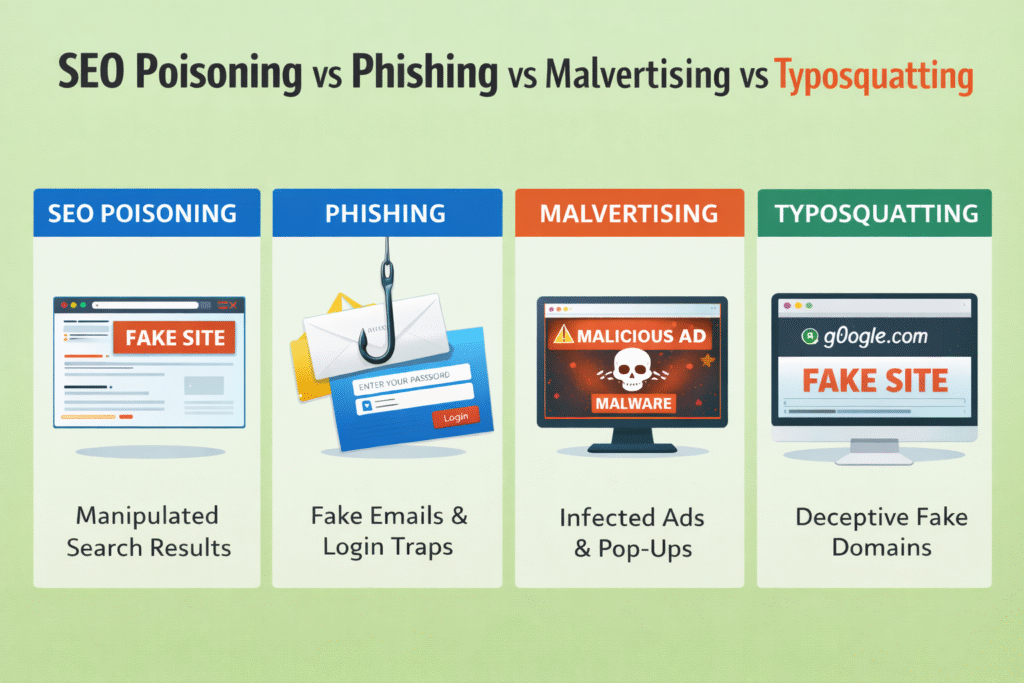
  • SEO POISONING: Before moving ahead with a detailed study, let’s take a quick look at a few terms that might be similar for some but do differ. An SEO poisoning attack is the manipulation of search engine results using Black Hat methods. Here, cyber attackers try to boost a website’s search results using unethical methods.
  • Phishing: It is an old-school method in which cyberattackers send spam emails and messages asking you for your personal information. Cyber attackers send links and messages pretending to be from reputable websites. They leverage the trust to ask for private details.
  • Malvertising: It is a method in which cyberattackers embed harmful code into a legitimate website ad. Once you click a link or an ad, it can slowly spread malware and steal your personal information.  
  • Typosquatting: Also known as URL hijacking, it is a method in which attackers create confusion by misspelling a website’s name or registering a similar domain to trick users. These fake websites are termed as sting sites or cousin domains. These sites help the attackers steal all your data and spread malware.

Common SEO Poisoning Techniques

SEO Poisoning attacks can be done in various ways. Let’s take note of a few popular methods that attackers use to create a search engine poisoning attack.

Keyword Stuffing: Attackers use trending search terms such as ‘free software download’ or ‘login pages’ to lure users into clicking links.

Compromised Websites: Cyber attackers might even exploit users’ trust. They might find a vulnerable website or embed malware on a trusted website to target users. Just a click, and users will be in their trap, manipulated into successfully manipulating search results.

Cloaking: It is a deceptive method in which search engine crawlers or bots are shown a different page than humans are shown. It helps them create a different picture for users, which boosts their ranking.

Typosquatting: Cyber attackers use this method to exploit misspelled or similar domain names to confuse users. Users are misled to a page where they might lose their personal information or important data.

Link Farm: Another technique to confuse or mislead users by interlinking many fake websites. With this method, they try to boost the authority of the tampered website.

How SEO Poisoning Attacks Users & Businesses?

  • Method of Keyword Stuffing and Black-Hat SEO Tactics: This is a method in which cyber attackers use unnatural repetition of keywords in content or meta tags to manipulate search engines. This method spoils the user experience and violates the search engine’s guidelines. This violation may ruin the website’s reputation, lead to a penalty, or lower its ranking.
  • Brief Discussion About Cloaking Techniques: It is a method in which cyber attackers serve different content to search engine crawlers or bots than to humans. It is a black hat technique that helps them manipulate search engine results. As the name suggests, the attackers hide the page behind another page and try to manipulate rankings and sabotage the website’s reputation.  
  • Exploiting Trusted Platforms Like Google Search Results: Another way to search engine poison is to mislead users into submitting information to a trusted platform. For example, they might use SEO poisoning MITRE framework, or the Google search engine as a cover to misadvertise and lure users. Here, they ask users to click links or ads, then request their details. SEO poisoning attacks might also introduce malware into your system or device via this method.

Real World Impact of Search Engine Poisoning

  • Credential theft or Data Breach: One of the prominent impacts of SEO poisoning is a data breach. Cyber attackers invade your privacy and steal your personal information. In some cases, they hack your bank details and do frauds. They might also share or misuse the personal information or access your online accounts.
  • Ransomware: Search poisoning also poses a risk of ransomware. It is often delivered through phishing emails or compromised websites. Here, users are tricked into opening or downloading infected files. This malware steals your private details or credentials.
  • Cyber Crimes or Online Phishing: we can say that cybercrime is a criminal activity that occurs online via devices like phones, laptops, PC. It covers crimes such as identity theft, banking fraud, and data theft. Within cybercrime, phishing is a common issue, as most users are tricked by it. In phishing, users are often lured by deceptive messages, emails, and links to share their information. Cyber attackers impersonate reputable platforms and trick users into sharing sensitive information.
  • Financial Losses: SEO poisoning attacks often lead to financial losses, as cybercriminals use the information to steal money. Cyber attackers use malicious methods to steal information and identity details, which leads to financial fraud.
  • Heavy Regulatory Penalties: After cyber attackers use Search engine poisoning methods, a website may lose credibility, leading to severe penalties. Any breach of search engine regulations will result in severe penalties.

Types Of Cyber Attacks:

  • Fake Login Pages: Recently, cyberattacks have seen a major increase in credential harvesting. They trick users into clicking on malicious links or downloading infected files, and eventually hack into all their accounts. They mask their malicious software under the name of trusted brands, and users fall for their trick. They often sign up for pages that require them to share their details.
  • Malicious Ads: These ads often appear on the pages of trusted websites where users simply fill in their information or click on it. Sometimes a simple click might give them access to all your credentials.
  • Software Downloads: Another way of an SEO poisoning attack is to introduce them. Users are shown or advised to download certain software that is infected with malware. Cybercriminals trick them into clicking on downloads and gain access to all their information.

How Cyber Security SEO Helps Defend Against SEO Poisoning?

Cyber security SEO, as ethical search engine poisoning strengthens security protocols, which eventually builds user trust. They create high-quality, understandable content, which also boosts users’ confidence. It is a simple white-hat technique that enhances user trust and keeps them from being manipulated. Content authenticity, a user-centric approach, and the prevention of negative SEO are a few elements that help mitigate search poisoning. Including them will enhance a website’s security and help maintain its reputation. Having a trusted platform will surely attract more users and help prevent search poisoning in cybersecurity.

Why SEO Poisoning Is Increasing In 2026?

  • Remote Working: SEO poisoning is on the rise, and its primary target is work-from-home employees. They trick remote workers and leverage their trust to trust certain platforms. Employees who rely on search engines for research and downloading are often targeted by SEO poisoning attackers.
  • Too Much Reliance on AI-Generated Content: Cyber attackers are using AI to generate large volumes of keyword-centric content and tamper with search results. They usually automatically redirect users to malware or phishing links.
  • Too Much Competition In Search Rankings: To rank higher, cybercriminals often take shortcuts by using Black-Hat methods to boost rankings.

SEO Poisoning Detection & Prevention Techniques

If you are looking for how to prevent SEO poisoning attacks, you need to understand the defense and detention techniques below:

  • White-Hat Optimization or Ethical Practices: It builds a strong and secure platform. The content is transparent and easy to understand, which builds trust with users.  
  • Regularly Monitoring Search Engine Results: Regular monitoring will help prevent technical issues such as broken links or indexing errors. It will also keep an eye on the ranking and help in maintaining it.
  • Threat Intelligence Integration: It equips your security team to detect and combat security threats and move from a reactive to a proactive posture.
  • Performing Regular Site Audits: This SEO poisoning trick ensures the immediate eradication of security issues, keeping the site safe and fast for users.

Preventions Organizations Can Take To Keep SEO Poisoning Risk At Bay

  • Collaborate with SEO & Cybersecurity Teams: To keep your site safe and secure, collaborate with SEO and cybersecurity teams. They ensure there are no vulnerabilities and that your website is safe and user-friendly.
  • Train Employees About Phishing Risks: Often, traditional security tools don’t work out. Employees often face the risk of search engine poisoning when they trust search engine platforms; training them is recommended.  
  • Regularly Monitor Search Results To Maintain Your Brand Name: Regularly checking search results will help keep technical issues at bay and build user trust in your brand.
  • No Harm In Investing in Some Cyber Threat Detection Tools: Users, especially remote employees, are often at risk of SEO poisoning attacks, so investing in a cyber threat detection tool is a good option.

Conclusion: Staying Protected In Evolving Threat Landscape 

In the article above, we discussed the recent threat of SEO poisoning attacks, how to fix SEO poisoning, and the reasons they may occur. Additionally, we have discussed ways to address them and the importance of training employees on this matter. At Backlink Matters, we also recommend collaborating with a cybersecurity SEO to ensure your data is fully protected.
How to Choose the Right SaaS SEO Agency in 2026: A Complete Guide for B2B SaaS Companies

In 2026, SEO isn’t just about getting keywords rank at the top of the search results. It’s about how signals such as structure, authority, clarity, and trust are now interpreted across search engines, how AI search makes your business more visible, how it grows your business through products, and how to use a full-funnel strategy. Choosing the right SaaS SEO agency can directly influence your pipeline, CAC, and long-term growth.

Why Do B2B SaaS Companies Need a Specialized SaaS SEO Agency?

B2B SaaS companies operate in a very different environment compared to eCommerce, local businesses, or traditional B2B services.  That’s why working with a specialized SaaS SEO agency isn’t just helpful, it’s often necessary for scalable growth.

SEO is not a one-size-fits-all strategy. The approach that works for a traditional business (like a local store, manufacturer, or service company) is very different from what works for a SaaS (Software as a Service) company.

B2B SaaS companies need a specialized SaaS SEO agency because of the following reasons:

  • A SaaS SEO agency tracks SEO performance against monthly recurring revenue, customer lifetime value, customer acquisition cost, and sales qualified leads, to make sure that organic traffic directly contributes to maintaining and increasing the recurring revenue.
  • To help prospects move seamlessly from research to demo or trial, they develop structured content for the awareness, comparison, alternative, integration, and BOFU stages.
  • SEO content is designed to inform, develop, and influence over time because B2B SaaS buyers conduct in-depth research and involve a number of decision-makers.
  • To guarantee appropriate indexing and visibility, they oversee intricate SaaS architectures such as feature pages, dynamic templates, app subdomains, and crawl budgets.
  • To compete with well-funded SaaS rivals and prominent review sites like G2 and Capterra, they create content that is intent-driven and authority-driven.
  • They turn customer FAQs, feature updates, integrations, and sales objections into high-intent SEO assets that encourage conversions.
  • They build an organic growth engine for compounding, long-term results using programmatic SEO, internal linking systems, and content clusters.

What Does a SaaS SEO Agency Actually Do?

SaaS SEO agencies work beyond the keywords targeting and content publishing. It creates a business designed for organic growth by generating qualified leads, demo bookings, and recurring revenue for subscription-based software businesses.

Unlike traditional SEO firms, it aligns content, technical SEO, product positioning, and revenue metrics to support the full B2B buyer journey from awareness to conversion and retention.

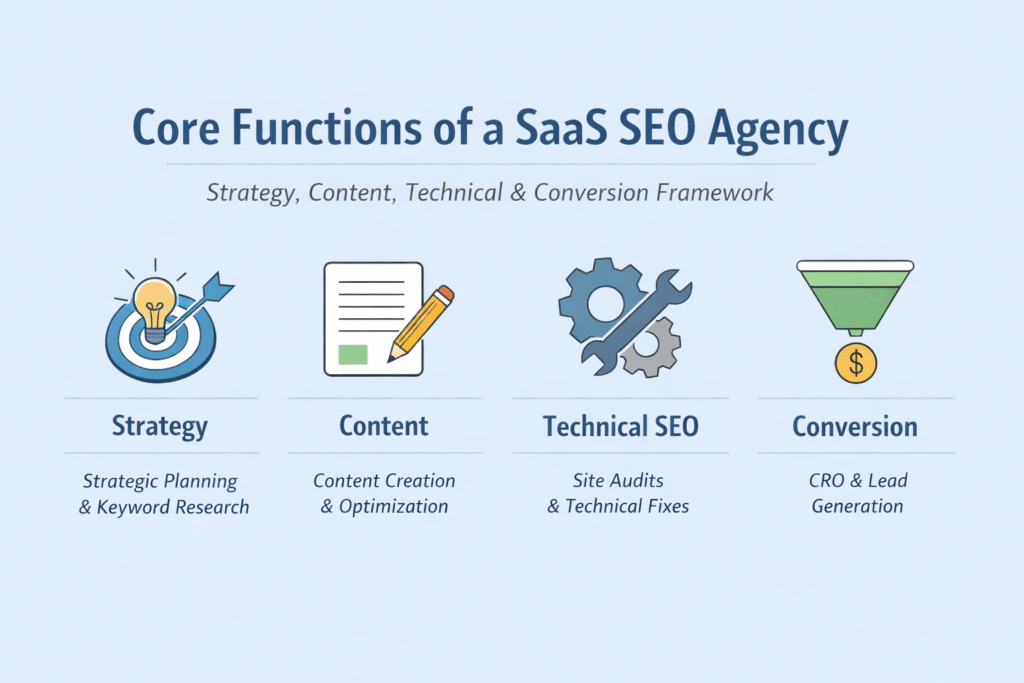
The Main Functions of a SaaS SEO Agency:

  • Creates an SEO Strategy Based on Revenue

links SEO efforts to pipeline, MRR, LTV, and CAC objectives rather than just traffic growth.

  • carries out in-depth keyword and intent research

finds comparison, integration, product-led, and high-intent keywords that draw in decision-makers as well as readers.

  • Produces Content for the Whole Funnel

creates BOFU landing pages, feature pages, use-case pages, comparison pages, “vs” pages, and awareness blogs to promote trials and demos.

  • Enhances SaaS Architecture Technical SEO

controls indexation, crawl budget, product templates, dynamic pages, app subdomains, and structured internal linking.

  • Increases Backlinks and Authority

acquires topical authority and high-quality backlinks to rival review sites like G2 and Capterra.

  • Develops Scalable and Programmatic SEO Systems

creates scalable landing page frameworks to promote compounding organic growth for use cases, locations, industries, and integrations.

  • Assists Sales and Product Teams

converts sales objections, product updates, and customer frequently asked questions into optimized content that accelerates the sales cycle.

  • Monitors Performance Using Revenue Measures

evaluates performance using more than just rankings or impressions; it also looks at pipeline contributions, revenue impact, demos, and SQLs.

Core Functions of a SaaS SEO Agency: Strategy, Content, Technical & Conversion Framework

functions of saas seo agency

Revenue-Oriented Keyword Approach

  • Targeting high-intent keywords that have a direct impact on demos, trials, and MRR (Monthly Recurring Revenue) rather than merely increasing sessions is known as the revenue-focused keyword strategy.
  • Keywords that are organized by funnel stage include BOFU (purchase intent), MOFU (solution evaluation), and TOFU (problem awareness) in order to direct users toward conversion.
  • Comparison pages, such as “X vs. Y,” are strategically created to attract high-intent traffic and buyers who are actively assessing competitors.
  • Alternative Pages: aims to attract unhappy rival users by focusing on “Best alternatives to X” searches.
  • In order to draw in solution-conscious prospects, feature-led SEO content creates SEO pages centered on the main features, advantages, and integrations of the product.

Content Strategy for SaaS

  • To increase topical authority and boost rankings, the Pillar + Cluster Model creates reputable pillar pages backed by interconnected cluster content.
  • Product-Led SEO aims to naturally direct traffic toward signups and demos by aligning content with product features and use cases.
  • Bottom-of-Funnel Landing Pages: These optimize high-intent pages that are centered around pricing, demos, trials, and solution-based queries.
  • Use Case Pages: These pages are tailored to a particular industry and role in order to draw in qualified leads who are looking for customized solutions.

Technical SEO for SaaS Websites

  • Site Structure for Scaling: To facilitate future growth and programmatic expansion, a logical, scalable URL and internal linking structure are designed.
  • In order to make sure search engines give priority to high-value pages, crawl optimization controls crawl budget, indexation, and technical directives.
  • Managing Dynamic Pages: Enhances template-driven and dynamically produced pages (such as industry pages or integrations) for appropriate indexation.
  • Core Web Vitals: Enhances user experience and rankings by improving site speed, stability, and performance.

Conversion Optimization

  • Demo Page Optimisation: Improves demo landing pages by adding trust signals, CTAs, compelling messaging, and reducing friction.
  • Trial Signups: Enhances signup and onboarding processes to boost the number of people who activate free trials.
  • Lead Magnet Offers: Captures and develops qualified leads through the use of gated resources (eBooks, templates, webinars).
  • Attribution tracking accurately measures the impact of demos, SQLs, and revenue by integrating SEO performance with CRM and analytics tools.

Key Traits of the Right SaaS SEO Agency

A right SaaS SEO agency provides a clear 6-12 month roadmap, laying out the full plan to ensure you’re in good hands. You’ll see real results in their work. They will not make false promises regarding instant results or vague growth over time. Instead, the right SaaS SEO agency will ensure you by showing similar SaaS clients’ case studies with real revenue impact, like increased qualified leads or pipeline growth, rather than just vanity metrics such as raw traffic.

Non-Negotiable Traits of B2B SaaS SEO Agency:

1. Proven B2B SaaS Case Studies

Reputable SaaS SEO firms need to display actual outcomes from other B2B SaaS businesses.

They are required to give evidence of:

  • Growth in natural traffic.
  • Increase in demo requests.
  • More people signed up for free trials.
  • A rise in Monthly Recurring Revenue.
  • Pipeline expansion from natural search

It is insufficient for an agency to display traffic screenshots with no effect on revenue.

A proficient B2B SaaS SEO firm links SEO initiatives to commercial outcomes.

2. Understanding of CAC, LTV & MRR

SaaS companies are supposed to understand the following matrices: 

  • CAC (Customer Acquisition Cost): The cost required to acquire a customer.
  • LTV (Lifetime Value): To understand how much revenue is generated per customer over time.

  • MRR (Monthly Recurring Revenue): To understand predictable recurring income.

The right SaaS SEO agency understands how SEO helps to:

  • Reduce CAC by lowering paid ad dependency

  • Increase LTV by targeting high-intent users

  • Grow recurring revenue through organic acquisition

If the agency talks only about rankings and backlinks, they may not understand SaaS growth.

3. Revenue Reporting, Not Just Rankings

Many agencies focus on Keyword rankings, Traffic increase, and Domain authority. But the best SaaS SEO agencies report Organic demo conversions, Trial signups, Sales-qualified leads (SQLs,) and Revenue influenced by SEO

Rankings are important, but revenue is the real goal.

Your SEO agency for SaaS should track performance from keyword → traffic → demo → revenue.

4. Strong Content and Technical SEO Team

SaaS websites are often complex. They include:

  • Product pages

  • Use case pages

  • Feature pages

  • Integration pages

  • Comparison pages

A strong SaaS SEO agency must have:

  • Content strategists

  • Technical SEO experts

  • SaaS-focused writers

  • Experience with structured site architecture

Content without technical SEO will not rank. Technical SEO without strong content will not convert.

You need both.

5. Transparent Process and Clear Communication

The right SaaS SEO agency works with transparency.

They should provide:

  • A clear strategy

  • Monthly deliverables

  • Regular reporting

  • Clear KPIs

  • Ongoing performance updates

You should always know what work is being done and how it supports your SaaS growth.

6. Clear 6–12 Month SEO Roadmap

For SaaS businesses, SEO takes time. A competent SaaS SEO company will offer a detailed roadmap for the next six to twelve months.

This roadmap ought to comprise:

Months 1-2: 

  • Audit of the website
  • Research on competitors
  • Strategy for keywords
  • Technical solutions

Months 3–6: 

  • Release content at the bottom of the funnel
  • Make product pages more efficient.
  • Begin constructing links.
  • Scale content clusters in months six through twelve
  • Establish authority
  • Boost conversion rates
  • Investing in SEO takes time. There is no clear direction in the absence of a roadmap.

Best SaaS SEO Agencies in the US

Backlinks Matters: For White Label Link Building

backlinksmatters the backlink building agency

Backlinks Matters is a dedicated link building and SEO services agency focused on helping businesses improve their search engine visibility and organic rankings through high-quality backlink acquisition, outreach, and content marketing.

They have specialization in building relevant, permanent do-follow backlinks that strengthen domain authority and drive sustainable traffic growth.

Their Services include:

  • Seo Outreach 
  • White label link building
  • Niche edit service
  • Keyword research service
  • Guest Posting Service
  • Blogger outreach service
  • Link building service
  • In-house link-building service
  • Outsource link building service

Apart from these services, they offer customized SEO packages as per the client’s requirements.

TrustPilot Ratings: 4.0 / 5

TripleDart: For Revenue-Driven SaaS Marketing

tripledart

TripleDart is a B2B SaaS SEO company that uses performance-driven SEO, content, and demand-generation tactics to produce quantifiable outcomes.

They specialize in building scalable organic acquisition systems that align SEO with product positioning, sales funnel stages, and revenue metrics like MRR and pipeline contribution.

Their Services include:

  • SaaS SEO strategy
  • Content marketing for SaaS
  • Product-led growth marketing
  • Demand generation
  • Paid media for SaaS
  • SEO + Content integration
  • Conversion-focused landing pages
  • Marketing analytics & attribution

Apart from these services, they offer customized SaaS growth frameworks tailored to different funding stages

Trustpilot Ratings: 4.8 / 5

Quoleady: SaaS Content Marketing Agency

quoleady

Quoleady is a SaaS-focused SEO and content marketing agency that uses authority backlinks and thoughtful, outstanding content to help software companies scale organic growth.

They specialize in thought-leadership content, data-driven link building, and SEO content strategies that attract high-intent traffic and support long sales cycles typical in B2B SaaS.

Their Services include:

  • SaaS SEO
  • Content strategy development
  • SEO blog writing
  • White-hat link building
  • Guest posting
  • Digital PR
  • Content repurposing
  • Landing page optimization

Apart from these services, they provide tailored content marketing programs designed specifically for SaaS startups and scaling tech companies.

Trustpilot Ratings: 4.9 / 5

How Long Does SaaS SEO Take to Show Results?

There is no magic trick to get instant results. SaaS SEO is a long-term growth strategy; it requires time to build authority,  improve rankings, and earn trust from search engines. Typically, SaaS companies begin seeing early signs of progress within 3 to 6 months, while meaningful pipeline and revenue impact usually takes 6 to 12 months.

Initially, they focus on technical optimization, keyword research aligned to the sales funnel, competitor analysis, and publishing high-intent content. All these efforts are not for the traffic increase.

As the months go by, optimized pages start to rank for pertinent keywords, particularly bottom-of-funnel queries that lead to free trial signups and demo requests. Strong internal linking, regular content publishing, and the acquisition of high-quality backlinks all contribute to the development of domain authority by the six to twelve-month mark.

This is the time when SaaS SEO starts booming, organic traffic increases, ranking improves faster, and the channels start contributing to conversions and customer acquisition. Then, after a year of executing these efforts, SEO would become the best channel among all.

Wrapping it up: Choosing the Right SaaS SEO Agency

SaaS SEO is no more about simply ranking the keywords, It’s more about building a revenue-driven, full-funnel organic growth engine that directly impacts pipeline, CAC, LTV, and MRR(Monthly Recurring Revenue). SaaS SEO agencies work in a complex buying environment where multiple stakeholders research deeply before booking a demo or getting a trial. That is why choosing the right SEO agency is critical nowadays. 

The ideal SaaS SEO agency creates a robust technical architecture, builds intent-driven content across awareness to BOFU stages, comprehends SaaS economics, and links every SEO endeavor to quantifiable business results.

Cyber Security SEO Guide: Best Ranking Strategies for Security Websites

Cybersecurity is a busy space. Every company says that they are the safest, smartest, and are using the most advanced industry methods, but when user searches for answers or a security solution, merely a fraction of websites actually show up.

That gap in visibility is why cybersecurity seo matters

Let’s clear the doubts, cybersecurity seo is not about gaming search engines or stuffing keywords like a big jar of chocolate cookies, it is about making sure that your website provides genuine solutions and cybersecurity content that is trusted both by users and search engines.

This is much more difficult in cybersecurity than in most industries, like eCommerce and Saas because the topics are technical and require both technical and good writing skills, and that’s why  Google expects a high level of credibility.

So in this article, we will break down what cybersecurity seo actually means, how Google checks the cybersecurity websites, and what practical measures you can take to increase your ranking in the search, without going into the shady tactics that hurt trust.

Let’s begin

What is Cyber Security SEO?

Cybersecurity SEO is simply the practice of optimizing a website that provides cybersecurity and data protection services, so it can rank in Google search results while also maintaining high standards, such as accuracy in information, trust, and content depth.

Unlike traditional SEO, cybersecurity SEO addresses topics that directly impact people’s digital security, data, and business. This is why Google considers it high-stakes content; search engines are much more cautious when ranking this type of content because wrong information can cause real harm. As a result, shallow blogs, plagiarized content, and claims without facts rarely perform well.

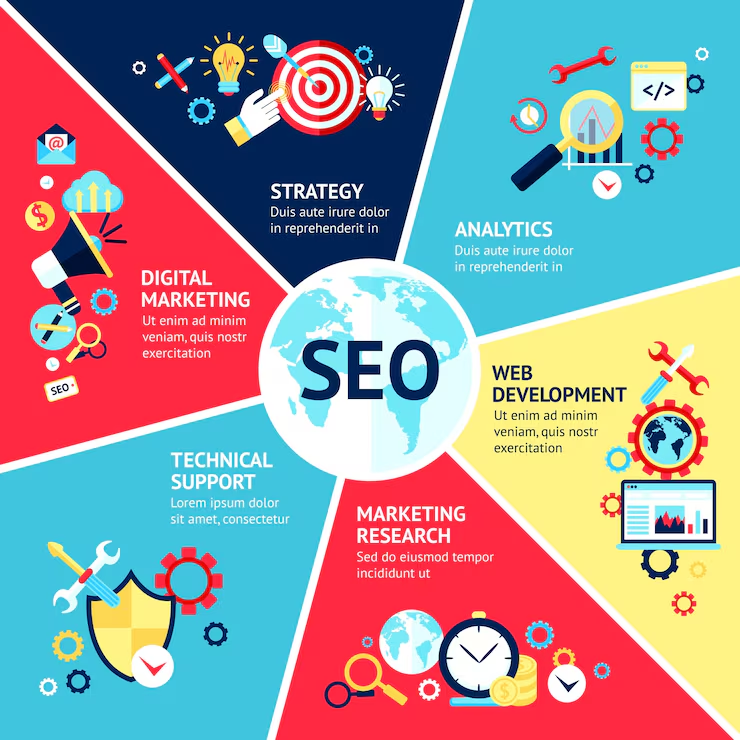
Cyber Security SEO

                                                                                                        [Image Source: Freepik]

Let’s see the 3 main things that cyber security is about.

First, clarity. Complex and hard to grasp ideas for a general audience, like threat models, encryption zero day vulnerabliies should be explained in a way that is easy to understand for an audience who has nearly zero knowledge of cybersecurity.

Second, credibility is also a must; Google looks closely at those websites that are publishing content, how experiences they appear, and if other trusted websites reference them, through backlinks.

Third, and the most important, search intent. A person who is searching for “ransomware protection” wants something completely different from someone who is searching “enterprise endpoint security software.”

A good cyber security SEO is always up to mark in technical accuracy with search intent. This helps search engines to understand what your website is offering, who is your target audience and why it deserves to rank.

When this is executed well, it does not water down expertise and makes it easier to find.

How Does Google Rank CyberSecurity Websites?

Google is very careful when ranking cybersecurity websites. The reason is simple, as I explained before, that people rely on this information to protect their systems data and sometimes their entire businesses. Because of that, Google put much stricter standards, compared to less sensitive topics like “food recipes” or “binge-worthy shows.”

One of the biggest factors is trust. Google checks for clear signals that a cybersecurity website provides information that is factually correct, and the author knows what they are talking about. This includes accurate content, transparent authorship (Author Bio), and signs of real-world experiences.

Pages that explain who is behind the website, what their background is, and how their knowledge is useful usually performs better on the search engine over time. And this can be easily achieved by adding an author bio in your articles and showcasing expertise.

Content quality also plays an important role. Google prefers a detailed explanation that goes a bit into depth and beyond the surface level. In this  field, it is very important to demonstrate the ability to research deeply into the topic, make your articles a bit more detailed, don’t just state the fact or go over them briefly, dive deeper into them, and explain them to your audience in an extensive manner

Other websites that refer to your website can boost domain authority and give you more credibility, and by reference, I mean backlinks. It is a very significant sign of expertise if authoritative cybersecurity websites, research organization or tech magazines are linking back to your website. These backlinks tells Google that your website is an integral part of a fully established network in the field, thus increasing your chances of ranking well in search engines.

Finally, usability and technical health of the websites are also very important. Your pages need to load reliably, work responsively on all devices,s and should be easy to navigate. Even many strong cybersecurity websites struggle to rank well solely due to the reason that their website is slow, confusing, or structured in a poor manner.

If we summarize everything in this section in one line, Google ranks cybersecurity websites by asking a few questions.

Is this accurate? Is this trustworthy? Is this useful for the searcher? Cyber Security SEO is about answering yes to all three.

5 Tips To Rank Your Cybersecurity Website

Ranking a cybersecurity website is not about some clever, shady tricks; it’s more like following a structured strategy.

Cyber Security SEO rewards those websites that are consistent, accurate, and focused on long-term growth.

Here are 5 practical tips to actually move the needle of your rankings.

1. Keyword Research for Cyber Security SEO

Keyword research is a must, not only in cybersecurity SEO but also in traditional SEO. In the initial stages, you should not focus on how vendor describe their products; start with understanding how people actually search.

People with different occupations, like security professionals, founders, and decision makers, all use different languages. Your main focus should be on bridging that gap without diluting accuracy.

 Focus on intent before keyword volume, for instance, a keyword like “cybersecurity frameworks for small businesses” can bring less search than a broader term, but it attracts the right audience. Long tail keywords often perform better in cybersecurity because these types of searches are more specific and problem-driven

Stop chasing every trending term; instead, build a cluster around core cybersecurity topics, like a pillar page. Such as ransomware, cloud security, or endpoint protection.  

This helps Google understand topical depth and add your sites to the list of serious resources instead of in a collection of unrelated pages.

2. Building Authority With Backlinks in SEO for CyberSecurity

Backlinks matter a lot in SEO for Cyber Security, but quality matters much more than quantity. A single link from a trusted security blog, any research-based publication, or even a tech outlet can outweigh dozens of low-quality links from random websites with low DA (Domain Authority).

Also Keep in mind that authority is built through contribution, not manipulation. Publishing research-based, technical background analysis gives others a reason to reference your works. 

Building Authority With Backlinks

If you believe you have good articles and resources, then you can manually approach them for a mutual collaboration, or if you want to save the hassle, you can purchase the backlinks from a trusted source that provides genuine backlinks from the most relevant websites in your industry. 

A great source for purchasing high-quality backlinks is Backlinks Matters

Want to Build Authority Without Chasing Collaborators?

Backlinks Matters focuses on relevant, industry-specific placements that support long-term authority rather than quick wins.

3. Technical SEO for CyberSecurity

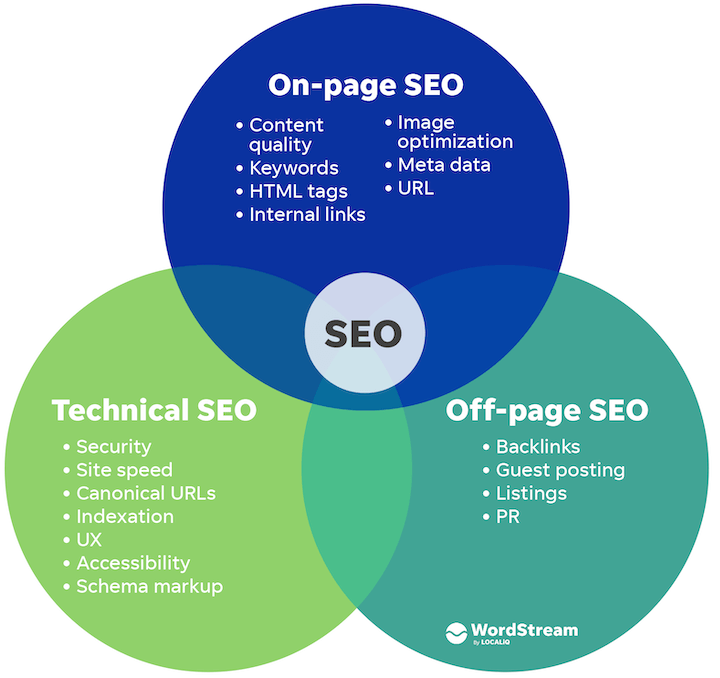
As we have discussed before, Technical SEO for CyberSecurity companies is non-negotiable for cybersecurity websites. If your site takes ages to load, is broken, or insecure, then it can directly undermine trust.

Technical SEO for CyberSecurity

                                                                                                     [Image Source: WordStream]

Don’t get overwhelmed. Start with the basics. 

  • Pages should load quickly
  • Pages should work properly on mobile devices and tablets
  • Follow a clean website’s structure
  • Your website should be secured with SSL (Https)

Apply these basic but essential tips, because broken links, crawling errors, or messy URLs can send a negative signal to search engines.

Clear schema and sitemaps, proper indexing, and logical internal links that connect the source and referred article can help Google understand your content better.

In SEO for cybersecurity, technical health supports credibility. How do you expect to provide good security services to your users, if your own websites take ages to load and have technical issues

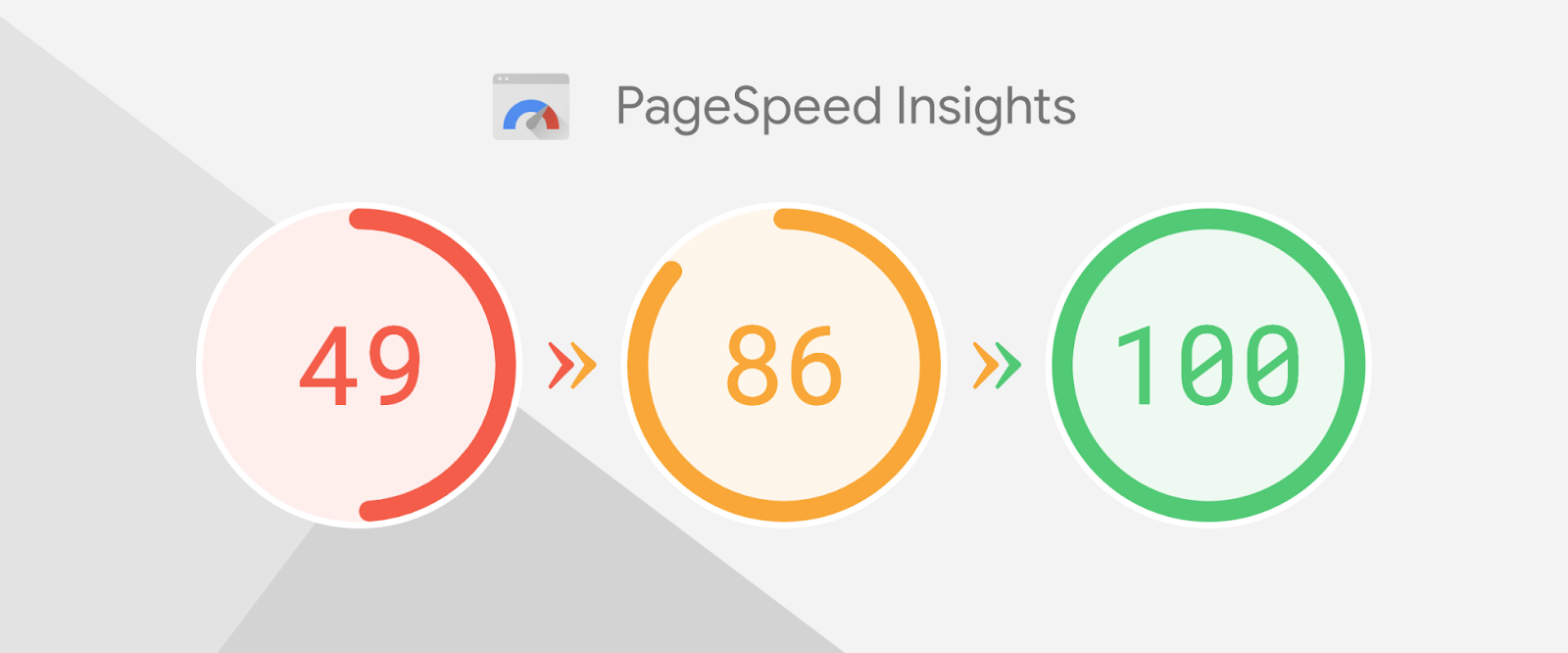
A website that looks careless rarely ranks well, no matter how strong the content is, so make sure to consider the basics of technical SEO for cybersecurity, and perform regular checks with tools like PageSpeed Insights

4. Build Credibility With Guest Posts

Guest Posting is one of the most effective ways to build authority in Cyber Security SEO, only if it’s done properly. Your goal here should not be to just get backlinks; you should be more focused on getting visibility from the right circles.

Choose those platforms or websites for guest posting that are highly respected and recognized in the cybersecurity or broader tech niche. What is most important here is to show proficiency instead of being promotional.

Well, research your ideas, do a detailed technical analysis before publishing content, because they are far better than sales-oriented articles.

Readers seeing your name or your brand mentioned on reputable websites has a good impact on Google, too. With time, this helps you to build authority and trust without pressure. 

5. Measuring Performance

Measuring Cyber Security SEO performance is also important and goes beyond just checking rankings. Traffic alone does not tell the full story.

How do you expect to know if your cybersecurity seo strategies are working or not if you don’t continuously measure the performance? 

Regularly track which pages attract qualified visitors, how long they stay (using the bounce rate metric), and what action they take next (use heatmap tools like clarity).

Measuring Cyber Security SEO performance

                                                                                                  [Image Source: Engage Intractive]

Look at search queries in Google Search Console to see if your content is matching the users’ search intent. If the audience doesn’t stay long, then something is lacking or too complicated to understand

Conducting performance review regularly can help you identify which approaches works and which need improvement

Keep in mind that cybersecurity seo is not a one-off task; it is an everyday cycle of experimenting, understanding, and readjusting your cybersecurity seo strategies based on factual data

Final Words

So we have reached the end of this article. What is the conclusion you should draw from this article?

The conclusion is that SEO for Cyber Security is not like looking at algorithms or copying the stuff you saw work in some other industry. It is more like earning visibility and trust from your users and from Google itself.

Those websites that consistently rank in the top position are concerned with their audience. 

They publish content that reflects the real understanding of the field, maintain a technically sound website, and build authority by contributing to the wider field of cybersecurity by publishing guest posts and building authority through backlinks.

None of this happens overnight, that’s the point

If you approach SEO for Cyber Security with patience and honesty, the results tend to compound.