#1 WordPress SEO Services Company: Increase Traffic & Boost Results

In today’s digital-first world, simply having a WordPress website is not enough. With millions of websites competing for attention, businesses need a strategic approach to stand out, attract the right audience, and convert visitors into customers. That’s where professional WordPress SEO services come in.

A dedicated WordPress SEO services company helps businesses improve search visibility, drive consistent organic traffic, and achieve measurable growth. Whether you are a small business, SaaS brand, or enterprise organization, SEO tailored specifically for WordPress can unlock long-term success.

Why WordPress SEO Matters in 2026

WordPress continues to dominate the internet, powering over 40% of all websites globally. Its flexibility, scalability, and extensive plugin ecosystem make it the platform of choice for businesses of all sizes. From blogs and corporate websites to SaaS platforms and enterprise portals, WordPress remains the backbone of modern web development.

However, as WordPress adoption grows, so does competition. Search engines have become more sophisticated, prioritizing user experience, technical performance, and content quality more than ever before. Simply installing an SEO plugin is no longer enough to rank.

This is why WordPress SEO services are critical in 2026. They combine technical optimization, content strategy, and authority building to help WordPress websites rank higher, load faster, and convert better. Businesses that invest in professional SEO gain a competitive edge that compounds over time.

What Are WordPress SEO Services?

WordPress SEO services are specialized optimization strategies designed specifically for WordPress-powered websites. These services focus on improving search engine visibility while leveraging WordPress’s unique architecture, themes, and plugins.

Unlike general SEO, WordPress SEO takes platform-specific factors into account. This includes optimizing WordPress themes, managing plugin conflicts, improving database performance, and ensuring clean URL structures. It also involves tailoring content and metadata to work seamlessly with WordPress SEO tools.

Businesses that benefit from WordPress SEO services include:

  • Small and medium-sized enterprises (SMEs) looking for cost-effective growth
  • Local businesses aiming to dominate regional searches
  • SaaS companies competing in high-intent keyword spaces
  • Enterprises managing large WordPress websites with thousands of pages

Why Choose a Dedicated WordPress SEO Services Company?

Hiring a dedicated WordPress SEO services company provides far more value than generic SEO support. WordPress-specific expertise ensures that every optimization effort aligns with the platform’s best practices.

A specialized company understands how WordPress plugins, themes, hosting, and WordPress core updates impact SEO. They can identify technical bottlenecks, improve performance, and prevent issues that commonly hurt rankings.

More importantly, professional WordPress SEO services are designed for long-term ROI. Instead of quick fixes, they focus on sustainable growth, scalability, and adaptability as search algorithms evolve. This makes them ideal for businesses planning to grow steadily over time.

Core WordPress SEO Services We Offer

A comprehensive WordPress SEO strategy combines multiple services working together. Each component plays a vital role in improving rankings, traffic, and conversions.

On-Page SEO Services for WordPress

On-page SEO services are the foundation of any successful SEO strategy. For WordPress websites, this starts with content optimization that aligns with search intent and user expectations.

Professionally optimized content includes keyword mapping, structured headings, internal linking, and readability enhancements. Metadata such as title tags and meta descriptions are crafted to improve click-through rates from search results.

User experience is another critical factor. WordPress on-page SEO focuses on improving navigation, mobile responsiveness, and page load times. A fast, user-friendly website not only ranks better but also keeps visitors engaged longer.

Off-Page SEO & Link Building Services
backlinks matters

                                                           Source backlinksmatters

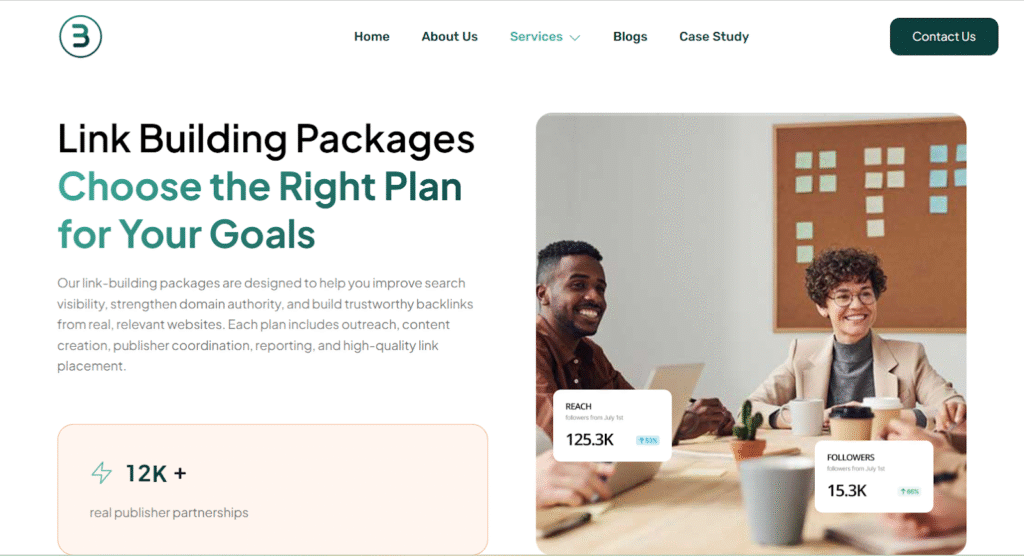
Off-page SEO plays a critical role in building authority and trust for your WordPress website. Our off-page SEO and link-building services focus on acquiring high-quality, relevant backlinks through ethical, white-hat practices.

We implement strategic link-building campaigns that include guest posting, niche edits, digital PR, and brand mentions. Our SEO outreach services help your WordPress site earn authoritative links that improve domain strength, keyword rankings, and long-term credibility.

By combining on-page optimization, technical SEO, and off-page link building, we deliver a complete WordPress SEO solution that drives sustainable traffic growth and measurable results.

Build Long-Term SEO Authority with High-Quality Backlinks

Backlinks Matters delivers relevant, industry-specific link placements that support sustainable SEO growth and long-term rankings

Technical WordPress SEO Optimization

Technical SEO ensures that search engines can properly crawl, index, and understand your WordPress website. This includes optimizing site structure, fixing crawl errors, and managing duplicate content issues.

Core Web Vitals play a major role in rankings. Technical WordPress SEO focuses on improving loading speed, interactivity, and visual stability across all devices. Clean code, optimized images, and efficient caching are essential here.

Schema markup and indexing strategies further enhance visibility by helping search engines display rich results. This leads to higher click-through rates and improved organic performance.

Advanced WordPress SEO Optimization Service​ for Growth

WordPress SEO Services

For businesses looking to scale aggressively, advanced SEO strategies are essential. These solutions go beyond basic optimization and focus on authority, automation, and competitive dominance.

Enterprise SEO Services for Large WordPress Websites

Enterprise SEO services are designed for large WordPress websites with extensive content libraries and complex structures. Managing thousands of pages requires advanced keyword segmentation, content governance, and technical precision.

Enterprise SEO includes automation tools for audits, reporting, and performance tracking. It also focuses on advanced internal linking strategies and data-driven optimization to ensure every page contributes to overall growth.

These services are ideal for enterprises, large publishers, and high-growth SaaS platforms operating on WordPress.

Local SEO Services for WordPress Businesses

Local businesses rely heavily on location-based visibility. It focuses on optimizing Google Business Profiles, creating geo-targeted landing pages, and building local citations.

Location-based keywords help businesses appear in “near me” and regional searches. Optimized WordPress pages combined with local SEO strategies drive high-intent traffic that converts into real customers.

For small businesses, these services often outperform paid ads in terms of ROI, making them essential for sustainable growth.

SEO Outreach Services: Building Authority for WordPress Sites

Backlinks remain one of the strongest ranking factors in SEO. High-quality backlinks signal trust, authority, and relevance to search engines.

SEO outreach services focus on acquiring backlinks through ethical, white-hat methods. This includes guest posting, editorial placements, and digital PR campaigns that build genuine authority.

A strong outreach strategy not only improves rankings but also increases brand visibility and referral traffic. For WordPress websites competing in crowded niches, link building is often the differentiator between page one and page two rankings.

How WordPress SEO Services Increase Traffic & Boost Results

Professional WordPress SEO services deliver measurable results across multiple dimensions. Improved keyword rankings lead to higher organic traffic, while optimized content attracts users who are actively searching for solutions.

Beyond traffic, SEO enhances conversion rates by improving site usability and aligning content with user intent. Visitors spend more time on the site, engage with key pages, and are more likely to take action.

The real-world impact of WordPress SEO is long-term and compounding. Unlike paid advertising, organic growth continues to deliver value even after initial investments.

Industries That Benefit from WordPress SEO Services

WordPress SEO services are versatile and adaptable across industries.

Service-based businesses benefit from lead-focused optimization and local SEO strategies.
eCommerce brands improve product visibility and transactional traffic.
SaaS companies rely on SEO for scalable, high-intent user acquisition, often working with a specialized SaaS SEO agency.
Local businesses gain consistent foot traffic and inquiries through regional searches.
Enterprises leverage enterprise SEO services to manage large-scale growth and brand authority.

How to Choose the Right WordPress SEO Services Company

Selecting the right SEO partner is crucial for success. Experience with WordPress-specific challenges is a key indicator of expertise.

A reliable SEO company uses advanced tools, provides transparent reporting, and follows ethical SEO practices. Avoid agencies that promise instant rankings or use black-hat techniques.

Custom strategies tailored to business goals separate professional providers from generic agencies. Many of the best SEO companies for small businesses focus on flexibility, communication, and measurable outcomes.

WordPress SEO Services: Pricing & Engagement Models

Pricing models vary based on business size and goals. Monthly SEO plans are ideal for long-term growth and consistent optimization.

Project-based SEO works well for website launches, migrations, or audits.
Enterprise SEO plans are customized for large organizations with complex requirements.

The right pricing model aligns with growth objectives, the level of competition, and desired outcomes.

(FAQs)

How long does WordPress SEO take?
SEO is a long-term strategy. Initial improvements may appear within 3–4 months, while significant growth typically takes 6–12 months.

Is WordPress good for SEO?
Yes, WordPress is highly SEO-friendly when properly optimized with the right themes, plugins, and strategies.

Do plugins replace SEO services?
No. Plugins assist with implementation, but professional SEO expertise is required for strategy, analysis, and growth.

Is SEO a one-time or ongoing process?
SEO is ongoing. Search algorithms, competitors, and user behavior constantly change, requiring continuous optimization.

Conclusion: Grow Faster with Professional WordPress SEO Services

Professional WordPress SEO services provide businesses with a powerful growth engine. From technical optimization and content strategy to SEO outreach services and enterprise SEO services, a comprehensive approach delivers sustainable results.

By partnering with an experienced WordPress SEO services company, businesses gain expertise, scalability, and a competitive advantage in search results.
If you want to increase traffic, boost rankings, and drive consistent growth, investing in professional WordPress SEO is the smartest move you can make in 2026.

Cyber Security SEO Guide: Best Ranking Strategies for Security Websites

Cybersecurity is a busy space. Every company says that they are the safest, smartest, and are using the most advanced industry methods, but when user searches for answers or a security solution, merely a fraction of websites actually show up.

That gap in visibility is why cybersecurity seo matters

Let’s clear the doubts, cybersecurity seo is not about gaming search engines or stuffing keywords like a big jar of chocolate cookies, it is about making sure that your website provides genuine solutions and cybersecurity content that is trusted both by users and search engines.

This is much more difficult in cybersecurity than in most industries, like eCommerce and Saas because the topics are technical and require both technical and good writing skills, and that’s why  Google expects a high level of credibility.

So in this article, we will break down what cybersecurity seo actually means, how Google checks the cybersecurity websites, and what practical measures you can take to increase your ranking in the search, without going into the shady tactics that hurt trust.

Let’s begin

What is Cyber Security SEO?

Cybersecurity SEO is simply the practice of optimizing a website that provides cybersecurity and data protection services, so it can rank in Google search results while also maintaining high standards, such as accuracy in information, trust, and content depth.

Unlike traditional SEO, cybersecurity SEO addresses topics that directly impact people’s digital security, data, and business. This is why Google considers it high-stakes content; search engines are much more cautious when ranking this type of content because wrong information can cause real harm. As a result, shallow blogs, plagiarized content, and claims without facts rarely perform well.

Cyber Security SEO

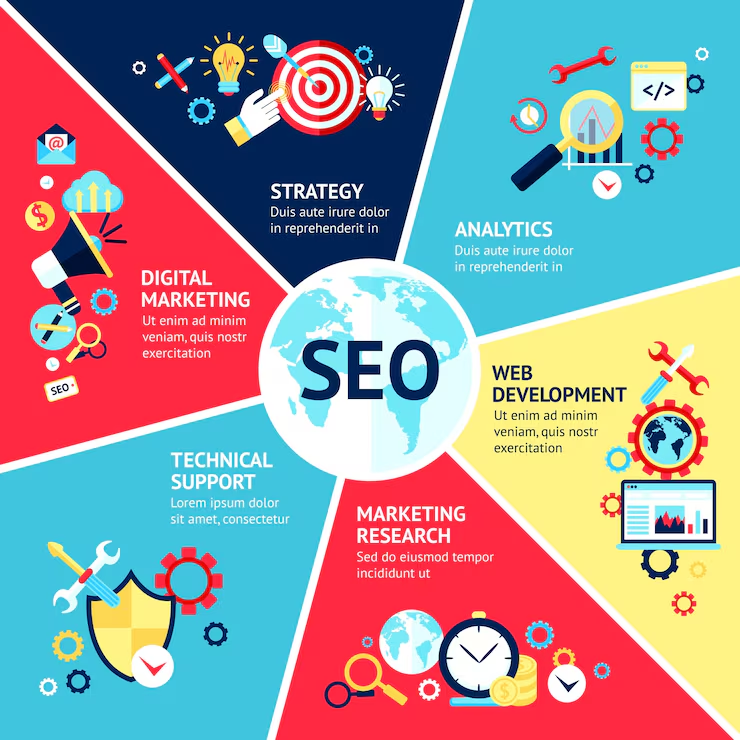
                                                                                                        [Image Source: Freepik]

Let’s see the 3 main things that cyber security is about.

First, clarity. Complex and hard to grasp ideas for a general audience, like threat models, encryption zero day vulnerabliies should be explained in a way that is easy to understand for an audience who has nearly zero knowledge of cybersecurity.

Second, credibility is also a must; Google looks closely at those websites that are publishing content, how experiences they appear, and if other trusted websites reference them, through backlinks.

Third, and the most important, search intent. A person who is searching for “ransomware protection” wants something completely different from someone who is searching “enterprise endpoint security software.”

A good cyber security SEO is always up to mark in technical accuracy with search intent. This helps search engines to understand what your website is offering, who is your target audience and why it deserves to rank.

When this is executed well, it does not water down expertise and makes it easier to find.

How Does Google Rank CyberSecurity Websites?

Google is very careful when ranking cybersecurity websites. The reason is simple, as I explained before, that people rely on this information to protect their systems data and sometimes their entire businesses. Because of that, Google put much stricter standards, compared to less sensitive topics like “food recipes” or “binge-worthy shows.”

One of the biggest factors is trust. Google checks for clear signals that a cybersecurity website provides information that is factually correct, and the author knows what they are talking about. This includes accurate content, transparent authorship (Author Bio), and signs of real-world experiences.

Pages that explain who is behind the website, what their background is, and how their knowledge is useful usually performs better on the search engine over time. And this can be easily achieved by adding an author bio in your articles and showcasing expertise.

Content quality also plays an important role. Google prefers a detailed explanation that goes a bit into depth and beyond the surface level. In this  field, it is very important to demonstrate the ability to research deeply into the topic, make your articles a bit more detailed, don’t just state the fact or go over them briefly, dive deeper into them, and explain them to your audience in an extensive manner

Other websites that refer to your website can boost domain authority and give you more credibility, and by reference, I mean backlinks. It is a very significant sign of expertise if authoritative cybersecurity websites, research organization or tech magazines are linking back to your website. These backlinks tells Google that your website is an integral part of a fully established network in the field, thus increasing your chances of ranking well in search engines.

Finally, usability and technical health of the websites are also very important. Your pages need to load reliably, work responsively on all devices,s and should be easy to navigate. Even many strong cybersecurity websites struggle to rank well solely due to the reason that their website is slow, confusing, or structured in a poor manner.

If we summarize everything in this section in one line, Google ranks cybersecurity websites by asking a few questions.

Is this accurate? Is this trustworthy? Is this useful for the searcher? Cyber Security SEO is about answering yes to all three.

5 Tips To Rank Your Cybersecurity Website

Ranking a cybersecurity website is not about some clever, shady tricks; it’s more like following a structured strategy.

Cyber Security SEO rewards those websites that are consistent, accurate, and focused on long-term growth.

Here are 5 practical tips to actually move the needle of your rankings.

1. Keyword Research for Cyber Security SEO

Keyword research is a must, not only in cybersecurity SEO but also in traditional SEO. In the initial stages, you should not focus on how vendor describe their products; start with understanding how people actually search.

People with different occupations, like security professionals, founders, and decision makers, all use different languages. Your main focus should be on bridging that gap without diluting accuracy.

 Focus on intent before keyword volume, for instance, a keyword like “cybersecurity frameworks for small businesses” can bring less search than a broader term, but it attracts the right audience. Long tail keywords often perform better in cybersecurity because these types of searches are more specific and problem-driven

Stop chasing every trending term; instead, build a cluster around core cybersecurity topics, like a pillar page. Such as ransomware, cloud security, or endpoint protection.  

This helps Google understand topical depth and add your sites to the list of serious resources instead of in a collection of unrelated pages.

2. Building Authority With Backlinks in SEO for CyberSecurity

Backlinks matter a lot in SEO for Cyber Security, but quality matters much more than quantity. A single link from a trusted security blog, any research-based publication, or even a tech outlet can outweigh dozens of low-quality links from random websites with low DA (Domain Authority).

Also Keep in mind that authority is built through contribution, not manipulation. Publishing research-based, technical background analysis gives others a reason to reference your works. 

Building Authority With Backlinks

If you believe you have good articles and resources, then you can manually approach them for a mutual collaboration, or if you want to save the hassle, you can purchase the backlinks from a trusted source that provides genuine backlinks from the most relevant websites in your industry. 

A great source for purchasing high-quality backlinks is Backlinks Matters

Want to Build Authority Without Chasing Collaborators?

Backlinks Matters focuses on relevant, industry-specific placements that support long-term authority rather than quick wins.

3. Technical SEO for CyberSecurity

As we have discussed before, Technical SEO for CyberSecurity companies is non-negotiable for cybersecurity websites. If your site takes ages to load, is broken, or insecure, then it can directly undermine trust.

Technical SEO for CyberSecurity

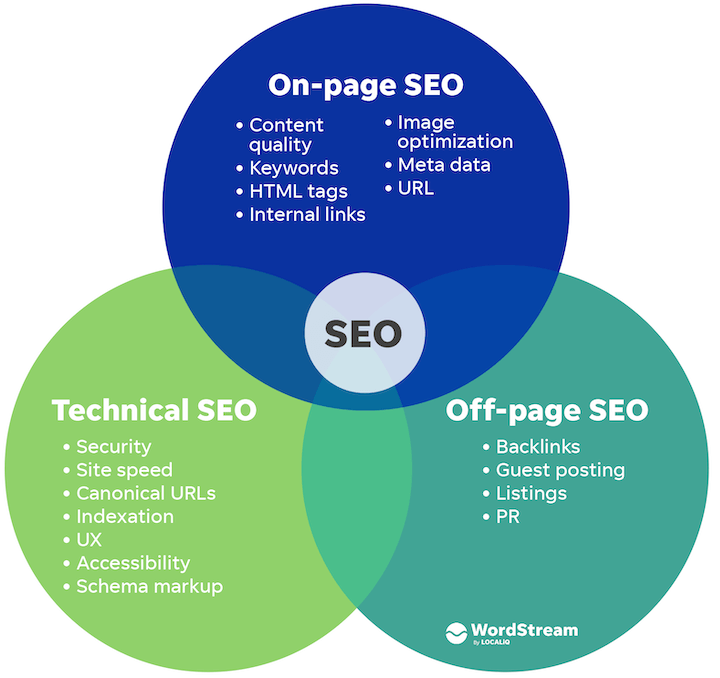
                                                                                                     [Image Source: WordStream]

Don’t get overwhelmed. Start with the basics. 

  • Pages should load quickly
  • Pages should work properly on mobile devices and tablets
  • Follow a clean website’s structure
  • Your website should be secured with SSL (Https)

Apply these basic but essential tips, because broken links, crawling errors, or messy URLs can send a negative signal to search engines.

Clear schema and sitemaps, proper indexing, and logical internal links that connect the source and referred article can help Google understand your content better.

In SEO for cybersecurity, technical health supports credibility. How do you expect to provide good security services to your users, if your own websites take ages to load and have technical issues

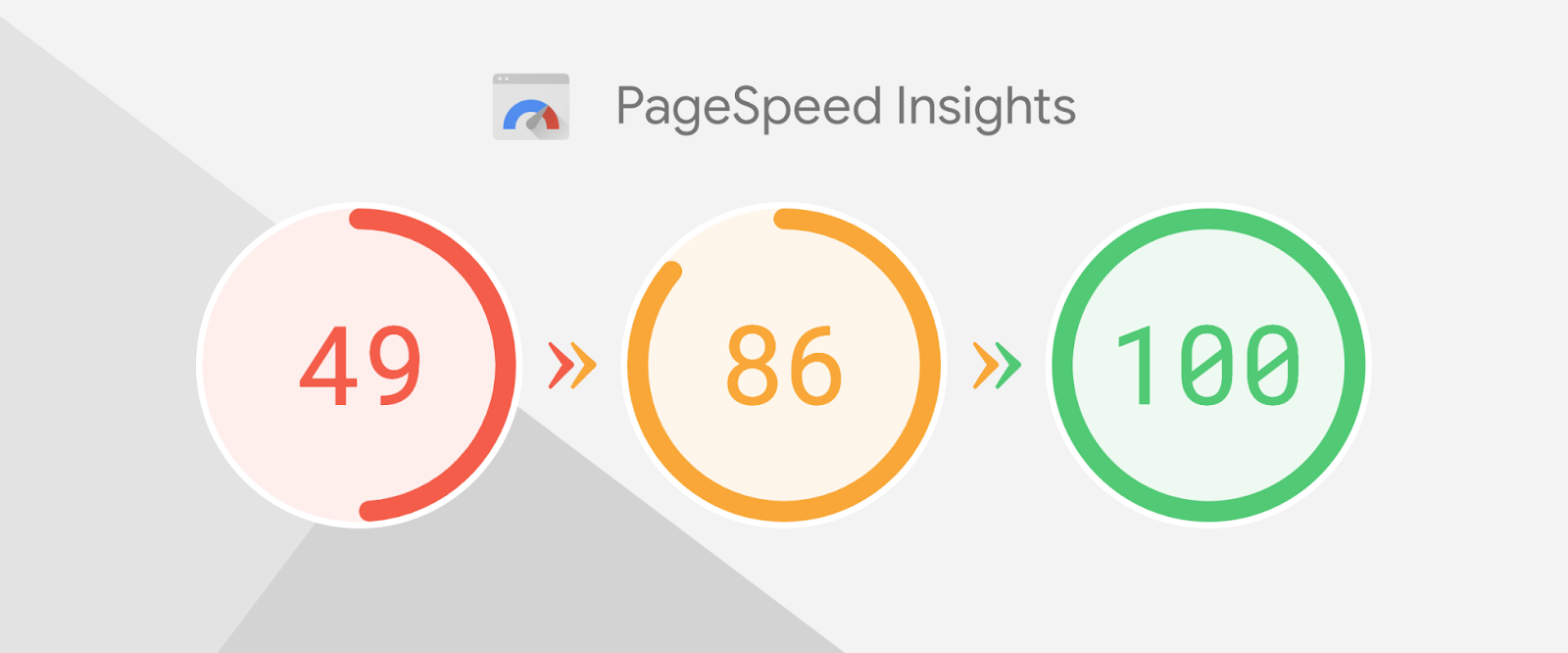
A website that looks careless rarely ranks well, no matter how strong the content is, so make sure to consider the basics of technical SEO for cybersecurity, and perform regular checks with tools like PageSpeed Insights

4. Build Credibility With Guest Posts

Guest Posting is one of the most effective ways to build authority in Cyber Security SEO, only if it’s done properly. Your goal here should not be to just get backlinks; you should be more focused on getting visibility from the right circles.

Choose those platforms or websites for guest posting that are highly respected and recognized in the cybersecurity or broader tech niche. What is most important here is to show proficiency instead of being promotional.

Well, research your ideas, do a detailed technical analysis before publishing content, because they are far better than sales-oriented articles.

Readers seeing your name or your brand mentioned on reputable websites has a good impact on Google, too. With time, this helps you to build authority and trust without pressure. 

5. Measuring Performance

Measuring Cyber Security SEO performance is also important and goes beyond just checking rankings. Traffic alone does not tell the full story.

How do you expect to know if your cybersecurity seo strategies are working or not if you don’t continuously measure the performance? 

Regularly track which pages attract qualified visitors, how long they stay (using the bounce rate metric), and what action they take next (use heatmap tools like clarity).

Measuring Cyber Security SEO performance

                                                                                                  [Image Source: Engage Intractive]

Look at search queries in Google Search Console to see if your content is matching the users’ search intent. If the audience doesn’t stay long, then something is lacking or too complicated to understand

Conducting performance review regularly can help you identify which approaches works and which need improvement

Keep in mind that cybersecurity seo is not a one-off task; it is an everyday cycle of experimenting, understanding, and readjusting your cybersecurity seo strategies based on factual data

Final Words

So we have reached the end of this article. What is the conclusion you should draw from this article?

The conclusion is that SEO for Cyber Security is not like looking at algorithms or copying the stuff you saw work in some other industry. It is more like earning visibility and trust from your users and from Google itself.

Those websites that consistently rank in the top position are concerned with their audience. 

They publish content that reflects the real understanding of the field, maintain a technically sound website, and build authority by contributing to the wider field of cybersecurity by publishing guest posts and building authority through backlinks.

None of this happens overnight, that’s the point

If you approach SEO for Cyber Security with patience and honesty, the results tend to compound. 

What is the SEO Funnel, and How Does it Work?

In 2025, SEO is no longer just about ranking in search engines with keywords; it’s now about understanding your users’ intent, using AI-driven insights, and building trust with consistent value. SEO funnel has become the backbone of this approach, helping brands to improve their organic reach.

As Google’s Search Generative Experience (SGE) and AI Overviews change how users discover and read information, creating and improving the SEO funnel is a must, and it allows businesses to guide customers from the awareness stage to the conversion stage.

Key Takeaways

1. A strong SEO funnel is important in 2025, as AI-driven search is growing and impacts user behaviour

2. Backlinks stay the most powerful authority signal across all funnel stages.

3. Intent-aligned content and clear internal linking help both users and AI models understand what your expertise is in.

4. Middle-of-funnel pages perform better when supported by niche-relevant backlinks.

5. Pages that are focused on conversion need trust elements like proof, clarity, fast load speed, and high-authority links.

6. Reviewing your funnel regularly keeps you competitive and visible in both traditional search and AI overviews.

In this article, we’ll break down what the SEO funnel is, how it works across its three key stages, the important role of backlinks, and how we’ve successfully created SEO funnels for our clients. 

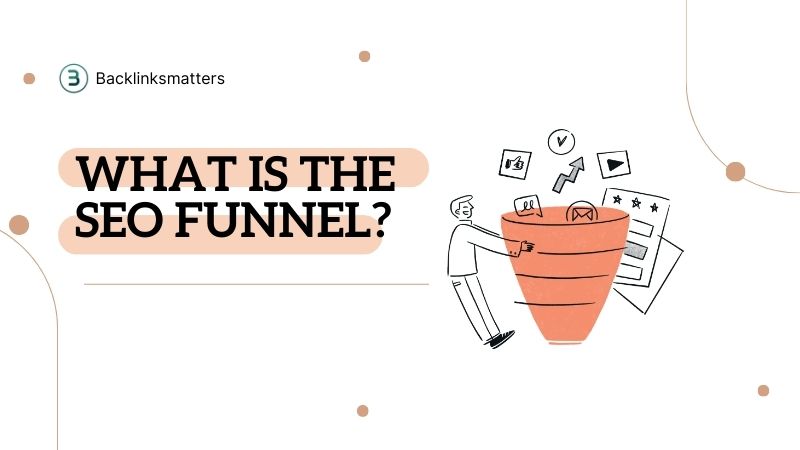
What Is the SEO Funnel?

SEO funnel is a strategic model that helps businesses understand how their users move after discovering their brand, to taking a meaningful action, like purchasing, all through organic search.

It is built on the principle that every search shows an intent, and by adjusting content, keywords, and backlinks to those specific intents, you can guide users naturally toward conversion.

Instead of focusing on rankings, the SEO funnel focuses on building expertise, experience, authority, and trust (E-E-A-T) at each stage.

An SEO Funnel has 3 interconnected types, which are listed below

  • Seo Content Funnel: Seo content funnel educates your users and builds awareness through valuable insights.
  • Link Funnel: Link funnel builds credibility through high-quality, contextual, and relevant backlinks.
  • Sales Funnel: Sales funnel converts customer interest into measurable business growth.

How the SEO Funnel Works?

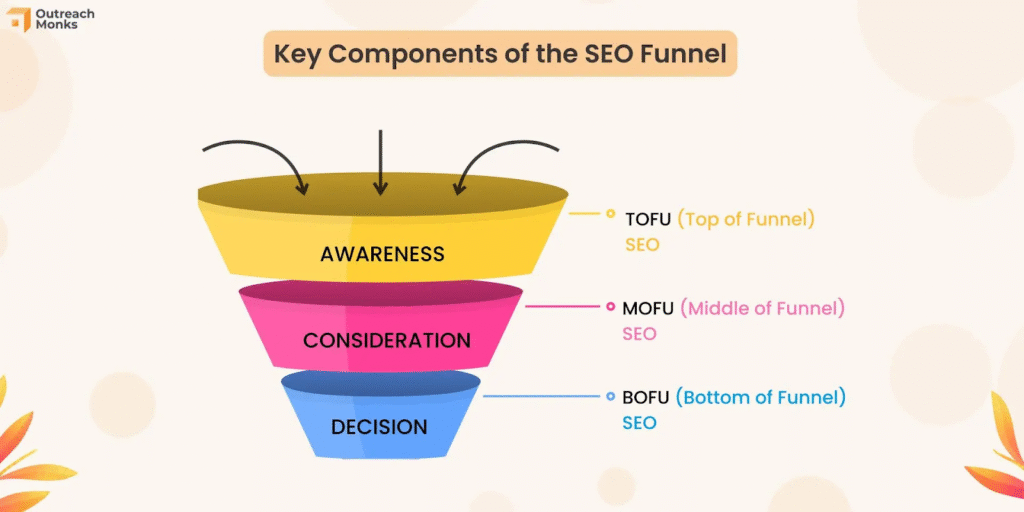
SEO funnel works like a guided path that leads users from their first encounter with your brand to a point where they trust you enough to make a purchase. It imitates the buyer’s journey through three important stages: Awareness, Consideration, and Decision.

[Image Source: Outreach Monks]

Each of these stages of the seo funnel demands different methods, such as content optimization, building a keyword strategy, and trust signals. However, all of them have one thing in common: they are connected through consistent messaging, strong internal links, and data-backed optimization.

1. Top of the Funnel (TOFU) — Awareness

This is where the seo funnel starts. Users at this stage don’t know about your brand yet they are still searching for solutions to a problem they are facing. Currently, your goal should be to educate users and avoid focusing on selling at this stage

  • User Intent: Informational Content 
  • Type: Blog posts, guides, infographics, videos, and educational explainers.
  • Optimization Focus: Broader keywords, topic authority, readability, and shareability.
  • Example: A user searching how to improve website visibility might discover your blog post introducing SEO fundamentals, just like you found this blog about SEO Funnels.

Creating content that is genuinely helpful boosts E-E-A-T signals and shows Google that your expertise serves the user’s needs first, which is very important in appearing in AI overviews and featured snippets.

2. Middle of the Funnel (MOFU) — Consideration

In this stage, users exactly know what their problem is, and they are actively looking and comparing multiple solutions to find the best one. Your job here is to make your content demonstrate your expertise and trustworthiness.

  • User Intent: Comparative or evaluative
  • Content Type: Case studies, how-to guides, webinars, whitepapers, and product comparisons.
  • Optimization Focus: Semantic keywords, topic clusters, internal linking, and data-backed examples.
  • Example: A post like “Best SEO funnel strategies for 2025” can build credibility and gently nudges your readers toward your service or product you provide.

At this stage, you should also use expert insights like stats from credible sources to tell your users and AI engines that your website provides the best authoritative and accurate information, which is an important factor for ranking in Search Generative Experience (SGE) results.

3. Bottom of the Funnel (BOFU) — Conversion

Now your users have the solution to their problem, and they know about your brand. At this stage, they are ready to act. Your goal is to remove any hesitation and doubt to make the next step (conversion) obvious

  • User Intent: Transactional or action-oriented
  • Content Type: Landing pages, testimonials, comparison charts, pricing pages, and demo offers.
  • Optimization Focus: Conversion Rate Optimization (CRO), schema markup, persuasive CTAs, and UX clarity.
  • Example: Showing a landing page offering a “Free SEO Funnel Audit” converts awareness-stage users into clients.

You can achieve this by using testimonials and pricing that are transparent without any additional charges, plus make sure to use author bios and external validations so that E E A T helps your brand stand out from the competitors and even rank in AI summarised search results.

The Role of Backlinks in the SEO Funnel

Backlinks are still one of the strongest ranking factors in 2025, not just because of their volume, but also because of their context and quality. In a modern SEO funnel, backlinks serve as trust badges that inform users and search engines at each stage.

Along with boosting visibility, they also validate the expertise, boost your website’s domain authority, and create an interconnected ecosystem of internal links, which are important for ranking in AI overviews and search engines (Which should be your main goal to rank higher and faster)

Why Backlinks Still Matter?

Google’s algorithm and now its AI-based understanding of web context still rely on backlinks to determine topical authority and trustworthiness. 

When a credible site with high domain authority links to your content, it endorses your expertise. 

The act matches directly with the E-E-A-T principle, showing your knowledge is recognised by other experts in the same niche.

For instance,  a niche-specific backlink from a marketing publication shows stronger authority than dozens of random backlinks that don’t match your niche

How We Built SEO Funnels for Our Clients

Here at BacklinksMatters, we have noticed that every funnel in seo is powered by one core strength: strategic and high-quality placement of backlinks.

Instead of trying and conquer every seo component, we focus on the single factor that affects the visibility and authority of your funnel movement the most.

We work in a very simple manner; we improve the client’s entire funnel by giving each stage the backlinks that it needs to attract more customer attention and to build credibility, and eventually drive more conversions.

We map your users’ search intent and identify the most plausible link-building opportunity, and secure the link placement.

Challenges and Solutions in the SEO Sales Funnel

Building a Seo conversion funnel is not easy, and most of the time it fails. Let me tell you some reasons why it fails.

A strong seo conversion funnel fails when visibility, authority, user experience, or any other test signals break at any stage. 

While backlinks still are one of the strongest drivers of authority and growth in ranking, businesses like yours can also face issues like poor content depth, ranking content with wrong intent keywords or external signals (like backlinks) and internal elements ( like UI/Ux and structure)  that guide users from search conversion.

Common Challenges & Their Solutions

  • Low search visibility? Solution: Get diversified backlinks for your top funnels, plus optimise your content from time to time
  •  
  • Strong content by no authority? Solution: Get High-quality backlinks from niche sites
  •  
  • High traffic but low engagement? Solution: Improve your page structure and provide clarity
  •  
  • Ranking stuck on page 2? Solution: Make sure your anchor texts are relevant to their links
  • Competitors dominating SERPs? Solution: Do a backlink gap analysis and replace your outdated content 

Optimizing Each Funnel Stage for Better Results

A high-performing SEO funnel scales only when you improve each stage from time to time. Growth comes from aligning content with improving users’ journey, search intent, and optimizing for AI-driven discovery.

At the top stage of the funnel, visibility increases when you publish intent-based content, solve users’ problems by answering real questions, and use structured data to surface in AI overviews.

In the middle stage of the funnel, users engage more when your guides, comparisons, and resource page are supported with niche-relevant backlinks and strong internal linking across your content, which enhances EEAT.

At the bottom funnel, conversions rise when your service pages are polished with case studies, social proofs, clear pricing, and smooth CTA’s

How to Use AI & AEO for Funnel Growth

AI tools and answer engines’ first priority is clarity and authority with structured information. AEO checks if your content is ready for AI-powered summaries and contextual responses.

Key optimization actions you can take

  • Use Q&A formatting, definitions, and structured bullets to match AI response patterns.
  • Add schema markup such as FAQ, How-To, and Organization data.
  • Build authority backlinks toward your informational content to rank in AI summaries.
  • Include expert quotes, personal experience, original analysis, and supporting data for stronger EEAT.

How to Track and Measure Performance

Tracking can turn your assumptions into actionable steps. GA4, UTM tags, and conversion dashboards can help you understand which funnel assets work and which one needs improvement.

What to measure

  • Traffic Source Performance: Which backlinks drive qualified sessions?
  • Engagement Metrics: Scroll depth, time on page, navigation patterns.
  • Conversion Paths: Where drop-offs occur across the funnel.
  • Campaign Tracking: UTM codes to identify high-performing backlinks, partnerships, and content.
  • Revenue Impact: Assisted conversions, last-click conversions, and ROI from SEO efforts.

Use Personalization & Experimentation Across the Funnel

A strong funnel in seo is which adapts to users’ behaviour. Personalization, testing, and CRO (conversion rate optimization) help convert more visitors without depending on additional traffic

Practical improvements you can make

  • Personalize CTAs based on visitor intent (cold, warm, or ready-to-buy).
  • Test landing page layouts, headlines, value propositions, and offers.
  • Use heatmaps to understand friction and remove unnecessary elements.
  • Build topic clusters and refine internal linking to improve user flow.
  • Create multiple content variations for AI Overviews and monitor which performs best.

Final Thoughts

A well-designed seo funnel is still one of the most reliable growth engines in 2025, especially as an AI system prioritizes authority and clarity. 

When each stage is supported with strong content, meaningful use experience, and planned backlinks authority, your brand becomes easier to discover and more convincing to engage with

The businesses that are winning today are the ones that understand how searchers think, what AI tools prioritize first, and how to build trust at every touch point

If you want to scale sustainability, review your seo funnel and identify where users fall off.

Because every improvement can make compounds into long-term growth.