

Millions of users click the top results without hesitation because search engines are supposed to be safe. But what if we say, it is NOT? Search engines have become the front door to our digital lives. Everything is just one click away, and we trust what we see first on search engines. However, what if we say that the search result you have received is designed to deceive you? SEO poisoning attacks have rapidly increased since the rise of the digital era. It is a cyberattack technique in which cyber attackers aim to disrupt search engine results.
This activity is done to promote a destructive website. In search poisoning attacks, attackers avoid sending spam emails or phishing messages. Instead, they target users’ trust; they send links to trusted websites like Google and Bing, where people generally react without second thoughts.
In Search Engine Poisoning attacks, people are asked to enter their legit info and are often redirected to suspicious pages. Often, cyberattackers share links that prompt you to download software that slowly corrupts your system. Hence, Backlink Matters created a comprehensive guide to help you understand, defend, and secure your data.
What Is SEO Poisoning?
We must understand the issue to fight the problem. Hence, learning about SEO Poisoning is essential before eradicating the cause. In simple terms, search poisoning is a cyberattack in which search engine results are manipulated.
In SEO poisoning attacks, cyberattackers send you links rather than emails or phishing messages. These links lead to a page where they might collect your personal info and use it for their own benefit. They might often use websites with weak security as backdoors to manipulate search results.
They might use methods such as keyword stuffing and targeting, or compromised websites, typosquatting, or cloaking to mislead users. No matter which search engine poisoning method they choose, the goal is simply to exploit search engine results.
By using Back Hat SEO techniques, cyber attackers employ deceptive methods to artificially boost a website’s ranking. This manipulation of SEO positioning is usually done by violating search engine guidelines. A few common techniques to manipulate SEO rankings are CTR manipulation, Doorway pages, Parasite SEO, and sneaky redirects.
SEO Poisoning vs Phishing vs Malvertising vs Typosquatting
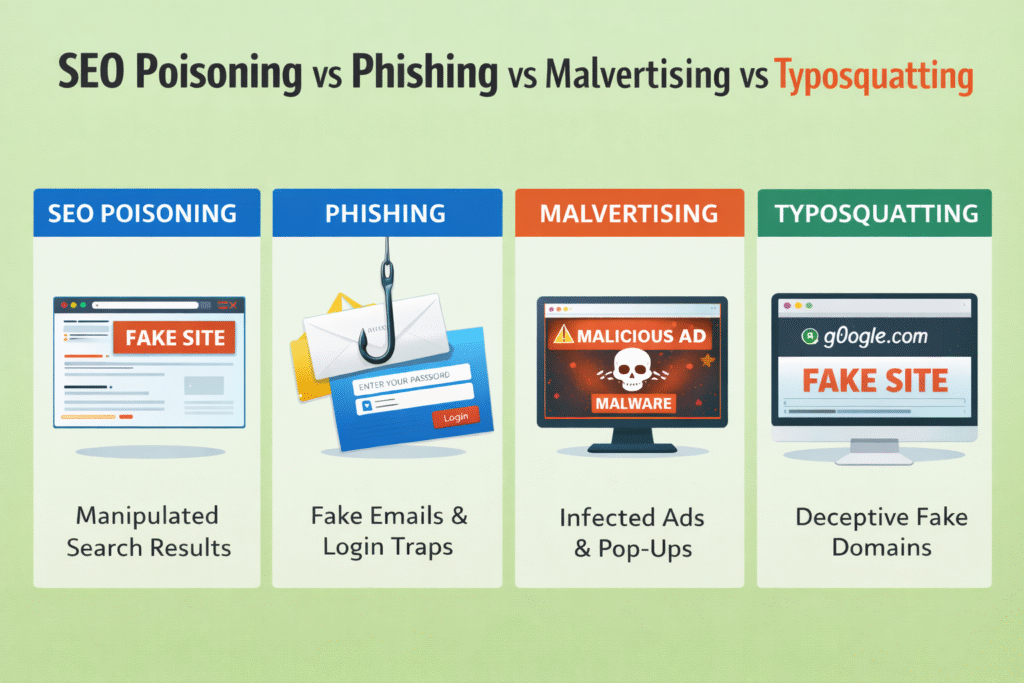
- SEO POISONING: Before moving ahead with a detailed study, let’s take a quick look at a few terms that might be similar for some but do differ. An SEO poisoning attack is the manipulation of search engine results using Black Hat methods. Here, cyber attackers try to boost a website’s search results using unethical methods.
- Phishing: It is an old-school method in which cyberattackers send spam emails and messages asking you for your personal information. Cyber attackers send links and messages pretending to be from reputable websites. They leverage the trust to ask for private details.
- Malvertising: It is a method in which cyberattackers embed harmful code into a legitimate website ad. Once you click a link or an ad, it can slowly spread malware and steal your personal information.
- Typosquatting: Also known as URL hijacking, it is a method in which attackers create confusion by misspelling a website’s name or registering a similar domain to trick users. These fake websites are termed as sting sites or cousin domains. These sites help the attackers steal all your data and spread malware.
Common SEO Poisoning Techniques
SEO Poisoning attacks can be done in various ways. Let’s take note of a few popular methods that attackers use to create a search engine poisoning attack.
Keyword Stuffing: Attackers use trending search terms such as ‘free software download’ or ‘login pages’ to lure users into clicking links.
Compromised Websites: Cyber attackers might even exploit users’ trust. They might find a vulnerable website or embed malware on a trusted website to target users. Just a click, and users will be in their trap, manipulated into successfully manipulating search results.
Cloaking: It is a deceptive method in which search engine crawlers or bots are shown a different page than humans are shown. It helps them create a different picture for users, which boosts their ranking.
Typosquatting: Cyber attackers use this method to exploit misspelled or similar domain names to confuse users. Users are misled to a page where they might lose their personal information or important data.
Link Farm: Another technique to confuse or mislead users by interlinking many fake websites. With this method, they try to boost the authority of the tampered website.
How SEO Poisoning Attacks Users & Businesses?
- Method of Keyword Stuffing and Black-Hat SEO Tactics: This is a method in which cyber attackers use unnatural repetition of keywords in content or meta tags to manipulate search engines. This method spoils the user experience and violates the search engine’s guidelines. This violation may ruin the website’s reputation, lead to a penalty, or lower its ranking.
- Brief Discussion About Cloaking Techniques: It is a method in which cyber attackers serve different content to search engine crawlers or bots than to humans. It is a black hat technique that helps them manipulate search engine results. As the name suggests, the attackers hide the page behind another page and try to manipulate rankings and sabotage the website’s reputation.
- Exploiting Trusted Platforms Like Google Search Results: Another way to search engine poison is to mislead users into submitting information to a trusted platform. For example, they might use SEO poisoning MITRE framework, or the Google search engine as a cover to misadvertise and lure users. Here, they ask users to click links or ads, then request their details. SEO poisoning attacks might also introduce malware into your system or device via this method.
Real World Impact of Search Engine Poisoning
- Credential theft or Data Breach: One of the prominent impacts of SEO poisoning is a data breach. Cyber attackers invade your privacy and steal your personal information. In some cases, they hack your bank details and do frauds. They might also share or misuse the personal information or access your online accounts.
- Ransomware: Search poisoning also poses a risk of ransomware. It is often delivered through phishing emails or compromised websites. Here, users are tricked into opening or downloading infected files. This malware steals your private details or credentials.
- Cyber Crimes or Online Phishing: we can say that cybercrime is a criminal activity that occurs online via devices like phones, laptops, PC. It covers crimes such as identity theft, banking fraud, and data theft. Within cybercrime, phishing is a common issue, as most users are tricked by it. In phishing, users are often lured by deceptive messages, emails, and links to share their information. Cyber attackers impersonate reputable platforms and trick users into sharing sensitive information.
- Financial Losses: SEO poisoning attacks often lead to financial losses, as cybercriminals use the information to steal money. Cyber attackers use malicious methods to steal information and identity details, which leads to financial fraud.
- Heavy Regulatory Penalties: After cyber attackers use Search engine poisoning methods, a website may lose credibility, leading to severe penalties. Any breach of search engine regulations will result in severe penalties.
Types Of Cyber Attacks:
- Fake Login Pages: Recently, cyberattacks have seen a major increase in credential harvesting. They trick users into clicking on malicious links or downloading infected files, and eventually hack into all their accounts. They mask their malicious software under the name of trusted brands, and users fall for their trick. They often sign up for pages that require them to share their details.
- Malicious Ads: These ads often appear on the pages of trusted websites where users simply fill in their information or click on it. Sometimes a simple click might give them access to all your credentials.
- Software Downloads: Another way of an SEO poisoning attack is to introduce them. Users are shown or advised to download certain software that is infected with malware. Cybercriminals trick them into clicking on downloads and gain access to all their information.
How Cyber Security SEO Helps Defend Against SEO Poisoning?
Cyber security SEO, as ethical search engine poisoning strengthens security protocols, which eventually builds user trust. They create high-quality, understandable content, which also boosts users’ confidence. It is a simple white-hat technique that enhances user trust and keeps them from being manipulated. Content authenticity, a user-centric approach, and the prevention of negative SEO are a few elements that help mitigate search poisoning. Including them will enhance a website’s security and help maintain its reputation. Having a trusted platform will surely attract more users and help prevent search poisoning in cybersecurity.
Why SEO Poisoning Is Increasing In 2026?
- Remote Working: SEO poisoning is on the rise, and its primary target is work-from-home employees. They trick remote workers and leverage their trust to trust certain platforms. Employees who rely on search engines for research and downloading are often targeted by SEO poisoning attackers.
- Too Much Reliance on AI-Generated Content: Cyber attackers are using AI to generate large volumes of keyword-centric content and tamper with search results. They usually automatically redirect users to malware or phishing links.
- Too Much Competition In Search Rankings: To rank higher, cybercriminals often take shortcuts by using Black-Hat methods to boost rankings.
SEO Poisoning Detection & Prevention Techniques
If you are looking for how to prevent SEO poisoning attacks, you need to understand the defense and detention techniques below:
- White-Hat Optimization or Ethical Practices: It builds a strong and secure platform. The content is transparent and easy to understand, which builds trust with users.
- Regularly Monitoring Search Engine Results: Regular monitoring will help prevent technical issues such as broken links or indexing errors. It will also keep an eye on the ranking and help in maintaining it.
- Threat Intelligence Integration: It equips your security team to detect and combat security threats and move from a reactive to a proactive posture.
- Performing Regular Site Audits: This SEO poisoning trick ensures the immediate eradication of security issues, keeping the site safe and fast for users.
Preventions Organizations Can Take To Keep SEO Poisoning Risk At Bay
- Collaborate with SEO & Cybersecurity Teams: To keep your site safe and secure, collaborate with SEO and cybersecurity teams. They ensure there are no vulnerabilities and that your website is safe and user-friendly.
- Train Employees About Phishing Risks: Often, traditional security tools don’t work out. Employees often face the risk of search engine poisoning when they trust search engine platforms; training them is recommended.
- Regularly Monitor Search Results To Maintain Your Brand Name: Regularly checking search results will help keep technical issues at bay and build user trust in your brand.
- No Harm In Investing in Some Cyber Threat Detection Tools: Users, especially remote employees, are often at risk of SEO poisoning attacks, so investing in a cyber threat detection tool is a good option.
Conclusion: Staying Protected In Evolving Threat Landscape
In the article above, we discussed the recent threat of SEO poisoning attacks, how to fix SEO poisoning, and the reasons they may occur. Additionally, we have discussed ways to address them and the importance of training employees on this matter. At Backlink Matters, we also recommend collaborating with a cybersecurity SEO to ensure your data is fully protected.