

In 2025, SEO is no longer just about ranking in search engines with keywords; it’s now about understanding your users’ intent, using AI-driven insights, and building trust with consistent value. SEO funnel has become the backbone of this approach, helping brands to improve their organic reach.
As Google’s Search Generative Experience (SGE) and AI Overviews change how users discover and read information, creating and improving the SEO funnel is a must, and it allows businesses to guide customers from the awareness stage to the conversion stage.
| Key Takeaways 1. A strong SEO funnel is important in 2025, as AI-driven search is growing and impacts user behaviour 2. Backlinks stay the most powerful authority signal across all funnel stages. 3. Intent-aligned content and clear internal linking help both users and AI models understand what your expertise is in. 4. Middle-of-funnel pages perform better when supported by niche-relevant backlinks. 5. Pages that are focused on conversion need trust elements like proof, clarity, fast load speed, and high-authority links. 6. Reviewing your funnel regularly keeps you competitive and visible in both traditional search and AI overviews. |
In this article, we’ll break down what the SEO funnel is, how it works across its three key stages, the important role of backlinks, and how we’ve successfully created SEO funnels for our clients.
What Is the SEO Funnel?
SEO funnel is a strategic model that helps businesses understand how their users move after discovering their brand, to taking a meaningful action, like purchasing, all through organic search.
It is built on the principle that every search shows an intent, and by adjusting content, keywords, and backlinks to those specific intents, you can guide users naturally toward conversion.
Instead of focusing on rankings, the SEO funnel focuses on building expertise, experience, authority, and trust (E-E-A-T) at each stage.
An SEO Funnel has 3 interconnected types, which are listed below
- Seo Content Funnel: Seo content funnel educates your users and builds awareness through valuable insights.
- Link Funnel: Link funnel builds credibility through high-quality, contextual, and relevant backlinks.
- Sales Funnel: Sales funnel converts customer interest into measurable business growth.
How the SEO Funnel Works?
SEO funnel works like a guided path that leads users from their first encounter with your brand to a point where they trust you enough to make a purchase. It imitates the buyer’s journey through three important stages: Awareness, Consideration, and Decision.
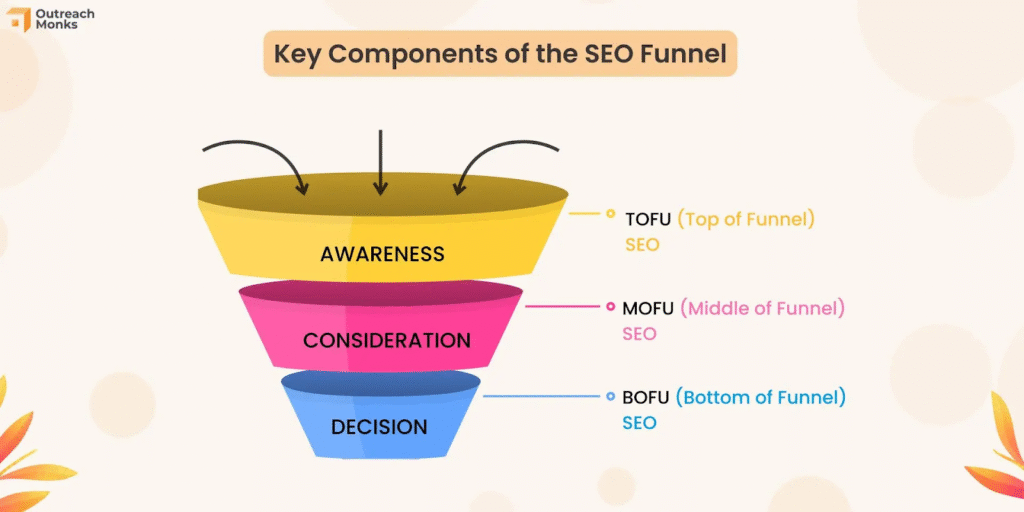
[Image Source: Outreach Monks]
Each of these stages of the seo funnel demands different methods, such as content optimization, building a keyword strategy, and trust signals. However, all of them have one thing in common: they are connected through consistent messaging, strong internal links, and data-backed optimization.
1. Top of the Funnel (TOFU) — Awareness
This is where the seo funnel starts. Users at this stage don’t know about your brand yet they are still searching for solutions to a problem they are facing. Currently, your goal should be to educate users and avoid focusing on selling at this stage
- User Intent: Informational Content
- Type: Blog posts, guides, infographics, videos, and educational explainers.
- Optimization Focus: Broader keywords, topic authority, readability, and shareability.
- Example: A user searching “how to improve website visibility” might discover your blog post introducing SEO fundamentals, just like you found this blog about SEO Funnels.
Creating content that is genuinely helpful boosts E-E-A-T signals and shows Google that your expertise serves the user’s needs first, which is very important in appearing in AI overviews and featured snippets.
2. Middle of the Funnel (MOFU) — Consideration
In this stage, users exactly know what their problem is, and they are actively looking and comparing multiple solutions to find the best one. Your job here is to make your content demonstrate your expertise and trustworthiness.
- User Intent: Comparative or evaluative
- Content Type: Case studies, how-to guides, webinars, whitepapers, and product comparisons.
- Optimization Focus: Semantic keywords, topic clusters, internal linking, and data-backed examples.
- Example: A post like “Best SEO funnel strategies for 2025” can build credibility and gently nudges your readers toward your service or product you provide.
At this stage, you should also use expert insights like stats from credible sources to tell your users and AI engines that your website provides the best authoritative and accurate information, which is an important factor for ranking in Search Generative Experience (SGE) results.
3. Bottom of the Funnel (BOFU) — Conversion
Now your users have the solution to their problem, and they know about your brand. At this stage, they are ready to act. Your goal is to remove any hesitation and doubt to make the next step (conversion) obvious
- User Intent: Transactional or action-oriented
- Content Type: Landing pages, testimonials, comparison charts, pricing pages, and demo offers.
- Optimization Focus: Conversion Rate Optimization (CRO), schema markup, persuasive CTAs, and UX clarity.
- Example: Showing a landing page offering a “Free SEO Funnel Audit” converts awareness-stage users into clients.
You can achieve this by using testimonials and pricing that are transparent without any additional charges, plus make sure to use author bios and external validations so that E E A T helps your brand stand out from the competitors and even rank in AI summarised search results.
The Role of Backlinks in the SEO Funnel
Backlinks are still one of the strongest ranking factors in 2025, not just because of their volume, but also because of their context and quality. In a modern SEO funnel, backlinks serve as trust badges that inform users and search engines at each stage.
Along with boosting visibility, they also validate the expertise, boost your website’s domain authority, and create an interconnected ecosystem of internal links, which are important for ranking in AI overviews and search engines (Which should be your main goal to rank higher and faster)
Why Backlinks Still Matter?
Google’s algorithm and now its AI-based understanding of web context still rely on backlinks to determine topical authority and trustworthiness.
When a credible site with high domain authority links to your content, it endorses your expertise.
The act matches directly with the E-E-A-T principle, showing your knowledge is recognised by other experts in the same niche.
For instance, a niche-specific backlink from a marketing publication shows stronger authority than dozens of random backlinks that don’t match your niche
How We Built SEO Funnels for Our Clients
Here at BacklinksMatters, we have noticed that every funnel in seo is powered by one core strength: strategic and high-quality placement of backlinks.
Instead of trying and conquer every seo component, we focus on the single factor that affects the visibility and authority of your funnel movement the most.
We work in a very simple manner; we improve the client’s entire funnel by giving each stage the backlinks that it needs to attract more customer attention and to build credibility, and eventually drive more conversions.
We map your users’ search intent and identify the most plausible link-building opportunity, and secure the link placement.
Challenges and Solutions in the SEO Sales Funnel
Building a Seo conversion funnel is not easy, and most of the time it fails. Let me tell you some reasons why it fails.
A strong seo conversion funnel fails when visibility, authority, user experience, or any other test signals break at any stage.
While backlinks still are one of the strongest drivers of authority and growth in ranking, businesses like yours can also face issues like poor content depth, ranking content with wrong intent keywords or external signals (like backlinks) and internal elements ( like UI/Ux and structure) that guide users from search conversion.
Common Challenges & Their Solutions
- Low search visibility? Solution: Get diversified backlinks for your top funnels, plus optimise your content from time to time
- Strong content by no authority? Solution: Get High-quality backlinks from niche sites
- High traffic but low engagement? Solution: Improve your page structure and provide clarity
- Ranking stuck on page 2? Solution: Make sure your anchor texts are relevant to their links
- Competitors dominating SERPs? Solution: Do a backlink gap analysis and replace your outdated content
Optimizing Each Funnel Stage for Better Results
A high-performing SEO funnel scales only when you improve each stage from time to time. Growth comes from aligning content with improving users’ journey, search intent, and optimizing for AI-driven discovery.
At the top stage of the funnel, visibility increases when you publish intent-based content, solve users’ problems by answering real questions, and use structured data to surface in AI overviews.
In the middle stage of the funnel, users engage more when your guides, comparisons, and resource page are supported with niche-relevant backlinks and strong internal linking across your content, which enhances EEAT.
At the bottom funnel, conversions rise when your service pages are polished with case studies, social proofs, clear pricing, and smooth CTA’s
How to Use AI & AEO for Funnel Growth
AI tools and answer engines’ first priority is clarity and authority with structured information. AEO checks if your content is ready for AI-powered summaries and contextual responses.
Key optimization actions you can take
- Use Q&A formatting, definitions, and structured bullets to match AI response patterns.
- Add schema markup such as FAQ, How-To, and Organization data.
- Build authority backlinks toward your informational content to rank in AI summaries.
- Include expert quotes, personal experience, original analysis, and supporting data for stronger EEAT.
How to Track and Measure Performance
Tracking can turn your assumptions into actionable steps. GA4, UTM tags, and conversion dashboards can help you understand which funnel assets work and which one needs improvement.
What to measure
- Traffic Source Performance: Which backlinks drive qualified sessions?
- Engagement Metrics: Scroll depth, time on page, navigation patterns.
- Conversion Paths: Where drop-offs occur across the funnel.
- Campaign Tracking: UTM codes to identify high-performing backlinks, partnerships, and content.
- Revenue Impact: Assisted conversions, last-click conversions, and ROI from SEO efforts.
Use Personalization & Experimentation Across the Funnel
A strong funnel in seo is which adapts to users’ behaviour. Personalization, testing, and CRO (conversion rate optimization) help convert more visitors without depending on additional traffic
Practical improvements you can make
- Personalize CTAs based on visitor intent (cold, warm, or ready-to-buy).
- Test landing page layouts, headlines, value propositions, and offers.
- Use heatmaps to understand friction and remove unnecessary elements.
- Build topic clusters and refine internal linking to improve user flow.
- Create multiple content variations for AI Overviews and monitor which performs best.
Final Thoughts
A well-designed seo funnel is still one of the most reliable growth engines in 2025, especially as an AI system prioritizes authority and clarity.
When each stage is supported with strong content, meaningful use experience, and planned backlinks authority, your brand becomes easier to discover and more convincing to engage with
The businesses that are winning today are the ones that understand how searchers think, what AI tools prioritize first, and how to build trust at every touch point
If you want to scale sustainability, review your seo funnel and identify where users fall off.
Because every improvement can make compounds into long-term growth.