

PBN links are still a hot topic in SEO. Even in 2026, it is still a topic that triggers a debate: Are PBN links effective? Should I consider this strategy? Are they risky? Or this strategy is no longer in practice in the era of AI search and advanced spam detection.
In this article, we are going to take a deep dive into discussing PBN (Private Blogs Network) links in modern SEO. No matter whether you are a business owner, marketer, SEO analyst, or content creator. We will try to cover all the details regarding PBN links, what strategies were used earlier for them, and now over the period of time.
Why Are PBN Links Still Discussed in SEO Today?
PBN link methods are still a hot topic to discuss in today’s SEO because it acts as a kick start for newly established websites. Lots of marketers are still wondering whether PBN links are still an effective strategy in an actively evolving SEO environment. Like many marketers, SEO professionals have used PBN link tactics successfully in the past.
But also, there is a high risk with this method, as it can lead towards the long term SEO consequences.
No doubt it increases the domain authority (DA) and search rankings of websites quickly, but at very high risk, as soon as Google detects the PBN links, the website has to face some consequences, such as:-
- Manual penalties and algorithmic demotions in ranking( it would be visible on your associated Google Search Console).
- Deindexing of all the links that are coming from the PBN websites and overnight vanish all your rankings gained with your SEO.
- It may hinder your partner’s and clients’ trust, and also result in a loss of reputation in the market.
Why SEO Professionals Still Experiment With PBN Links?
Some SEO professionals continue to use PBN link tactics despite their known risks. As organic link building through outreach, internal linking, and all these kinds of methods take time to reflect the results. Since the marketers have certain deadlines to meet, they still experiment with PBN links, but these experiments undergo precautions, controlled and calculated.
These PBN links are typically tested on non-critical or low-priority websites so that, even if Google detects and penalises them, there is no negative impact on the core business or its primary online assets.
Are PBN Links a Legacy Tactic or an Ongoing SEO Shortcut?
PBN links are considered a legacy tactic lately, but some marketers or SEO specialists view them as an SEO shortcut. Earlier, PBN links were highly effective because search engines relied heavily on link volume with anchor texts. But now things have changed, Google algorithms have evolved to focus on link quality, relevance, and trust.
Now PBN strategy of building website authority serves as a reference point of outdated SEO practices rather than a growth strategy. Sustainable SEO success is now based on EEAT (Experience, Expertise, Authoritativeness, and Trustworthiness). It helps search engines like Google to determine whether the content is reliable, relevant and helpful to the end user.
What are PBN links?
PBN links (Private blog network links) are the backlinks formed by a network of websites owned by the same individual or organisation. These are groups of websites or expired domains consisting of backlink authority to pass the link to the main website.
The link that points from the website networks to the main website is called a PBN link. This tactic is used by the owners/marketers/SEO just to improve ranking, not intentionally to help users. That is why Google considers it a policy violation and considers it spam.
Google considers PBN links as a kind of “link scheme” (to trick Google’s ranking algorithm) because it passes the authority to the main website. A website links to another website in order to provide related and useful content to the end user.
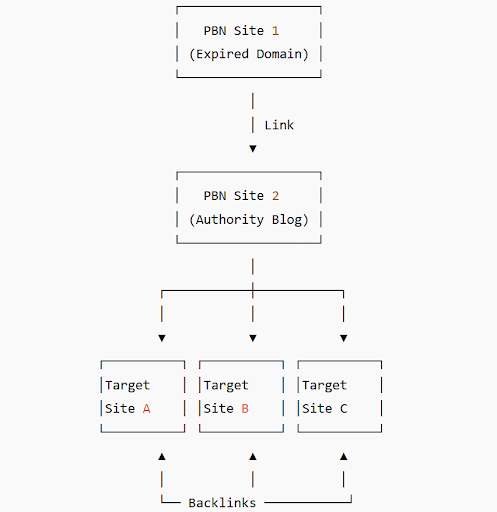
With the help of the above image, we are going to take a deep dive in order to understand the working of PBN links.
So, the above figure is about how the link is flowing from a PBN website (expired domain) and how authority and link equity are artificially distributed from multiple controlled websites to a target website.
- So, as you can see in the above figure, the link is flowing from the multiple PBN websites (It could be multiple), these are the expired domain websites with existing backlink authority, in the graph, they appear as multiple source points linking outward.
- All outgoing links from PBN sites that are intentionally placed by the SEO professionals, as they control: Anchor text, Link placement (contextual, footer, sidebar), Link frequency and timing. These controlled behaviours are flagged by Google as they are unnatural.
- The main site is sitting at the end of the graph, as you can see (the target website), it receives the backlinks from several PBN websites in order to boost authority artificially, as they are detectable by the search engines.
- You can also see several PBN sites linking to each other before linking to the target site. This is done intentionally to simulate relevance and strengthen perceived authority, but it increases footprint risk if patterns are identified.
How PBN Links Are Different From Natural Editorial Links
The main difference revolves around intent and autonomy. Natural editorial links are given by independent publishers because the content is helpful to their audience. These links are motivated by relevance, trustworthiness, and authentic endorsement.
On the other hand, PBN links are intentionally placed by the site owner. The linking site and the linked site are not truly independent of one another, despite appearances. This absence of genuine editorial decision-making makes PBN links unnatural from the perspective of search engines.
Want to Build Authority Without Chasing Collaborators?
Backlinks Matters focuses on relevant, industry-specific placements that support long-term authority rather than quick wins.
The Real Intent Behind Building PBN Links
The real intent behind PBN links is control. Control over anchor text, link placement, link velocity, and the number of referring domains. This level of control allows SEOs to influence ranking signals faster than traditional link-building methods. PBNs are often used to bypass the time, effort, and uncertainty involved in earning organic backlinks through content marketing or digital PR.
However, this control comes at the cost of long-term trust, making PBNs a short-term tactic rather than a sustainable SEO strategy.
Ownership-Controlled Links vs Earned Authority Links
Ownership-controlled links are those that are completely controlled by the same individual or organisation that controls both linking and receiving websites. The main purpose is to transfer the authority and get ranked over search results, not to recommend helpful content to the user.
Earned authority links, on the other hand, are a result of merit. They are created to provide links to useful, trustworthy, or authoritative content. These links build long-term credibility and remain in favour of algorithm updates, making them the foundation of sustainable SEO growth.
How PBN Links Work in Search Engine Ranking Systems?
PBN links manipulate authority signals based on links in an artificial way in order to improve rankings. Search engines use backlinks to check the website’s credibility, relevance, and authority. PBNs are created to take advantage of this system by directing link equity from several websites that seem independent but are actually managed by a single entity.
Within a PBN structure, SEO professionals use old or expired domains consisting of accumulated backlinks. These domains are restored with new content so that they can appear legitimate and can be directly linked to the targeted website using strategically chosen anchor text and placements.
Why PBN Links Can Temporarily Influence Rankings
When PBN links are first discovered, algorithms may initially assign value based on historical authority, relevance, and link context. This creates a sudden rise in ranking, leading some SEO practitioners to believe the strategy is effective. However, search engines started to analyse link patterns, ownership footprints, and unnatural behaviours. PBN links are either devalued or penalised. When this happens, ranking gains disappear, sometimes suddenly.
BUT!!!
True SEO success comes from earned authority links that build trust over time, according to algorithm updates. PBN-driven results, by contrast, are temporary and unstable, making them unsuitable for long-term, growth-focused SEO strategies.
How Google Evaluates PBN Links in 2026
Google uses a combination of advanced link assessment, pattern recognition, and AI-enhanced spam-detecting algorithms to examine PBN links. In contrast to previous years, Google no longer relies entirely on manual penalties to address manipulative link building. Rather, it gradually reduces the value of questionable connections in a covert way, reducing their efficacy without alerting the owner of the page.
Google looks at things including anchor text distribution, hosting circumstances, link growth pace, domain ownership trends, and previous linking activity. Google may ignore links entirely if a group of websites seems to be run by a single organisation and are primarily used to transfer authority. Although manual punishments can still be applied in more severe circumstances, this strategy is no longer the main one.
Common Footprints That Expose PBN Links
Even with careful construction, the majority of PBNs leave noticeable traces. By examining both technological and content-based trends among connecting websites, Google detects these signals.
Similar IP ranges, DNS patterns, shared hosting providers, and frequent use of CMSs or themes are examples of technical footprints. Combined patterns greatly raise the likelihood of discovery, even if these signals might not cause action on their own.
Content footprints are just as important. Strong signs of a PBN include thin content, irregular posting frequency, repetitive templates, and strange outbound linking behaviour. It becomes hard to ignore a pattern when several websites post generic material yet link out with well-optimised anchor text.
Link velocity and anchor text modification are two more significant footprints. Common warning signs that reveal PBN activity include links heading mostly to a single target website, frequent keyword-rich anchors, and abrupt spikes in backlinks.
The Real Cost of Using PBN Links
The actual price of PBN connections goes much beyond their initial ranks. Maintaining a PBN entails ongoing costs for things like hosting, content production, domain renewals, and security monitoring. The expense of keeping a network “hidden” is going up as its efficacy decreases as Google’s identification gets better.
Instead of spending money on the PBN links maintenance, if spent on content creation, organic link building and other authority-building collaborations, then the benefits would be permanent.
From a brand perspective, the risk is even higher. If PBN usage becomes associated with a business, it can damage trust with clients, partners, and stakeholders. For agencies and B2B brands, this reputational risk often outweighs any short-term SEO gains.
Final Verdict: Are PBN Links Worth the Risk in 2026?
In today’s SEO environment, PBN links are no longer a reliable source of growth. While they may still deliver temporary ranking fluctuations in low-competition or experimental scenarios, they fail to provide consistent, scalable, and sustainable results.
Earned authority links and trust-based signals surpass PBNs in every important criterion for long-term SEO performance, particularly in competitive or brand-driven environments: stability, visibility, credibility, and resistance to algorithm modifications.
To put it briefly, PBN linkages are risky and have diminishing returns. Using deceptive link strategies turns into a long-term liability rather than a quick fix as search engines continue to place a higher priority on legitimate authority and user value.